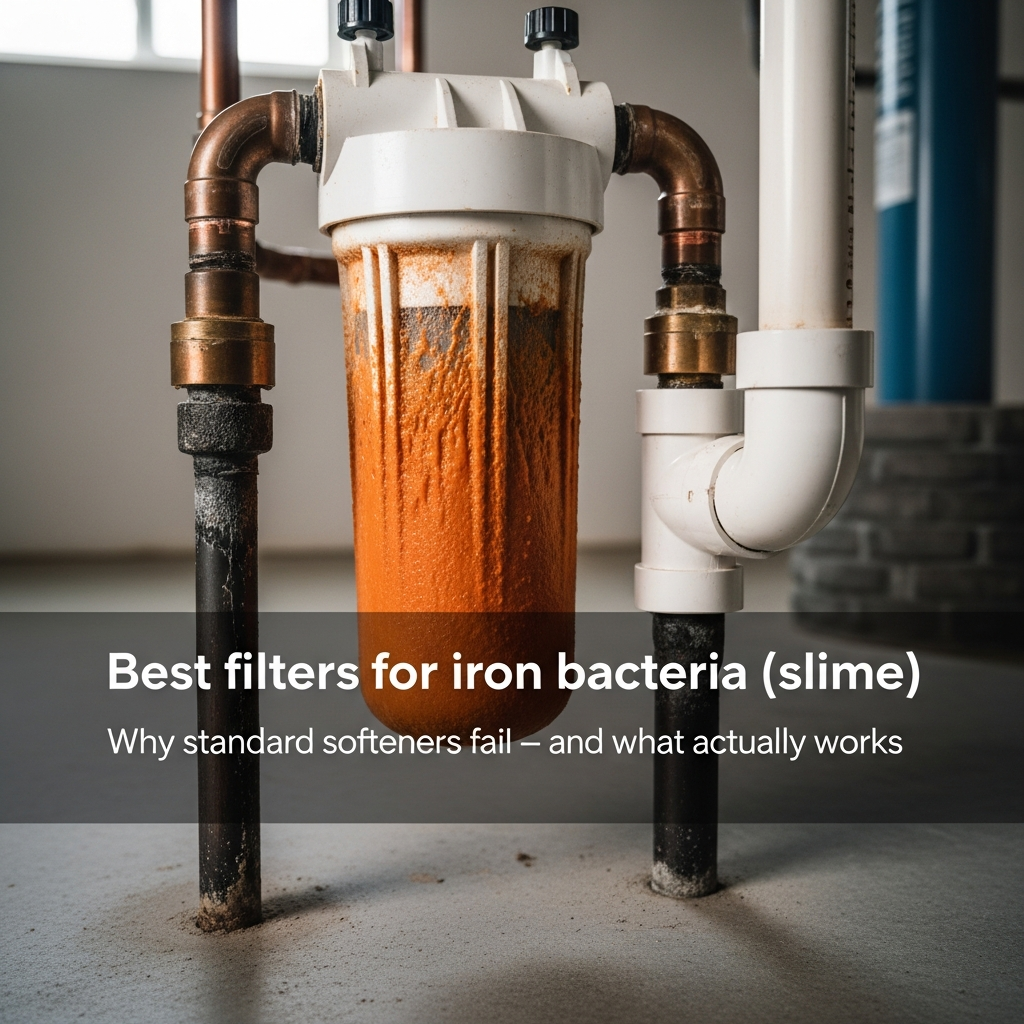
Best filters for iron bacteria (slime): why standard softeners fail
Updated February 20, 2026 — 11 min read
Standard water softeners and basic sediment filters won’t fix an iron bacteria problem. Iron bacteria aren’t dissolved minerals — they’re living organisms that form a sticky biofilm inside your well, pipes, and equipment. A softener designed to swap calcium and magnesium ions can’t kill bacteria or dissolve the slime they produce. You need oxidation, disinfection, or both.
I learned this the expensive way. Bought a water softener thinking it would clear the orange crud building up in my toilet tanks. Three months later, the softener resin was coated in the same slime, the control valve was gunked up, and I was staring at an $1,800 mistake. The softener was doing exactly what it was designed to do — just not what I needed it to do.
Here’s what iron bacteria actually is, why common equipment fails, and which systems handle it.
What iron bacteria really is (and isn’t)
Iron bacteria aren’t a single species. They’re a group of naturally occurring microorganisms — mostly Gallionella, Leptothrix, and Crenothrix — that feed on dissolved iron and manganese in your groundwater. They oxidize ferrous iron (dissolved, invisible) into ferric iron (solid, rusty) and excrete a sticky polysaccharide slime as a byproduct. That slime is the orange, reddish-brown, or yellowish gunk you find inside toilet tanks, coating filter cartridges, and lining pipes.
Iron bacteria aren’t dangerous to drink. The Minnesota Department of Health confirms they’re not known to cause disease. But they cause plenty of other problems:
- Clogged well screens and pump intakes. The biofilm restricts water flow and forces your pump to work harder. Shortened pump life, reduced flow rate, higher electricity bills.
- Fouled water treatment equipment. Softener resin, filter cartridges, RO membranes, and even UV sleeves get coated. Equipment that should last years fails in months.
- Corroded plumbing. The bacteria create oxygen-depleted zones under the biofilm, accelerating pitting corrosion in copper and steel pipes.
- Taste and odor. Homeowners describe it as swampy, oily, musty, or like cucumber. Not rotten eggs — that’s hydrogen sulfide, a different problem.
The classic sign: lift the lid off your toilet tank. If the walls and components are coated in slimy orange or reddish-brown goo that wipes off with a finger, you almost certainly have iron bacteria.
Why softeners and sediment filters don’t work
A water softener uses ion exchange resin beads to swap hardness minerals (calcium and magnesium) for sodium. That process does nothing to bacteria. Worse, iron bacteria colonize the resin bed itself. The sticky biofilm coats the beads, blocks the exchange sites, and turns your softener tank into a breeding ground. The slime also fouls the control valve — the most expensive component to replace.
Basic sediment filters (spin-down or cartridge) trap particles, but iron bacteria pass right through in their dissolved, planktonic form. By the time the bacteria have formed visible slime, they’re already downstream of your filter, colonizing everything they touch. You’ll burn through filter cartridges every few weeks and still have slimy toilet tanks.
Even standard iron filters using Birm or greensand media can struggle. These media oxidize dissolved iron effectively, but they don’t kill bacteria. If iron bacteria are present in your well water, the bacteria colonize the media bed, reducing its effectiveness and requiring more frequent backwashing. The filter treats the symptom (iron in the water) but not the cause (living organisms producing more iron deposits continuously).
Test before you buy anything
A standard water test for iron only tells you the iron concentration — it doesn’t tell you whether iron bacteria are present. You need a specific iron bacteria test. The IRB-BART (Biological Activity Reaction Test) kit costs $40-$50 and works at home with no lab equipment. You add a water sample to a vial containing growth media, then observe it for 8 days. A brown ring or foam indicates iron bacteria. The faster the reaction appears, the higher the bacterial population. If the reaction shows up within a day, your colony count is above 570,000 CFU/mL — that’s severe.
The systems that actually work
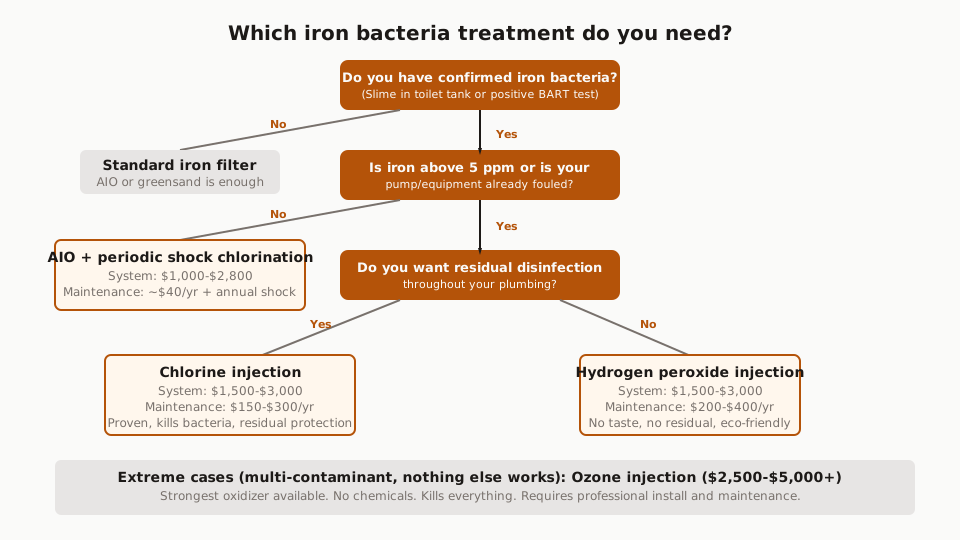
Iron bacteria need a two-pronged approach: kill the bacteria, then remove the iron they’ve deposited. Here are the technologies that do both, ranked from simplest to most aggressive.
Air injection oxidation (AIO) with backwashing filter
Cost: $1,000-$2,800 for the system. DIY installation. Best for: Moderate iron bacteria with iron levels under 7 ppm.
An AIO system draws air into a tank, creating a pocket of compressed air at the top. Water passes through this air pocket, and the oxygen oxidizes dissolved iron into solid particles. A filter bed (usually greensand, Birm, or catalytic carbon) traps the particles. The system backwashes automatically to flush accumulated iron and recharge the air pocket.
The SpringWell WS series is the most popular AIO among well owners I’ve talked to. The WS1 handles up to 7 ppm iron, 8 ppm hydrogen sulfide, and 1 ppm manganese at 12 GPM. It starts around $1,100 for the base unit. The greensand media lasts 18-25 years, and annual maintenance runs about $40 in replacement sediment post-filters. If you’ve read the Aquasana vs. SpringWell vs. Culligan comparison, you already know it’s the best value for iron and sulfur problems.
The SoftPro IronMaster takes it further — up to 30 ppm of iron removal. If your iron is off the charts, that’s the one.
The catch with AIO for iron bacteria: Air injection oxidizes iron effectively, but it doesn’t kill bacteria. If you have an active bacterial colony in your well casing, the bacteria keep producing new biofilm. An AIO handles the downstream effects, but the source remains. For mild cases where the bacteria are mostly in the plumbing (not deep in the well), an AIO combined with periodic shock chlorination can keep things under control. For severe infestations, you need chemical injection.
Chlorine injection system
Cost: $1,500-$3,000 installed. Professional installation recommended. Best for: Severe iron bacteria, especially when combined with high iron (above 5 ppm).
This is what actually kills iron bacteria. A chemical feed pump injects a metered dose of sodium hypochlorite (chlorine) into your water line ahead of a contact tank. The chlorine needs 20-30 minutes of contact time to penetrate the biofilm and kill the bacteria inside. After the contact tank, the water passes through a backwashing filter to remove the oxidized iron particles, then through a carbon filter to strip the residual chlorine before it reaches your faucets.
The chlorine concentration matters. The Minnesota Department of Health recommends keeping it under 200 ppm for shock treatment — above that, disinfection effectiveness actually drops. For continuous injection, you’re dosing at much lower levels and adjusting based on your iron concentration and flow rate.
Chlorine injection is the most proven approach for iron bacteria. It kills the organisms, oxidizes the iron they produce, and provides residual disinfection throughout your plumbing. The downsides: you’re maintaining a chlorine supply (buying and mixing solution regularly), calibrating the injection pump seasonally, and replacing carbon filter media every 1-3 years. Annual maintenance runs $150-$300 between chemicals and filters.
Hydrogen peroxide injection system
Cost: $1,500-$3,000 installed. Best for: Iron bacteria with sulfur odor, or where chlorine taste/residual is a concern.
Hydrogen peroxide works similarly to chlorine but breaks down into water and oxygen instead of leaving a chemical residual. It’s particularly effective against what water treatment pros call “heme iron” — the organic iron bound up in bacterial slime that chlorine sometimes struggles to fully break down.
Peroxide needs less contact time than chlorine for iron oxidation (seconds rather than minutes), but it still needs a few minutes of contact to kill iron bacteria at effective doses. You’ll typically dose at 1-2 ppm before the carbon filter. No chlorine taste, no chemical residual, no downstream carbon filter required for taste (though you’ll still want one for particle filtration).
The tradeoff: hydrogen peroxide costs more per gallon than bleach, and the solution degrades faster in storage. You’ll go through it quicker. Some well owners report spending $200-$400 per year on peroxide versus $100-$200 for chlorine.
Ozone injection
Cost: $2,500-$5,000+ installed. Best for: The nuclear option for severe, multi-contaminant wells.
Ozone is the strongest oxidizer available for residential water treatment. An ozone generator creates O3 from ambient air and injects it into the water line. Ozone kills iron bacteria on contact, oxidizes iron and manganese aggressively, and destroys hydrogen sulfide. It leaves no chemical residual — ozone reverts to oxygen within minutes.
One forum post from a homeowner running a community well described ozone treatment running “flawlessly for 12 years” with iron bacteria. But the equipment cost is steep, the electrical draw is meaningful, and maintenance requires someone comfortable with the generator hardware. This is the right tool for wells with extreme iron bacteria combined with sulfur, manganese, and other contaminants where nothing else has worked.
Treatment comparison at a glance
| AIO filter | Chlorine injection | H2O2 injection | Ozone | |
|---|---|---|---|---|
| Kills bacteria | No | Yes | Yes | Yes |
| Removes iron | Up to 7-30 ppm | Yes (with filter) | Yes (with filter) | Yes (with filter) |
| Chemical supply | None | Bleach solution | Peroxide solution | None (uses air) |
| Annual maintenance | ~$40 | $150-$300 | $200-$400 | $100-$200 |
| System cost | $1,000-$2,800 | $1,500-$3,000 | $1,500-$3,000 | $2,500-$5,000 |
| DIY install | Yes | Possible | Possible | No |
| Residual disinfection | No | Yes | No | No |
Start with the right diagnosis
Before you spend money on any of these systems, confirm you actually have iron bacteria and not just dissolved iron. The distinction matters because dissolved iron is easy — an AIO or standard iron filter handles it. Iron bacteria require killing the organisms, not just filtering the mineral.
Three ways to confirm iron bacteria:
- The toilet tank test. Lift the lid. Orange, slimy biofilm coating the walls and components = iron bacteria. Dry rust-colored staining without slime = dissolved iron only.
- The BART test. $40-$50 for a home test kit. Definitive answer in 1-8 days.
- Lab test. Send a sample to a certified lab. Ask specifically for iron bacteria testing — a standard coliform or water chemistry panel won’t catch it.
If you confirm iron bacteria and your levels are moderate (iron under 5 ppm, slime is annoying but not clogging fixtures), start with an AIO system and periodic shock chlorination. If the bacteria keep coming back or your iron is above 5 ppm, move to continuous chlorine or peroxide injection. Skip straight to injection if your pump has already been fouled or your well screen is restricted — at that point, the bacteria are entrenched and half-measures waste time and money.
For the step-by-step shock chlorination protocol to knock back an active iron bacteria colony before installing a permanent system, see the complete shock chlorination guide. And if you’re still figuring out what’s in your water, start with the troubleshooting guide to match your symptoms to the right test.
Related guides
Best UV water purifiers for well water (bacteria defense)
The best UV purifier for well water is a Class A unit sized to your real peak flow and installed after pretreatment. Here are the systems I would actually buy.
12 min read
The beauty guide for well owners: hair, skin & laundry
Hardness, iron, manganese, and copper can wreck hair, irritate skin, and stain laundry. This guide shows how to tell which one is hitting your house and what actually fixes it.
12 min read
Well casing extension: when and why you need to extend your casing
How to tell if your well casing is too short, what state codes require, what extension costs, and whether you can do it yourself or need a licensed driller.
6 min read