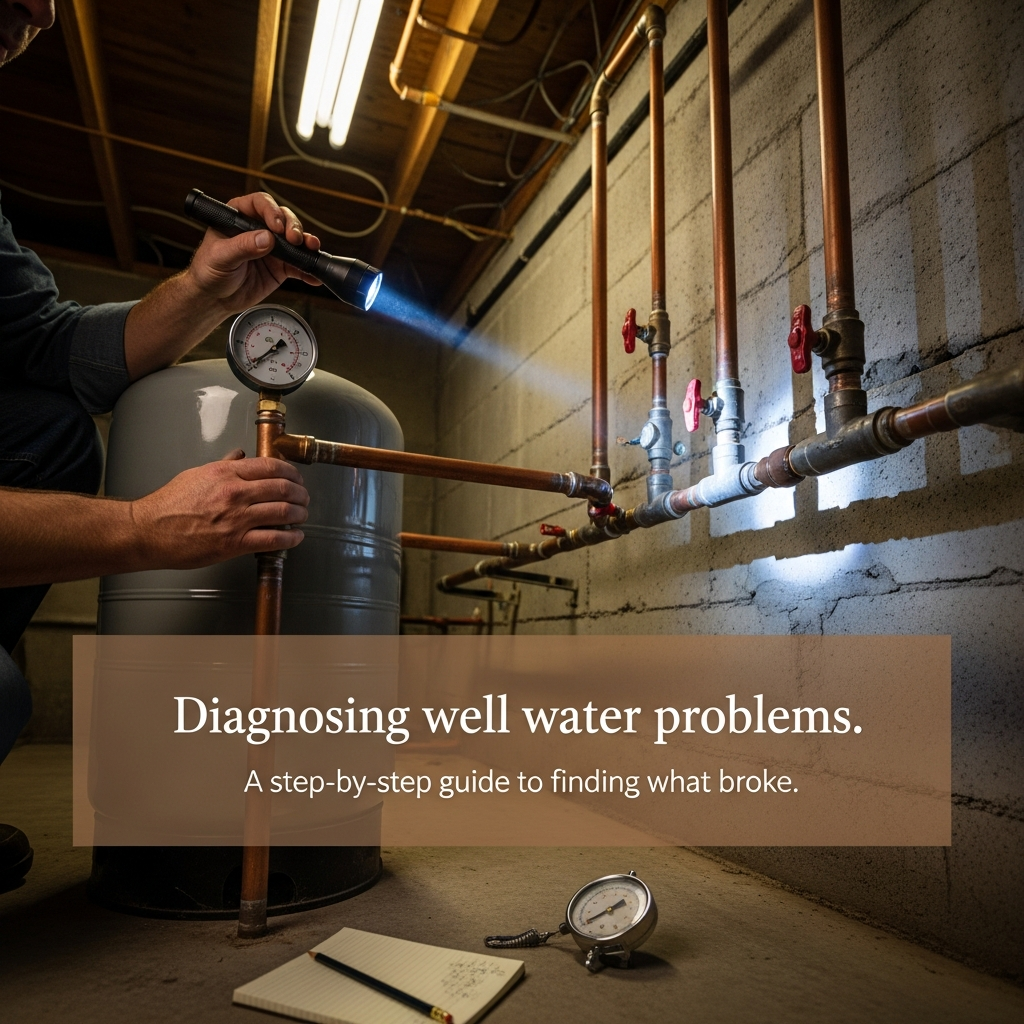
Well water problems: troubleshooting no water, low pressure, rotten egg smell, and more
Updated February 14, 2026 — 12 min read
Something is wrong with your well water. Start here.
This page is a triage guide. Each section identifies a symptom, gives you the one-sentence diagnosis that covers 80% of cases, and sends you to the dedicated article that covers the full fix. This keeps you from reading a 3,000-word deep dive on iron filtration when what you actually have is a rotten egg smell from a water heater anode rod.
If you’re not familiar with what each component does, the well system hardware guide covers every part — pump, pressure tank, pressure switch, check valve — before you start diagnosing.
Rotten egg / sulfur smell
What you’re smelling: Hydrogen sulfide gas. But the source matters enormously.
Run this one test before doing anything else: fill a glass from a cold-water faucet and smell it. Then run hot water and smell that.
- Both hot and cold smell: Hydrogen sulfide is in your well water itself — either from sulfur bacteria or sulfur-bearing rock. Needs a treatment system.
- Only the hot water smells: This is almost certainly your water heater’s magnesium anode rod reacting with sulfur bacteria in the tank. A $30 part swap fixes it. This is not a well problem.
- Intermittent, or only at certain faucets: Sulfur bacteria colonizing specific fixtures or pipe sections.
Go here: Well water rotten egg smell — causes and fixes
Discolored water
Orange or rust-brown water
Most likely cause: Dissolved iron. The EPA secondary standard is 0.3 mg/L; many wells test well above that.
Do the glass test: fill a clear glass from the cold tap and let it sit 20 minutes. If the color settles to the bottom, you have sediment. If it stays uniformly orange, you have dissolved iron. These require different treatment approaches.
Also check: if the water turns orange only after heavy rain and clears within a day, you likely have surface water entering through a compromised well cap or casing — not a chemistry problem.
Go here: Best filters for iron and iron bacteria
For iron staining on laundry and fixtures: Removing orange iron stains from laundry
Tea-brown or yellowish water
If the water looks like weak tea — yellow-brown, transparent, no particles settling out — it’s likely tannins from organic material in the soil. An iron filter does nothing for tannins. They require a different treatment system entirely (tannin-selective anion resin).
Go here: Well water filtration guide
No water or very low pressure
No water at all
Before assuming a dead pump: 60% of total water loss is electrical. Check in this order:
- Circuit breaker — find the 240V double breaker labeled “well pump.” Reset once. If it trips again immediately, stop — you have an electrical fault.
- Pressure switch — the small gray box near the pressure tank. Dead contacts or insects in the switch are common culprits. A new switch is $20-$50.
- Control box (if your pump is 1 HP or larger) — a failed starting capacitor mimics a dead pump and costs $15 to replace.
- Listen at the wellhead — if the pump hums but no water reaches the house, suspect a failed check valve or cracked drop pipe.
Go here: Well pump and pressure tank guide
Low pressure at all fixtures
Water comes out weak everywhere — barely enough to run a shower. Most common causes:
- Waterlogged pressure tank — the bladder has failed or the air charge has leaked out. Check the Schrader valve on top of the tank with a tire gauge.
- Clogged sediment filter — if you have a whole-house filter that hasn’t been changed in months, this is the first thing to check.
- Pressure switch set wrong — gauge reads lower than your 30/50 or 40/60 system should.
Go here: Pressure tank air charge — diagnosis and recharge
Pump short cycling (turns on and off rapidly every 10-30 seconds)
Short cycling kills pump motors. The most common cause (two out of three cases) is a waterlogged pressure tank — the bladder has failed. Confirm it: turn off the pump, drain the tank, check the Schrader valve. If you get zero PSI or water sprays out, you need a new tank.
Go here: Pressure tank air charge — diagnosis and recharge
Hair, skin, and laundry issues
Well water that looks perfectly clear can still wreak havoc on hair, skin, and clothes. The usual suspects:
- Hard water (calcium and magnesium): Leaves hair brittle and dull, makes skin feel dry and squeaky, leaves a white film on fixtures and shower doors.
- Iron: Orange staining on laundry, rust rings in sinks and tubs.
- Low pH (acidic water): Can strip hair color and irritate skin; also slowly corrodes copper pipes.
Go here: Well water ruining your hair — what’s actually in your water
For iron staining specifically: Removing orange iron stains from laundry
Bacteria and safety concerns
Coliform bacteria (failed a bacteria test, or concerned after flooding or new well work)
Private wells are vulnerable to coliform and E. coli contamination, especially after heavy rainfall, flooding, or any disturbance to the wellhead or casing. If you’ve had a positive coliform test, or if your well was recently worked on, test and treat before drinking.
Go here: Coliform bacteria in well water — testing and treatment
For shock chlorination after a positive test or after well work: How to shock chlorinate a well
PFAS / forever chemicals
Standard well water tests don’t detect PFAS at all. If you live near a military base, airport, or industrial facility, or if you’ve simply never tested for PFAS, this is the one test most well owners are missing.
Go here: Testing well water for PFAS — what you need to know
Not sure where to start? General maintenance first
If your water problems are vague or gradual — slowly declining pressure, increasing odors, aging equipment — the annual maintenance checklist is the right starting point. It catches most problems before they become emergencies.
Go here: Well owner’s annual maintenance checklist
For a full overview of treatment options across all water quality issues: Well water filtration guide
The rule of thumb: if you can see it and touch it from your basement or utility room — pressure switch, pressure tank, sediment filter — you can probably diagnose and fix it yourself. If it’s inside the well casing or underground, call a licensed well professional. Pulling a pump requires specialized equipment that doesn’t pay for itself on a single job.
Write down what you observe before you call anyone: Is the breaker tripped? What does the pressure gauge read? Did the pump run at all? A well tech who arrives with that information will diagnose faster and you’ll know if their quote makes sense.
Related guides

How to read a water analysis report
A plain-English guide to the lab terms, units, and cutoff numbers that tell you whether a well water result is urgent, cosmetic, or mostly a plumbing problem.
9 min read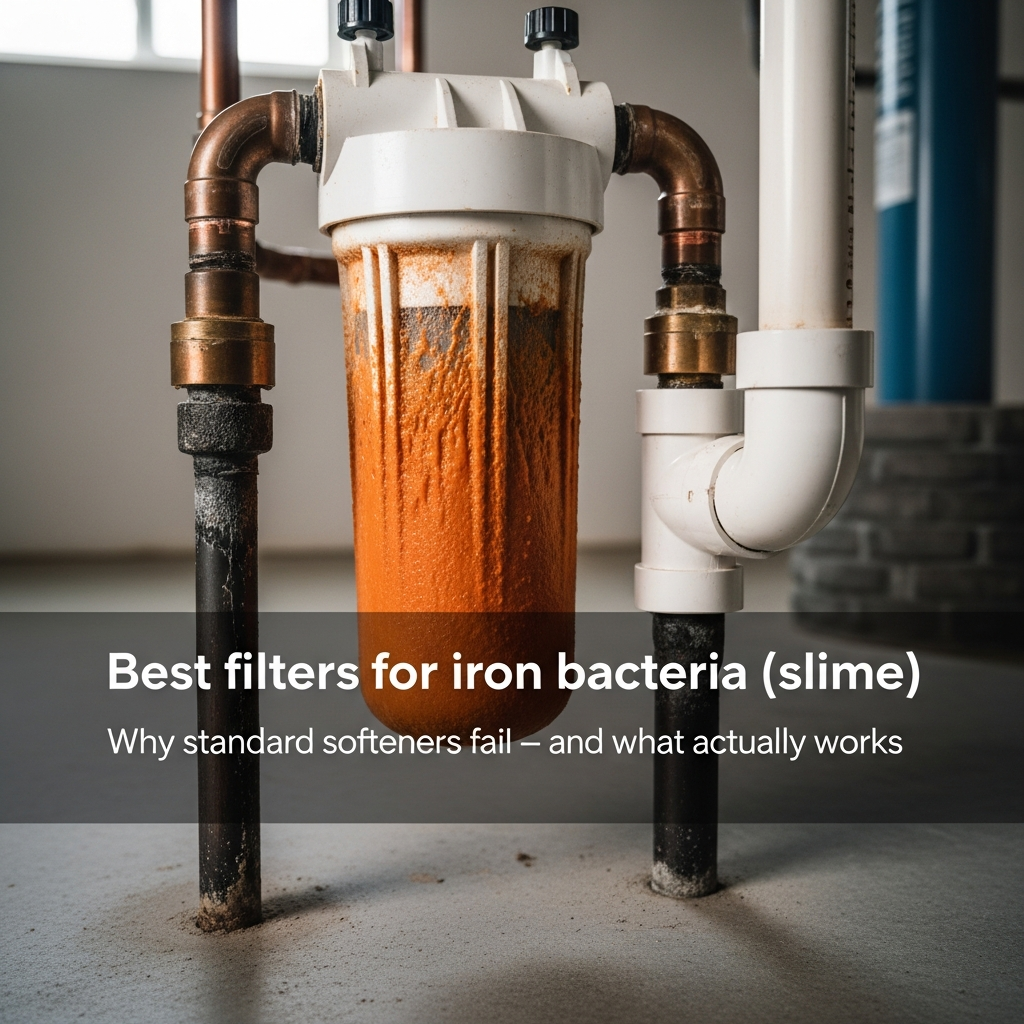
Best filters for iron bacteria (slime): why standard softeners fail
Iron bacteria coat your pipes and equipment with orange slime that standard softeners can't touch. Here are the filtration systems that actually work -- and why.
11 min read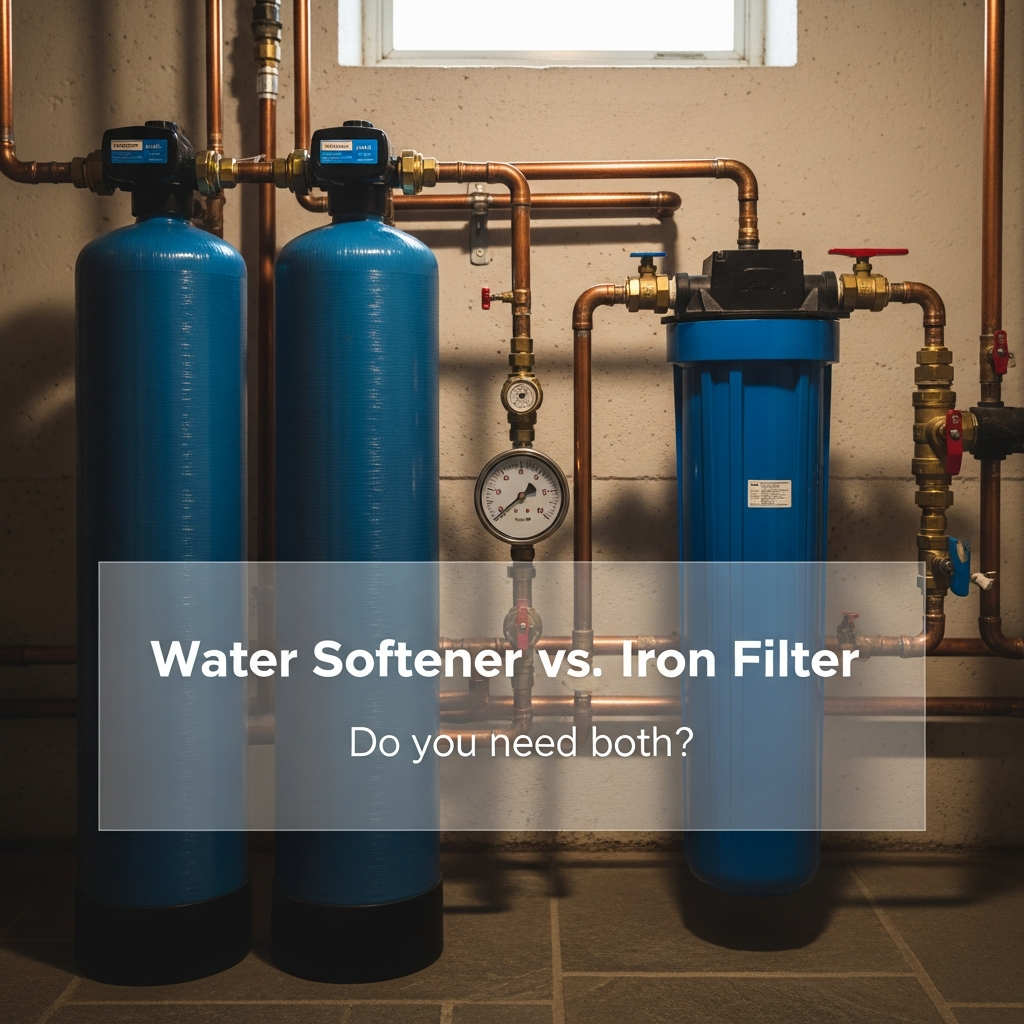
Water softener vs. iron filter: do you need both?
Softeners remove hardness but foul when iron exceeds 1 ppm. Iron filters oxidize iron but ignore hardness. Here's how to tell which you need -- or whether you need both.
10 min read