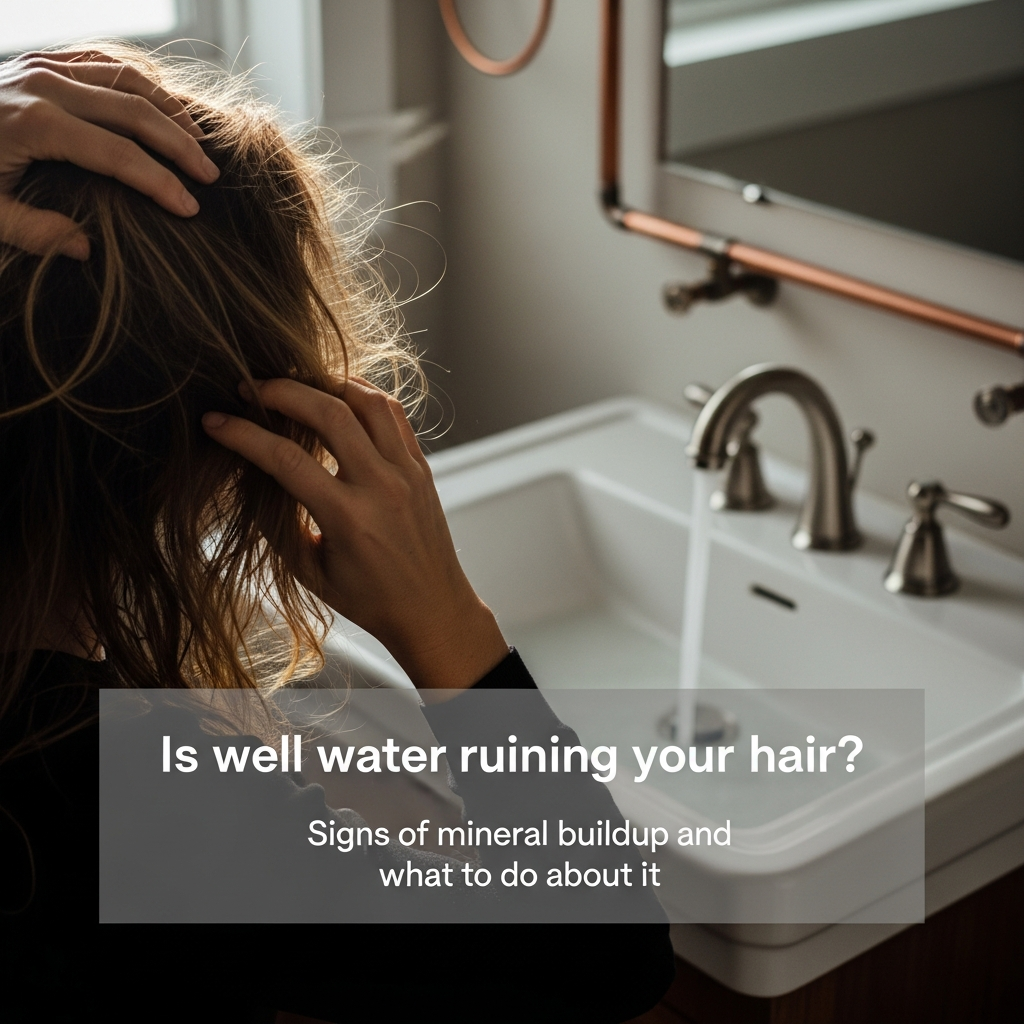
Is well water ruining your hair? Signs of mineral buildup
Updated February 19, 2026 — 8 min read
Yes, your well water is probably damaging your hair. The calcium, magnesium, and iron dissolved in untreated well water coat your hair shaft with a mineral film that blocks moisture, weakens the strand, and changes its color. The fix depends on which minerals are in your water and how much — which is why a water test matters more than a $25 bottle of shampoo.
I spent my first two years on well water blaming shampoo brands, humidity, and aging for what was happening to my hair. Turns out it was 22 grains per gallon of hardness and 0.8 ppm of iron doing all the damage. Once I figured that out, fixing it was straightforward.
What hard water actually does to your hair
Your well water is “hard” if it contains more than 120 mg/L (about 7 grains per gallon) of dissolved calcium and magnesium. Most private wells fall somewhere between 150 and 300 mg/L. Some hit 500+.
When you wash your hair with hard water, those minerals don’t rinse away. They bond to the proteins in your hair shaft and accumulate with every wash. A 2013 study in the International Journal of Trichology measured this directly: hair washed in hard water accumulated 3x more calcium and 4x more magnesium than hair washed in distilled water. That mineral layer does three things:
It blocks moisture. The mineral film prevents water and conditioner from penetrating the cuticle. Your hair feels dry no matter how much product you use. This is the “straw texture” that drives people crazy — it’s not damaged protein, it’s a physical coating preventing hydration.
It weakens the strand. A 2018 study in the same journal tested 70 hair samples over three months. Hair treated with hard water lost about 8% of its baseline tensile strength compared to hair treated with deionized water (P=0.001). That’s the difference between hair that tolerates brushing and hair that snaps.
It changes color. This is where well water gets worse than city hard water. Iron turns blonde and gray hair brassy orange. Copper (common in wells with copper plumbing or naturally acidic water) turns blonde hair green. These aren’t subtle shifts — if you’ve got 0.5+ ppm of iron, you’ll notice it within a few weeks.
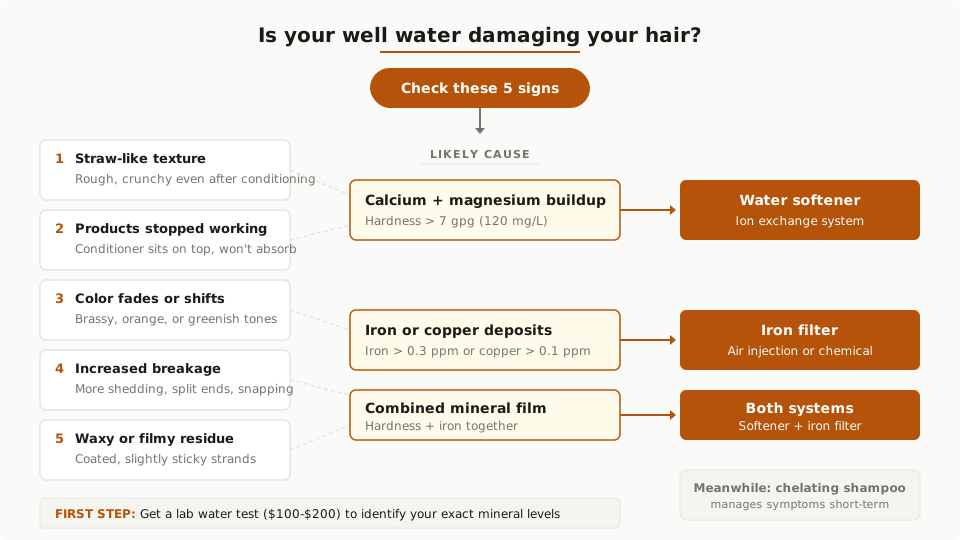
The 5 signs you’re dealing with mineral buildup
Not sure if hard water is your problem? Check this list:
-
Your hair feels like straw after washing. Not just dry — rough, crunchy, and impossible to run your fingers through. Conditioner sits on top instead of absorbing.
-
Products stopped working. That deep conditioner or hair mask that used to be great? Mineral buildup blocks it from reaching your hair. If your favorite products suddenly seem useless, it’s probably not the product.
-
Your color fades fast or shifts weird. Salon color that lasted 6 weeks now fades in 2. Blonde highlights go brassy or orange. Color-treated hair turns muddy.
-
Increased breakage and shedding. More hair in the drain, more split ends, more breakage mid-shaft. The weakened strands can’t handle normal styling.
-
A waxy or filmy residue. Run your fingers down a strand after it dries. If it feels coated or slightly sticky instead of smooth, that’s mineral film.
If you’re also seeing orange stains in your sinks and toilets or rotten egg smell from your faucets, your well water chemistry is the common thread.
What works (and what doesn’t)
Here’s where most advice articles go wrong: they recommend shower filters and expensive shampoos as the solution. Those help with symptoms, but they don’t fix the root cause for well water owners.
Chelating shampoos: good for maintenance, not a cure
Chelating shampoos contain ingredients like EDTA or citric acid that bind to mineral deposits and pull them off your hair. They work. But they’re a management strategy, not a solution.
The best options I’ve found:
- Malibu C Hard Water Wellness Shampoo (~$24 for 9 oz) — the professional standard. Sulfate-free, effective, but you’ll burn through a bottle fast at weekly use.
- Ion Hard Water Shampoo (~$12 for 12 oz) — EDTA-based, more affordable. Good for regular maintenance.
- Malibu C Crystal Treatment packets (~$6-8 each) — vitamin C crystals that dissolve heavy mineral buildup. Use one monthly as a deep reset, then maintain with the shampoo.
One thing I learned from hair care forums: a mild chelating shampoo used frequently works better than a strong one used every few weeks. The people who use a gentle chelating formula every other wash and keep buildup from accumulating report softer hair than those who let minerals pile up and then strip everything off monthly.
DIY alternatives that actually help
Apple cider vinegar rinse. Mix 1 part ACV with 10 parts water. Pour it through your hair after shampooing, let it sit for 2-3 minutes, then rinse. The acidity helps dissolve mineral deposits. It’s not as effective as a proper chelating shampoo, but it costs almost nothing and you can use it every wash.
Citric acid rinse. Dissolve 1 tablespoon of citric acid powder (~$8 for a pound) in a quart of water. Same process as ACV. Citric acid is a stronger chelator than vinegar and works better on heavy iron deposits.
Shower filters: mostly marketing for well water owners
Here’s the truth about shower filters that the $150+ brands don’t advertise: they don’t remove hardness minerals. Shower filters use KDF-55 and activated carbon media designed to remove chlorine — a city water problem. They can’t perform ion exchange at shower flow rates, so calcium, magnesium, and iron pass right through.
If your problem is hard well water, a $169 Jolie or $150 Canopy shower filter won’t fix it. Save that money.
The actual fix: treat the water, not the hair
For well water owners, the only real solution is treating the water before it reaches your shower:
Water softener (for hardness). A salt-based ion exchange softener removes up to 99% of calcium and magnesium from your entire house. Installed where the water enters from your well, it treats every faucet, shower, and appliance. Systems run $800-$2,500 installed. If your water test shows hardness above 7 gpg, this is the single best investment for your hair, skin, plumbing, and appliances.
Iron filter (for iron and manganese). If your water test shows iron above 0.3 ppm, you need an iron-specific treatment — either an air injection oxidizer or a chemical injection system. A softener alone can handle low iron (under 2-3 ppm), but higher concentrations need dedicated treatment. The filtration guide covers this in detail, and the Aquasana vs. SpringWell vs. Culligan comparison breaks down which systems handle well water iron best.
Start with a water test
Don’t guess. A basic water test from a certified lab costs $100-$200 and tells you exactly what minerals are in your water and at what concentrations. That test determines whether you need a softener, an iron filter, both, or something else entirely.
Your next step: get your water tested. The chelating shampoo and ACV rinses will help manage the symptoms while you figure out the right treatment system. But treating the water at the source is what actually solves the problem for good.
Related guides

Well casing extension: when and why you need to extend your casing
How to tell if your well casing is too short, what state codes require, what extension costs, and whether you can do it yourself or need a licensed driller.
6 min read
Arsenic and radon: the New England well water guide
If your private well is in New England, arsenic and radon belong on your testing list. Here's what to test, how state guidance differs, and what to do with the results.
10 min read
The beauty guide for well owners: hair, skin & laundry
Hardness, iron, manganese, and copper can wreck hair, irritate skin, and stain laundry. This guide shows how to tell which one is hitting your house and what actually fixes it.
12 min read