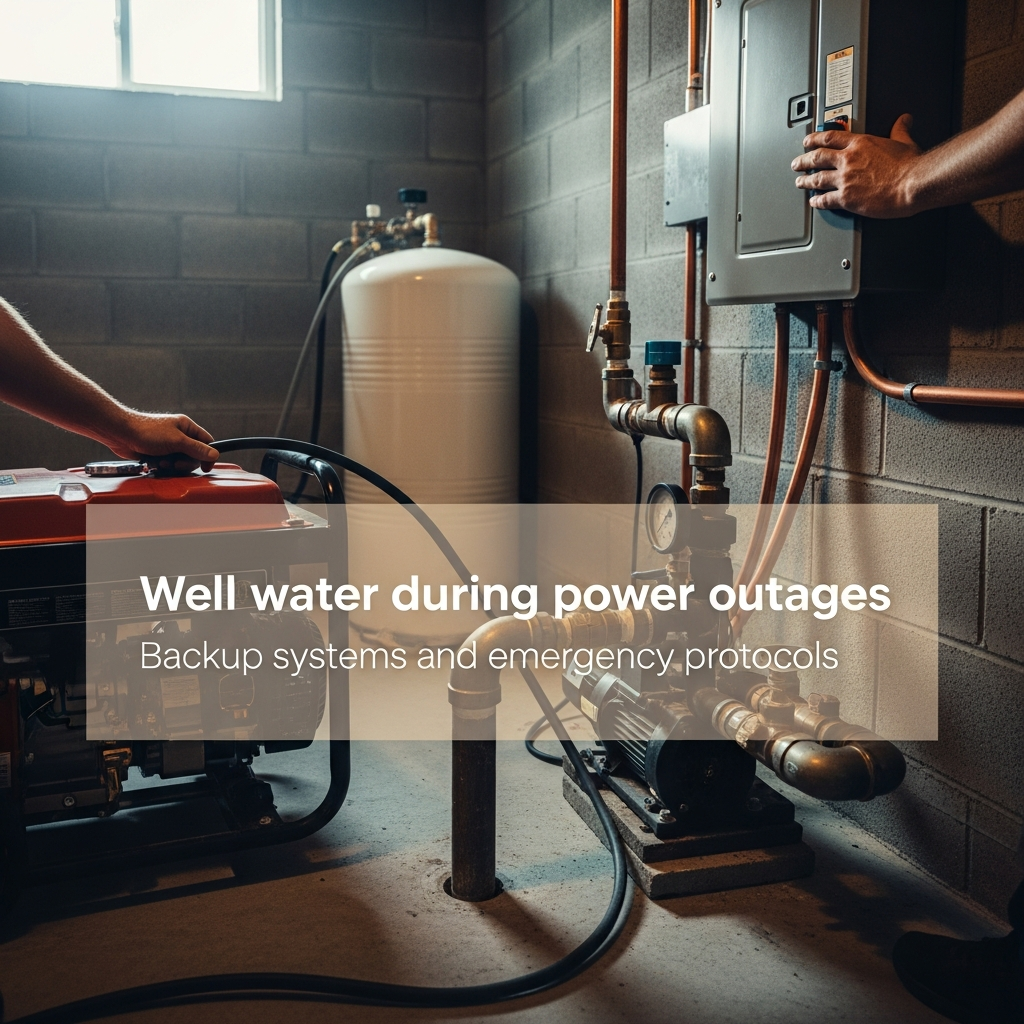
Well water during power outages: backup systems and emergency protocols
Updated March 13, 2026 — 11 min read
When the power goes out, your well pump stops. No pump, no water. Not low pressure, not a trickle — nothing. No flushing, no showers, no drinking water, no washing hands. City water customers lose pressure gradually during extended outages. Well owners lose it instantly.
The good news: every solution on this page works, and some cost less than a dinner out. The question is which backup fits your budget, your outage risk, and how much you want to spend versus how much inconvenience you’re willing to tolerate.
Your pressure tank is already a backup (sort of)
Before you spend a dime, know this: your pressure tank holds a small reserve of pressurized water after the pump stops. A standard 20-gallon tank holds about 5 to 7 gallons of usable water. A larger 44-gallon tank might give you 12 to 15 gallons. That’s enough for a few toilet flushes and some drinking water — maybe an hour of careful use.
The moment the power cuts, that reserve starts counting down. Use it wisely. Don’t run a shower. Don’t start a load of laundry. Fill a pot for drinking water and a bucket for flushing, then close every faucet.
For a full breakdown of how pressure tanks store and release water, the pump and pressure tank guide covers it in detail.
The $35 prep everyone should do
A WaterBOB is a food-grade plastic bladder that sits inside your bathtub and holds 100 gallons of clean drinking water. You attach it to the faucet, fill it in about 20 minutes, and use the included hand pump to dispense water. It keeps water fresh for up to 16 weeks, versus a bare bathtub full of stagnant water that’s only good for flushing.
Buy one before you need it. They cost $35 to $40 on Amazon during calm weather. Prices spike during hurricane season and winter storm warnings. It’s single-use — once deployed and emptied, you need a new one — but at that price, it’s the cheapest insurance on this page.
When a storm is in the forecast:
- Fill the WaterBOB in one bathtub (drinking and cooking water)
- Fill a second tub without a bladder (flushing and cleaning water)
- Fill pots, pitchers, and water bottles on the counter
- Run the dishwasher and washing machine so you start with clean dishes and clothes
- Top off the pressure tank — open a faucet briefly and let the pump cycle to build full pressure
- Fill freezer bags with water and freeze them — they keep food cold longer and become drinking water as they melt
A family of four needs about 2 gallons per person per day for drinking, cooking, and basic sanitation. That’s 56 gallons for a week. One WaterBOB plus a few filled containers gets you there for under $50.
Generators: the most common backup
A portable generator is the go-to solution for most well owners. Plug in, flip the transfer switch, and the pump runs like normal. But the sizing math trips people up, and the consequences of getting it wrong range from “pump won’t start” to “house fire.”
Starting watts vs. running watts
This is the part that catches people. Your well pump might run on 1,000 watts, but it needs 3,000 or more watts to start. Electric motors draw a massive surge of power at startup — two to three times their running wattage — before settling into steady operation. If your generator can’t deliver that surge, the pump just won’t turn on.
| Pump size | Running watts | Starting watts | Generator you need |
|---|---|---|---|
| 1/3 HP | 750 W | 1,400-1,800 W | 3,000-4,000 W |
| 1/2 HP | 900-1,200 W | 2,000-2,500 W | 3,000-4,000 W |
| 3/4 HP | 1,100-1,500 W | 2,200-3,000 W | 4,000-5,000 W |
| 1 HP | 1,500-2,000 W | 3,000-4,000 W | 5,000-6,000 W |
| 1.5 HP | 2,000-2,500 W | 4,000-5,000 W | 7,000-9,000 W |
The “Generator you need” column is the unit’s surge rating, not its running rating. A generator sold as “4,000 watts” usually means 4,000 running watts with a 5,000-watt surge. Check both numbers on the spec sheet.
A real example from the DIY forums: one homeowner with a 1.5 HP pump and a Yamaha EF4600 (4,000W running, 4,600W surge) found the pump wouldn’t start at all with the generator’s eco mode on. It only worked at full throttle — and barely. He had virtually no headroom for anything else on the circuit.
Add 20 to 25 percent headroom above your pump’s starting watts. This covers voltage drop across extension cords, other loads you might want to run simultaneously (a refrigerator, some lights), and the reality that generators lose output at altitude and in heat.
240V matters
Most submersible pumps 3/4 HP and up run on 240V circuits. A generator with only 120V outlets won’t work. Period. Verify your pump’s voltage before you buy a generator, and make sure the generator has the matching outlet — typically a NEMA L14-30 twist-lock for 240V.
What generators cost
| Category | Price range | Examples |
|---|---|---|
| Budget portable (3,500-4,500W) | $350-$700 | Champion 4375W, DuroStar DS4400 |
| Mid-range portable (5,000-6,500W) | $600-$1,200 | Westinghouse WGen6500, Champion 6250W |
| Dual-fuel portable | $500-$1,500 | Adds propane capability — propane doesn’t go stale |
| Premium portable (Honda/Yamaha) | $1,000-$3,000 | Quieter, more fuel-efficient, longer lifespan |
| Whole-house standby | $3,000-$15,000+ installed | Generac, Kohler — automatic, runs on natural gas or propane |
Dual-fuel generators deserve special attention. One Terry Love forum member runs a 6,000W LP gas generator during outages and swears by it — the propane runs the well pump, fridge, lights, water heater, and a window AC unit all at once. His main selling point: propane never goes stale. Gasoline goes bad in 3 to 6 months even with stabilizer. If you only use your generator a few times a year, stale fuel is a real problem.
You need a transfer switch
This isn’t optional. A transfer switch or interlock kit is the only safe and legal way to connect a generator to your home’s electrical panel.
Without one, you have two bad options: run extension cords directly to the pump (which requires the right plug and gauge wire), or backfeed through a wall outlet — which is illegal, violates electrical code, and can electrocute utility lineworkers repairing downed power lines.
| Transfer switch type | Cost (installed) | Notes |
|---|---|---|
| Interlock kit (DIY) | $50-$150 for the kit | Mounts on your panel cover, prevents main and generator breakers from being on simultaneously |
| Interlock kit (professional install) | $200-$500 | Same kit, electrician does the work |
| Manual transfer switch (6-10 circuits) | $400-$1,500 | Dedicated subpanel for critical circuits |
| Automatic transfer switch | $800-$2,500 | Auto-switches when power drops — paired with standby generators |
The GarageJournal consensus is that an interlock kit is the “simplest, quickest, most fixable, and probably cheapest” option for portable generators. It’s a $50 to $150 part that bolts onto your existing panel. If you’re comfortable identifying breakers and following an installation diagram, it’s a Saturday afternoon project. If not, an electrician can install it in about an hour.
Battery backup: the silent option
Portable battery stations from EcoFlow, Bluetti, and Goal Zero can run a well pump — but only if their surge rating is high enough to handle the starting current.
The same starting watts problem applies here. A battery station rated for 3,000 watts continuous might not start a pump that needs 4,000 watts of surge. Battery systems tend to protect themselves by shutting down during sustained over-current, rather than powering through it like a conventional generator would.
| System | Continuous / Surge | Battery capacity | Price |
|---|---|---|---|
| EcoFlow DELTA Pro | 3,600W / 7,200W | 3,600 Wh | ~$1,600 |
| EcoFlow DELTA Pro 3 | 4,000W / 8,000W | 4,096 Wh | ~$2,500 |
| EcoFlow DELTA Pro Ultra | 7,200W / 14,400W | 6,144 Wh | ~$4,000-$4,300 |
| Bluetti AC500 + B300S | 5,000W / 10,000W | 3,072 Wh | ~$4,500-$4,800 |
| Goal Zero Yeti 3000X | 2,000W / 3,500W | 2,982 Wh | ~$2,800-$3,500 |
The original DELTA Pro with its 7,200W surge handles most 1/2 HP and some 3/4 HP pumps. For larger pumps, you need the DELTA Pro Ultra or the Bluetti AC500.
One real-world data point: a homeowner shut off grid power at 3 PM with 90% charge on a DELTA Pro and still had 71% remaining at 8:30 AM the next morning with normal household usage — including the well pump cycling on and off as needed. Well pumps don’t run continuously. They kick on for a few minutes, fill the pressure tank, then shut off. That cycling behavior makes battery backup more viable than the raw capacity numbers suggest.
The 240V problem
Here’s the catch most people miss: many portable battery stations output 120V only. Most submersible pumps 3/4 HP and up need 240V. The EcoFlow DELTA Pro Ultra and Bluetti AC500 can do 240V, but the smaller units generally can’t without special configuration. Verify this before you spend $2,000+ on a battery that can’t talk to your pump.
Soft starters help
A soft starter gradually ramps up voltage to the motor, reducing that brutal starting surge by 40 to 70 percent. The SoftStartUSA Well Pump model costs about $300 to $400 and installs in 20 minutes on 240V pumps up to 3.5 HP. With a soft starter, a battery station that couldn’t handle your pump’s raw starting surge might handle the softened version.
Fair warning from the forums: soft starters reduce peak amperage but extend the duration of the higher-than-normal draw. Some inverter systems and battery stations time out on sustained over-current even if the peak is lower. Test it before the outage, not during.
Hand pumps: the grid-independent option
If you want water that doesn’t depend on electricity, fuel, or batteries at all, a manual hand pump is the answer. These install alongside your existing electric submersible pump in the same well casing (6-inch or larger) and work purely on muscle power.
Simple Pump — works to 325 feet of static water level. Stainless steel and bronze construction. Can be operated by one person, including kids and older adults. Has a unique motorization option: bolt on a 12V DC motor and power it from a solar panel or car battery for hands-free pumping. Five-year warranty. $1,500 to $2,500+ depending on depth.
Bison Pumps — works to about 200 feet. Marine-grade stainless steel, made in the USA. Generally praised on TractorByNet for build quality and aesthetics. $1,600 to $2,000+.
Forum users who’ve compared both generally say Simple Pump is easier to operate at greater depths because of its gearing, while Bison Pumps gets more praise for fit and finish. Simple Pump’s motorization kit is a meaningful differentiator — it turns a hand pump into a solar-powered pump for about $500 extra.
Installation runs $500 to $1,500 on top of the pump cost, depending on well depth and your installer’s rates. Total investment: $2,000 to $4,000. That’s real money, but it’s also true independence from the grid.
Long-term storage: gravity-fed tanks
For homeowners who lose power regularly — rural areas with aging infrastructure, hurricane zones, ice storm belts — a permanent water storage tank is worth considering.
The concept is simple: your well pump fills an above-ground or elevated tank during normal operation. When the power goes out, gravity feeds the water down to your house. No electricity needed.
The engineering constraint: every 2.31 feet of elevation above the point of use provides 1 PSI of water pressure. A tank 23 feet above your faucet gives you about 10 PSI. That’s enough for a trickle from the faucet and a slow toilet fill, but not a satisfying shower. Real gravity-fed pressure requires serious elevation — a hilltop, a tower, or a platform.
| Tank size | Tank cost | Full system installed |
|---|---|---|
| 250 gallons | $200-$500 | $800-$1,500 |
| 500 gallons | $300-$800 | $1,500-$3,000 |
| 1,000 gallons | $500-$1,200 | $2,000-$4,000 |
Use opaque, UV-resistant tanks to prevent algae growth. Connect the tank to your well pump’s output with a float valve so it fills automatically and stays topped off without any attention from you.
For shorter-term storage without the construction project, 55-gallon food-grade drums ($40 to $80 each) stacked in a garage or basement give you a meaningful reserve. A family of four can stretch 110 gallons (two drums) for about two weeks with careful use.
Solar backup
Solar panels paired with a battery station give you indefinite runtime during an outage — at least on sunny days. The EcoFlow DELTA Pro accepts up to 1,600 watts of solar input, which means a set of two or three 400-watt panels can keep the battery charged while the pump cycles throughout the day.
For true off-grid redundancy, dedicated DC solar pumps bypass batteries and inverters entirely. The Grundfos SQFlex runs directly from solar panels, pumps from depths up to 820 feet, and costs $1,500 to $3,000 for the pump alone. Pair it with an elevated storage tank, and you have water 24/7 without a single connection to the grid.
The downside: DC solar pumps only work during daylight. No sun, no water. That’s why the elevated storage tank matters — the pump fills it during the day, and gravity delivers water at night.
Mistakes that will cost you
Running the generator in the garage
Carbon monoxide kills. Generators must run outdoors, at least 20 feet from windows, doors, and vents. Even a cracked garage door is not enough ventilation. Some newer generators include CO-sensing automatic shutoff, but don’t rely on a safety feature to save you from a preventable decision.
Never testing the setup
A Westinghouse WGEN9500 owner on GarageJournal bought a tri-fuel generator, stored it in the garage, and discovered it wouldn’t start during the first outage one month later. Stale gas, corroded connections, something — the point is he’d never tested it. Run your generator quarterly. Start it, switch over via the transfer switch, and verify the pump starts and runs. Store fuel with stabilizer, and rotate it every 6 to 12 months.
Undersizing the generator
If the only number you checked was running watts, you undersized it. Your 1 HP pump runs on 1,500 watts but needs 3,000 to 4,000 to start. The generator bogs down, the breaker trips, and you have a $700 machine that can’t do the one job you bought it for.
Skipping the transfer switch
Backfeeding through a wall outlet is illegal in every jurisdiction I’ve checked, and it can electrocute utility workers. A $50 interlock kit eliminates this risk and makes the connection cleaner, safer, and code-compliant. There’s no good reason to skip it.
Your pre-storm checklist
- Fill a WaterBOB or large containers with drinking water
- Fill a second tub for flushing water
- Run the dishwasher and washing machine
- Top off the pressure tank (let the pump cycle to full pressure)
- Test the generator — start it, connect through the transfer switch, verify the pump runs
- Check fuel level and freshness (gasoline goes bad in 3-6 months)
- Freeze bags of water for the freezer (keeps food cold, becomes drinking water)
Picking the right backup for your situation
There’s no universal answer. A homeowner who loses power twice a year for a few hours has different needs than someone in rural Appalachia dealing with ice storms that knock out power for a week.
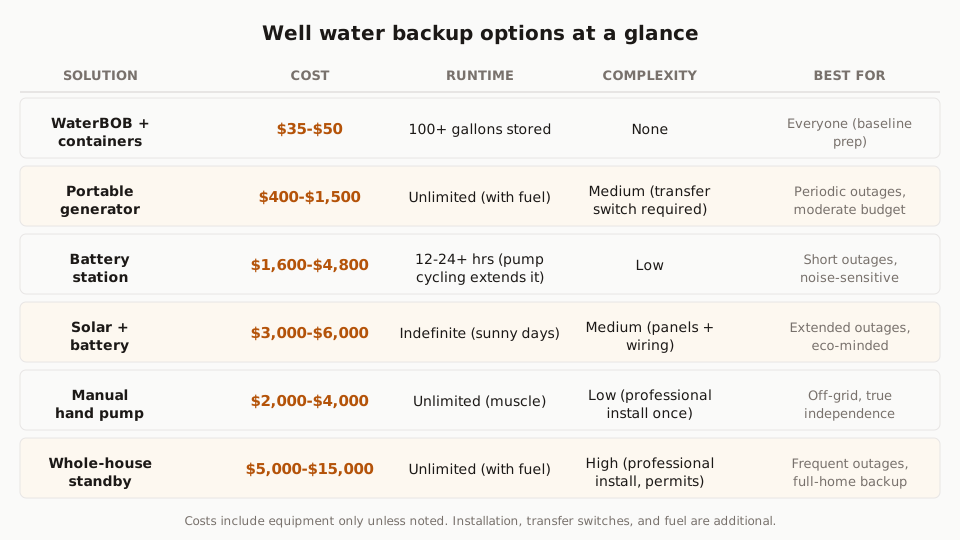
Tight budget, rare outages: A WaterBOB ($35), some filled containers, and a plan to buy or borrow a generator if things get bad. Total: under $50.
Moderate budget, periodic outages: A dual-fuel portable generator ($500-$1,000), an interlock kit ($50-$150), and a WaterBOB for immediate reserves. Total: $600 to $1,200.
Serious budget, frequent or extended outages: A whole-house standby generator ($5,000-$15,000 installed) with automatic transfer switch, or a battery station with solar panels ($3,000-$6,000). Add a hand pump ($2,000-$4,000 installed) for true grid independence.
Whatever you choose, test it before the storm, not during. And keep 100 gallons of water stored where you can reach it without electricity. That buys you time to figure out everything else.
For the full rundown of how your pump, pressure tank, and pressure switch work together, start with the pump and pressure tank guide. If your pump didn’t restart after the last outage and you’re wondering whether it’s dead, the pump replacement cost guide walks through the $25 diagnostic checks before you commit to a $2,000 replacement. And if your pressure tank isn’t holding pressure like it used to, the air charge guide covers the 2-minute test that catches the most common problem.
Related guides

How to test well water yourself (step by step)
Use home strips for trend checks. Use your own hands to collect a clean sample for the lab when the result affects health or treatment decisions.
8 min read
Hardness and drought: managing Texas well water
Texas wells often run hard year-round, then get saltier and touchier in drought. Here's what to test and when a softener is not enough.
10 min read
Removing orange iron stains from white laundry
Iron in well water oxidizes during the wash cycle and deposits rust on fabric. Here's why bleach makes it worse, which products actually remove the stains, and how to stop them permanently.
9 min read