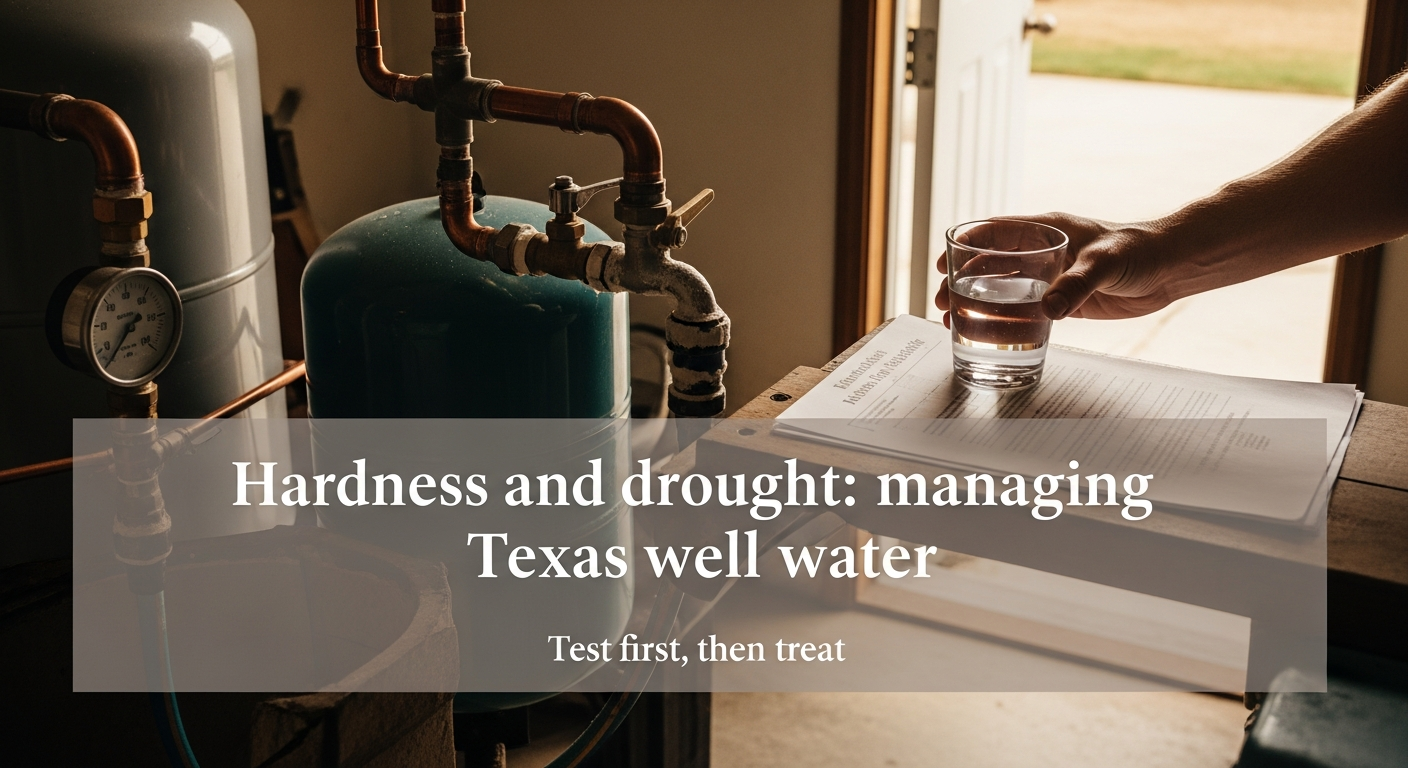
Hardness and drought: managing Texas well water
Updated April 10, 2026 — 10 min read
If your Texas well water leaves white crust on every fixture and gets weirder in a dry summer, start with two questions: is this plain old hardness, or is drought changing the well itself? In much of Texas, hard water is normal because groundwater picks up calcium and magnesium from rock. Drought makes that harder water more expensive to live with by dropping water levels, changing chemistry, and sometimes pushing contaminants like arsenic or total dissolved solids higher.
Key takeaway
In Texas, scale by itself usually means hardness. Scale plus salty taste, air spurts, sand in the toilet tank, or pressure problems during dry weather means you need a drought check too. Run a lab panel before you buy a softener, because a softener fixes scale, not every drought-driven water problem.
Why Texas wells get this combo
Texas A&M AgriLife says more than a million private water wells serve about 3 million Texans. In the Texas Well Owner Network’s 2024 screenings, 58% of sampled wells exceeded either a primary or secondary water-quality standard, with nitrate exceedances in 18% of samples and arsenic exceedances in 8% of the samples tested. So yes, hard water is common here. But “it’s just Texas water” is not a real diagnosis.
The hardness part is straightforward. Texas A&M’s water analysis parameter guide says hardness comes from calcium and magnesium, usually dissolved from limestone, dolomite, salts, and soil. That same guide classifies water above 180 ppm as very hard, which explains the white scale on shower glass, the crust on kettle elements, and the water heater that seems to age in dog years.
The drought part is where Texas gets more expensive. Texas A&M’s drought fact sheet for well owners warns that low water levels can make a pump short-cycle, pull in air, and start bringing up sand. It also notes that as aquifer conditions change during drought, arsenic and total dissolved solids can increase. In the southern part of the Ogallala Aquifer, the Texas Water Development Board says large areas already run above 1,000 mg/L of total dissolved solids and can carry naturally occurring arsenic, fluoride, and radionuclides. That is not a softener-only problem.
Run the Texas first check before you buy equipment
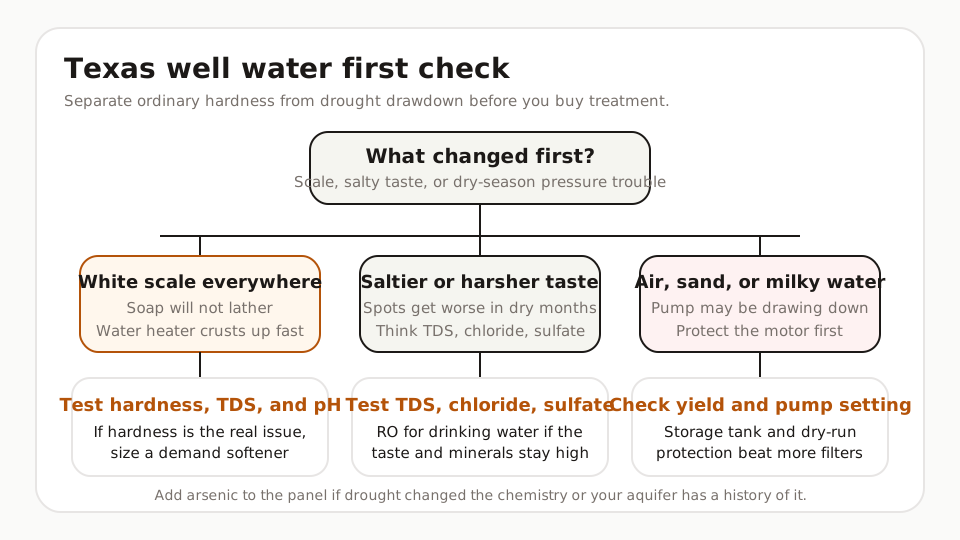
Before you call a treatment company, sort your symptoms into the right bucket.
| What you notice | Most likely issue | First move |
|---|---|---|
| White scale on faucets, poor soap lather, water heater crust | Hardness from calcium and magnesium | Test hardness, TDS, and pH |
| Water tastes saltier or more bitter in dry months | High TDS, chloride, sulfate, or sodium riding along with hardness | Test TDS, chloride, sulfate, and sodium |
| Air sputters at the tap, sand in the toilet tank, milky water that clears | Drought drawdown or a low-yield well pulling air | Cut back heavy use, protect the pump, and check yield |
| Summer retest shows arsenic moving up, especially in West Texas or the High Plains | Drought-driven chemistry change | Confirm with a certified lab before sizing treatment |
On GarageJournal and TractorByNet, the summer language is always the same: “running the well dry,” “sucking air,” “sand in the toilet tank.” That’s not homeowners being dramatic. It is exactly how drought stress shows up in the real world.
What to test this week
Do not let scale distract you from the health panel. Texas A&M says E. coli and nitrate are still the most common contaminants in private Texas wells, and drought can change chemistry enough that a “normal” nuisance-water year turns into a health-risk year.
For this Texas article, I would order:
- Hardness, TDS, and pH to separate ordinary scale from broader mineral loading
- Chloride, sulfate, and sodium if the water tastes salty, bitter, or just harsher than it used to
- Iron and manganese if you also have orange or black staining
- Coliform/E. coli and nitrate if you have not tested in the past year
- Arsenic during and after drought, especially in West Texas, the High Plains, and other areas where your local groundwater district flags it
- Fluoride or radionuclides if your lab or groundwater district says your aquifer is known for them
Then pull the well record. The TCEQ Water Well Report Viewer and the agency’s well-information page can help you find the original report. Depth, casing, pump setting, and tested yield matter a lot when a dry spell starts changing your water. If your report shows a marginal yield to begin with, you are not dealing with “just hard water.”
Related
Use the ultimate guide to testing your well water for the full lab strategy and sample-collection steps. If the real problem is drought drawdown rather than chemistry alone, go straight to low well yield: diagnostics, solutions, and storage tanks.
Choose the fix that matches the result
If it is plain hardness
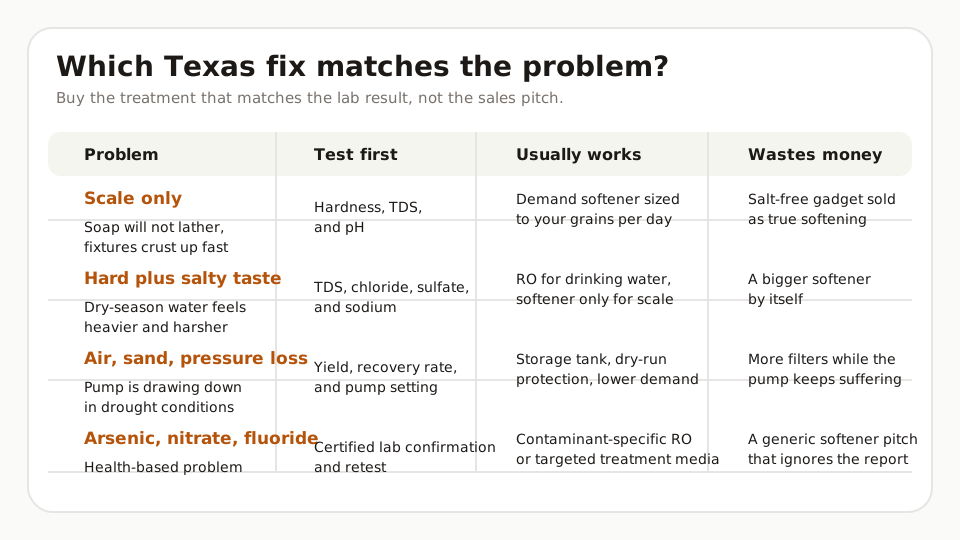
This is the easy version of Texas well water. The Water Quality Association describes hard water as calcium and magnesium that create scale, spots, dingy laundry, and high soap use. If your lab shows high hardness, your TDS is otherwise reasonable, and the well is producing normally, a demand-initiated whole-house softener is the right tool.
That is also where a lot of people stop thinking. Too soon.
If it is hardness plus high TDS or salty taste
A softener is not the whole answer here. Texas A&M’s parameter guide says reverse osmosis is the practical household treatment for sodium reduction, and it lists 500 ppm as the EPA secondary benchmark for TDS. WQA’s RO fact sheet notes that reverse osmosis removes a wide range of dissolved contaminants that a softener does not.
The practical setup for most homes is:
- A softener if you still need whole-house scale control
- A point-of-use RO system at the kitchen sink if drinking water tastes salty, bitter, or tests high for TDS, nitrate, arsenic, or fluoride
If you skip the testing and install a bigger softener when the real complaint is salty water, you spend a few thousand dollars and still hate the taste.
If drought is causing air, sand, or pressure crashes
Now you are on the water-quantity side, not just the water-quality side.
Texas A&M says low water levels can make pumps short-cycle, overheat, and pull air. If your faucet coughs, the pump starts and stops rapidly, or the toilet tank starts collecting sand, back off heavy use right away. Stop watering the lawn off the well, stagger laundry and showers, and protect the pump before you burn it up. The low-yield guide walks through storage tanks and dry-run protection. The pump replacement cost guide covers what that mistake costs when people wait too long.
If a health contaminant moves up during drought
This is the part I would not treat casually. If arsenic, nitrate, fluoride, or another health-based contaminant crosses the line, do not let anyone reduce the conversation to “hard Texas water.” That framing wastes time.
Retest with a certified lab. Then match the treatment to the contaminant. Our arsenic guide, nitrate guide, and well water filtration guide cover that treatment path in detail.
Your next move
Order a real lab panel this week, not a parking-lot hardness test. Pull your well report. If the dry-weather symptoms include air, sand, or pressure crashes, protect the pump before you shop for filters. And if the problem is just hardness, great. A softener is cheaper than guessing.
Texas well water does not have to be perfect. It does need to be diagnosed honestly.
Related guides
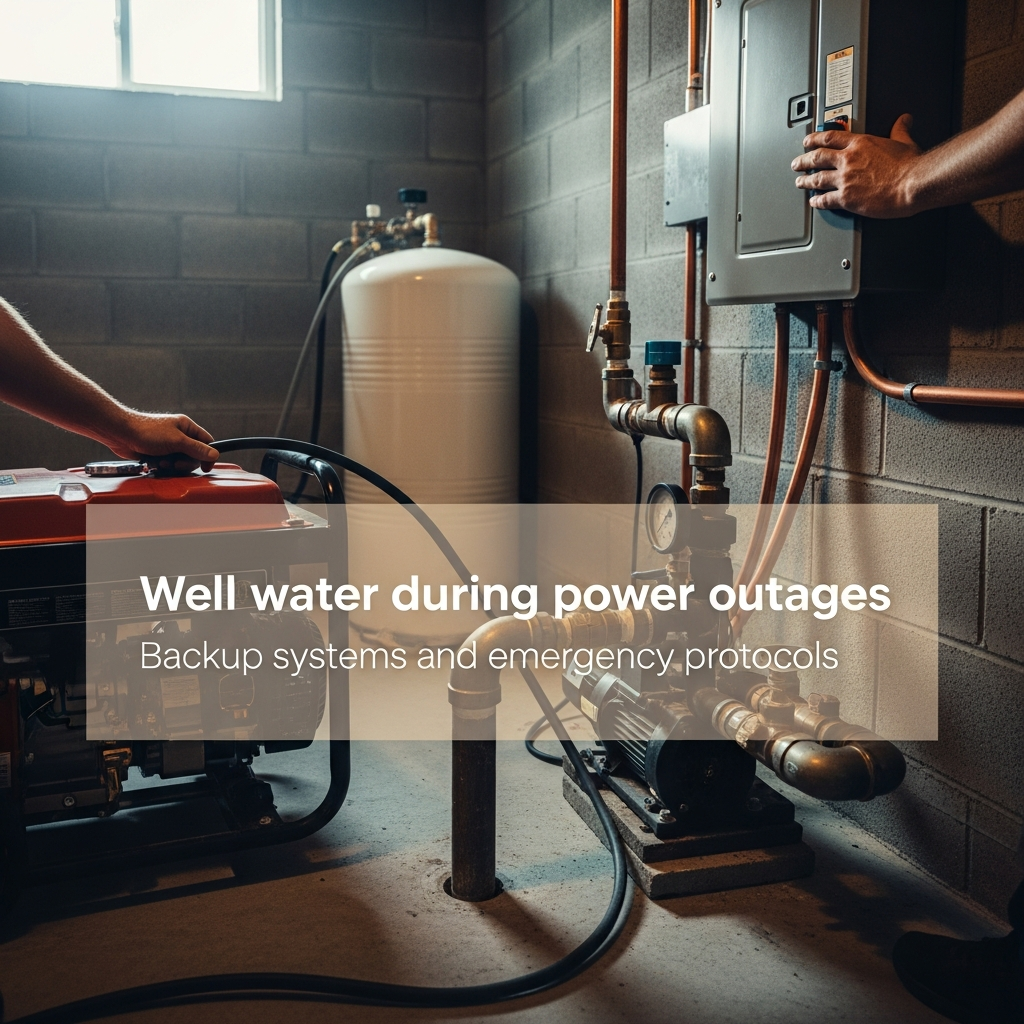
Well water during power outages: backup systems and emergency protocols
How to keep water flowing from a private well during a power outage -- generator sizing, battery backup, hand pumps, and the $35 prep that buys you 100 gallons.
11 min read
Radon in well water: aeration vs. charcoal filtration
Radon in well water is an invisible cancer risk that standard filters miss. Here's how aeration and GAC filtration compare on removal rates, costs, and the radioactive waste problem most installers won't mention.
10 min read
Buying a house with a private well: the inspection checklist
What to inspect, test, and negotiate before closing on a home with a private well. Flow rates, water quality, pump age, septic distances, and the contingency clause that protects you.
12 min read