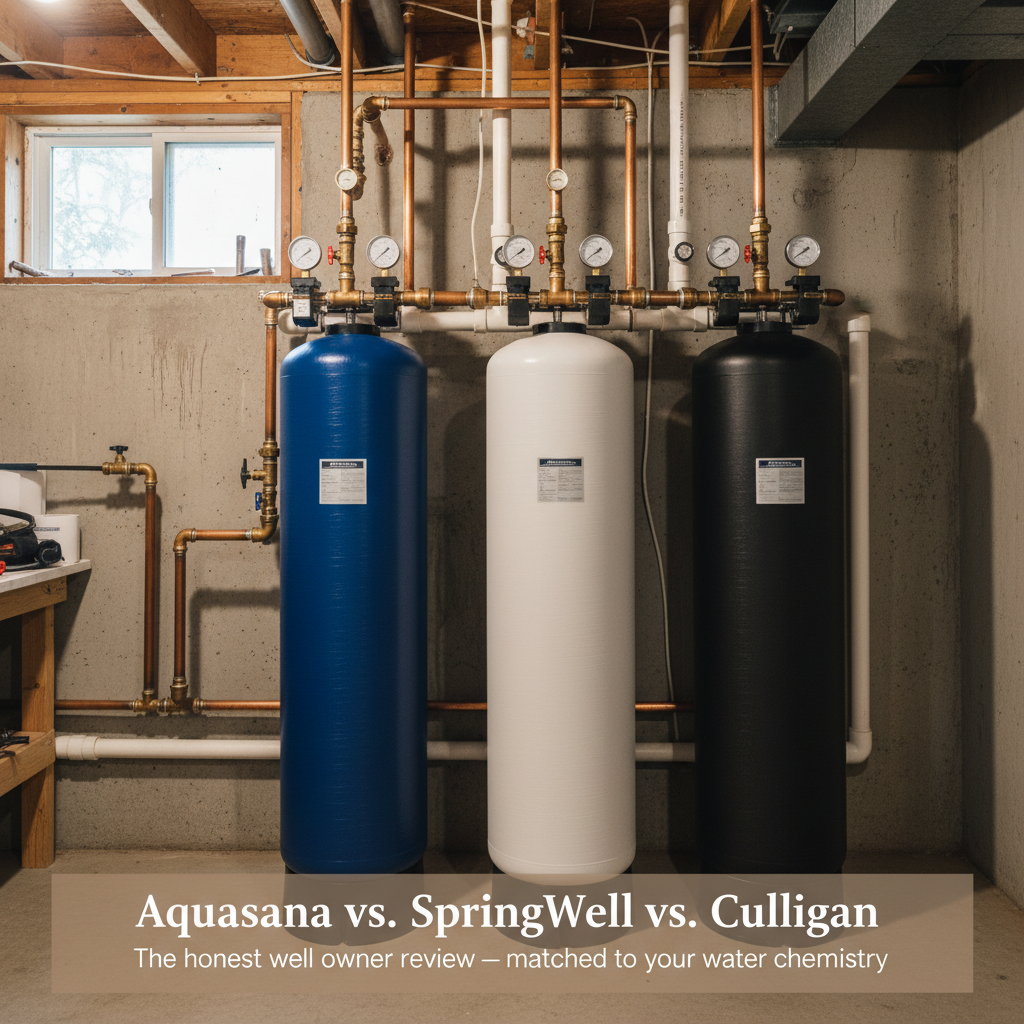
Aquasana vs. SpringWell vs. Culligan: the honest well owner's review
Updated February 17, 2026 — 14 min read
These three brands aren’t interchangeable. Aquasana is a city-water filtration company that sells a well-water model. SpringWell builds systems specifically for well water contaminants. Culligan sends a dealer to your house, tests your water, and proposes a custom setup at a price they won’t publish online. Picking the wrong one means spending $1,500-$3,000 on equipment that doesn’t fix your actual problem.
I’ve spent the last two years researching well water treatment systems for this site, talking to well owners who’ve installed each of these, and digging through forum threads where real people share what worked and what didn’t. Here’s what I’ve learned: most comparison articles treat these three brands like they’re competing for the same job. They’re not. Each one is built for a different type of well water problem, and if you buy the wrong one, no amount of troubleshooting will make it work.
Before we get into specs, here’s the foundational rule: test your water first. A $100-$200 lab test tells you exactly what contaminants you’re dealing with and at what concentrations. Without that test, you’re guessing — and guessing is how people end up with a $2,300 system that can’t handle the 3 ppm of iron in their water.
The quick verdict
If you want the short answer before the details:
| Your primary problem | Best match | Why |
|---|---|---|
| Iron, sulfur, or manganese | SpringWell WS1 | Purpose-built for well water’s Big Three at real-world concentrations |
| Bacteria, VOCs, or pesticides (with low iron) | Aquasana Rhino Well Water | UV disinfection included, strong carbon filtration for chemicals |
| Complex multi-contaminant water + you want hands-off service | Culligan | Custom-configured by dealer to match your exact water test |
| Hardness (true softening) | Culligan | Only one of the three that offers real ion-exchange softening as a core product |
Now let’s break down why.
Aquasana Rhino Well Water with UV
Price: $1,800-$2,300 for the system, plus $800-$1,200 for professional installation.
Aquasana’s well water system is a 6-stage setup: sediment pre-filter, copper-zinc (KDF-85) media, activated carbon, salt-free scale conditioner, UV purifier, and a post-filter. It’s NSF/ANSI 42 certified for chlorine reduction, NSF 55 certified for UV disinfection, and WQA certified to NSF 61 for materials safety.
On paper, it looks thorough. Six stages sounds like it covers everything. But here’s the problem most review sites gloss over.
The iron limit that changes everything
Aquasana rates this system for a maximum of 0.3 ppm iron. That’s not a typo. Zero point three.
To put that in context: if your well water has enough iron to leave the faintest orange ring in your toilet bowl, you’re probably above 0.3 ppm. Most wells with visible iron problems run 1-10 ppm. Aquasana’s own documentation tells you to “call our Water Experts” if you have iron issues — which is a polite way of saying their system can’t handle it.
The hardness limit is 15 grains per gallon. The pH must be below 8.3. These are not extreme water conditions. They’re typical well water.
What Aquasana actually does well
Where this system earns its keep is bacteria and chemical contamination. The UV purifier kills 99.99% of bacteria and viruses (NSF 55 certified — that certification matters). The activated carbon and KDF media handle VOCs, pesticides, herbicides, and industrial solvents. If your well sits near agricultural land and your water test shows pesticide residues but low iron, Aquasana is the right tool for that job.
The salt-free conditioner prevents scale buildup in your pipes and appliances, but it’s not a water softener. Your water will still test hard. It just won’t leave deposits.
Maintenance costs add up
You’ll replace the pre-filter every two months ($25 each), the post-filter every six months ($30), and the UV lamp annually (~$80). That’s $240-$350 per year in consumables. The main tank media lasts 5 years or 500,000 gallons before a full replacement.
The warranty problem
Here’s where Aquasana loses a lot of well owners. Install it yourself and the warranty drops from 10 years to 1 year. One year. On a $2,300 system. That means professional installation isn’t optional — it’s effectively mandatory if you want warranty protection, adding $800-$1,200 to the total.
For a well owner who replumbed their own house and maintains their own pressure tank, being told they’ll void most of their warranty by turning a wrench is insulting. SpringWell figured this out. Aquasana hasn’t.
Customer service red flags
I’ve read enough BBB complaints and forum posts to see a pattern. Aquasana has discontinued replacement parts for systems less than 10 years old, leaving owners stranded with functioning equipment they can’t maintain. Their “Water for Life” subscription program has been reported to increase prices without notification. Multiple customers have documented receiving wrong parts repeatedly.
This isn’t one angry customer. It’s a trend.
Before you buy Aquasana for well water
Get a water test and check your iron level. If it’s above 0.3 ppm (and it probably is), this system won’t solve your iron problem. You’ll spend $2,500+ and still have orange stains. The filtration guide explains how to match your water test results to the right technology.
SpringWell WS1 / WS4
Price: $1,500-$2,800 depending on the model. No installation cost if you DIY.
SpringWell’s well water system uses a fundamentally different technology than Aquasana. It’s an air injection oxidation (AIO) system with greensand filtration. Water flows through an air pocket at the top of the tank, which oxidizes dissolved iron, sulfur, and manganese into solid particles. Those particles get trapped in the greensand media bed. Every day, the system backwashes automatically to flush the trapped contaminants and recharge the air pocket.
No chemicals. No salt. No chlorine or peroxide injection. Just air and filtration media.
Built for the Big Three
This is where SpringWell separates from Aquasana. The WS1 handles up to 7 ppm iron, 8 ppm hydrogen sulfide, and 1-2 ppm manganese. The WS4 handles the same concentrations at a higher flow rate (20 GPM vs. 12 GPM for the WS1).
Those numbers cover the vast majority of residential well water problems. If you’ve read my guide on rotten egg smell, you know that air injection oxidation is one of the most effective treatments for hydrogen sulfide. SpringWell built their entire well water product around that technology.
What SpringWell doesn’t do
Here’s the honest part that SpringWell’s own marketing buries in the fine print: the WS system does not remove bacteria, VOCs, pesticides, heavy metals, or chemical contamination. It’s an iron/sulfur/manganese filter. Period.
If your water test shows bacteria, you need a UV system. If it shows PFAS or pesticides, you need carbon filtration. SpringWell sells add-on systems for these (their CF1 carbon filter and UV units), but each one is a separate purchase. A comprehensive setup can push the total past $3,000.
That’s not a flaw — it’s just the reality of well water treatment. Different contaminants need different technologies. But you should know going in that the base WS1 at $1,500 is solving one category of problems, not all of them.
Maintenance is almost nothing
This is SpringWell’s best feature and nobody talks about it enough. The greensand filter media lasts 18-25 years. You read that right. The only regular replacement is a sediment post-filter every 6-9 months. Annual maintenance cost: about $40.
Compare that to Aquasana’s $240-$350 per year. Over a 10-year span, the maintenance savings alone are $2,000-$3,100.
Warranty and installation
Lifetime warranty on all parts. Doesn’t matter who installs it — you or a plumber. The system is designed for DIY installation (single tank with a control head, installs like a water softener). Most people with basic plumbing skills complete it in 2-4 hours.
The Bluetooth-enabled control head lets you monitor and adjust settings from your phone. It’s a nice touch that signals who SpringWell built this system for: the kind of well owner who maintains their own equipment.
The NSF gap
SpringWell’s WS system does not have NSF system-level certification. This is a real gap. They say they use “certified components” and they’re a member of the Water Quality Association, but the system as a whole hasn’t been independently tested to NSF performance standards.
Does it work? Forum reports and customer reviews overwhelmingly say yes. But if third-party certification matters to you (and it’s reasonable if it does), this is a point against SpringWell.
Customer service: mixed
When things work, SpringWell gets positive reviews. When things go wrong, some customers report extended troubleshooting cycles and difficulty reaching support. Their 6-month money-back guarantee sounds great until you read the terms: you pay return shipping and a 25% restocking fee. On a $2,000 system, that’s $500 you don’t get back.
Culligan
Price: $1,000-$5,000+ installed. You won’t know the exact price until a dealer comes to your house.
Culligan is a different animal. You don’t browse their website and add a system to your cart. You call your local Culligan dealer, they send someone to test your water, and they design a system around your results. Iron problem? Iron-Cleer filter. Sulfur? Sulfur-Cleer. Acid water? Cullneu neutralizer. Hard water? A real ion-exchange softener. Heavy sediment? Filter-Cleer.
Each component is a separate piece of the system. Your quote depends on how many you need.
The customization advantage
This is Culligan’s genuine strength. If your water test comes back with iron, sulfur, low pH, and hardness — four problems at once — Culligan can build a treatment train that addresses all of them in one professionally installed package. Aquasana can’t touch most of those. SpringWell handles three of the four but not pH correction.
Culligan also offers the only true ion-exchange water softener among these three brands. If you have hard water and you want it actually soft (not just “conditioned”), Culligan can do that. Aquasana’s salt-free conditioner and SpringWell’s salt-free option prevent scale but don’t remove hardness minerals.
Their flow rates are the highest in the group — 18-22 GPM depending on the model size.
The price opacity problem
You will not find a Culligan price list. Not on their website, not at a retailer, nowhere. Every quote comes from a dealer visit, and the pricing varies widely. Customers have reported quotes ranging from $2,000 for a single system to $7,000-$11,000 for comprehensive multi-component packages.
On average, Culligan costs 40-60% more than a direct-to-consumer brand like SpringWell for comparable treatment capability. Some of that premium pays for professional installation and ongoing service. Whether that’s worth it depends on how much you value not doing the work yourself.
Culligan does offer a rental option at $10-$30 per month including maintenance. If the upfront cost is a barrier, that’s worth exploring.
The dealer lottery
Your Culligan experience depends almost entirely on your local franchise. Some dealers are excellent — professional installations, responsive service, fair pricing. Others are aggressive on sales, slow on service, and opaque on billing.
I’ve read forum posts from Culligan customers who’ve run the same system for 20 years with no issues and nothing but praise. I’ve also read posts from customers whose brand-new system leaked within 4 months, and service never showed up to fix it.
You’re not buying a product. You’re buying a relationship with a local business. Ask neighbors who use Culligan in your area. Check your local franchise’s reviews specifically — the national brand reputation doesn’t predict your local experience.
You’re locked in
Once Culligan installs your system, you’re in their ecosystem. Parts aren’t easily sourced elsewhere. Service visits are handled by the dealer. You can’t DIY your way out of a problem the way you can with SpringWell. If your local dealer is great, that’s fine. If they’re not, you’re stuck.
The rental option nobody mentions
Culligan’s $10-$30/month rental includes the equipment and all maintenance. If you run the math over 5 years, renting often costs less than buying outright when you factor in service visits. And if you hate it, you return the equipment. No $2,000 sunk cost. Ask your dealer about rental pricing before committing to a purchase.
The real comparison: match the system to your water
Every well is different, and the “best” system depends on what’s in your water. Here’s the comparison that actually matters.
| Aquasana | SpringWell WS | Culligan | |
|---|---|---|---|
| Iron removal | 0.3 ppm (negligible) | 7 ppm | Varies (Iron-Cleer) |
| Sulfur removal | Minimal | 8 ppm | Varies (Sulfur-Cleer) |
| Manganese | Not rated | 1-2 ppm | Custom configured |
| Bacteria/virus | UV included (NSF 55) | UV add-on | UV add-on |
| VOCs/chemicals | Yes (carbon + KDF) | Add-on required | Custom configured |
| True softening | No (conditioner only) | No (conditioner add-on) | Yes (ion-exchange) |
| pH correction | No | No | Yes (Cullneu) |
| System price | $1,800-$2,300 | $1,500-$2,800 | $1,000-$5,000+ |
| Install cost | $800-$1,200 (pro) | $0 (DIY) | Included |
| Annual maintenance | $240-$350 | ~$40 | $100-$300+ |
| Warranty | 1 yr DIY / 10 yr pro | Lifetime (any install) | 10 yr major parts |
| NSF certified | Yes (42, 55, 61) | No (system-level) | Yes (42, 372) |
| DIY friendly | Yes (with warranty penalty) | Yes (designed for it) | No |
| Price transparency | Yes | Yes | No |
Five-year cost of ownership
The sticker price is only part of the story. Here’s what each system actually costs over five years, assuming you need professional installation for Aquasana and Culligan.
Aquasana: $2,300 system + $1,000 install + ($300/yr x 5) maintenance = $4,800
SpringWell WS1: $1,800 system + $0 DIY install + ($40/yr x 5) maintenance = $2,000
Culligan (mid-range quote): $3,000 installed + ($200/yr x 5) maintenance = $4,000
SpringWell’s total cost is less than half of Aquasana’s over five years. That gap gets wider every year.
My recommendation by scenario
Your water test shows iron above 0.3 ppm, sulfur, or manganese: SpringWell WS1 (or WS4 for larger homes). This is what it’s built for, the maintenance costs are minimal, and the lifetime warranty means you’re covered. Pair it with a UV system if bacteria are also a concern.
Your water test shows bacteria or chemical contamination but low iron: Aquasana Rhino Well Water with UV. The NSF 55 UV certification is real and the carbon filtration handles VOCs effectively. Just make sure your iron is genuinely below 0.3 ppm and budget for professional installation to protect the warranty.
Your water test shows four or five problems at once and you don’t want to DIY: Get a Culligan quote. Their ability to combine specialized filters into a single managed system is unmatched. Just get multiple quotes from different dealers if possible, and ask about rental before purchasing.
You’re on a budget: SpringWell WS1, no question. Lowest upfront cost, lowest maintenance cost, DIY installation, lifetime warranty. Add other treatment components later as your budget allows.
If you haven’t tested your water yet, that’s your first step. Not this article. Not any product. A certified lab test. The filtration guide walks through how to get your water tested and what to ask for. If your test shows PFAS contamination, none of these three base systems will address it — you’ll need a reverse osmosis or specialized activated carbon system regardless of which brand you pick.
Your next move: dig out your most recent water test results (or order a test if you don’t have one) and check your iron, sulfur, manganese, and bacteria levels. Those four numbers tell you which of these systems will actually solve your problem and which ones will just drain your bank account.
Related guides
Arsenic in well water: health risks and removal methods
Arsenic in well water is invisible and tasteless. Here's what 10 micrograms per liter means, why arsenic III vs. V matters, and which treatment methods actually work.
9 min read
Best UV water purifiers for well water (bacteria defense)
The best UV purifier for well water is a Class A unit sized to your real peak flow and installed after pretreatment. Here are the systems I would actually buy.
12 min read
Nitrates in well water: sources, risks, and real fixes
Nitrates in well water are invisible and common in farm country. Here's how to read the lab result, protect infants, and choose treatment that actually removes nitrate.
9 min read