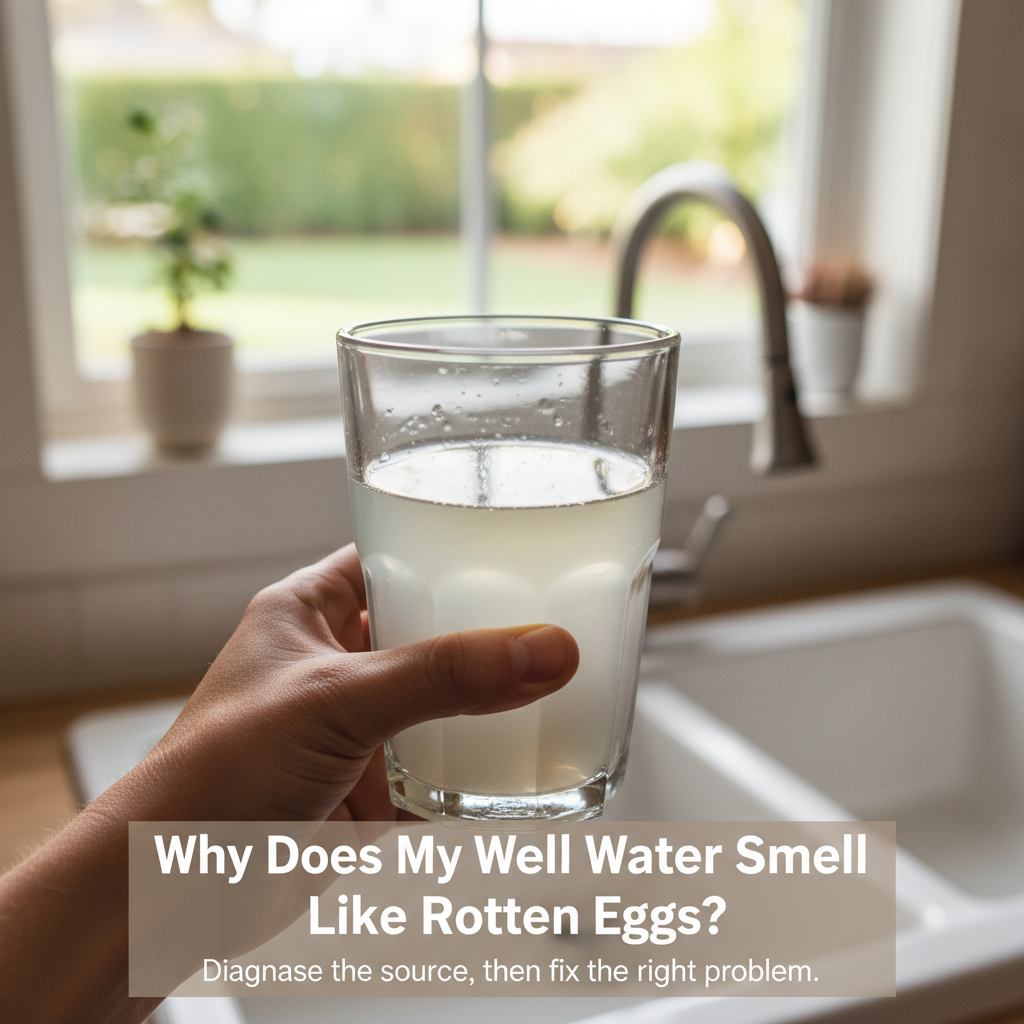
Why does my well water smell like rotten eggs? (and how to fix it)
Updated February 16, 2026 — 10 min read
That rotten egg smell is hydrogen sulfide gas dissolved in your water. It’s produced by sulfur-reducing bacteria in your well, a chemical reaction inside your water heater, or naturally occurring sulfur in your groundwater. The fix depends entirely on which of those three sources is causing it — and most people treat the wrong one because they skip the diagnosis.
I dealt with this in my own well. Turned on the kitchen faucet one morning and the smell hit me before the water reached the glass. My first instinct was to call a well company. Instead, I spent 10 minutes running some tests, figured out the source was my water heater’s magnesium anode rod, and fixed it for $40. The well company would have quoted me $2,000+ for a whole-house treatment system I didn’t need.
Here’s the diagnostic process I use, followed by the right fix for each cause.
The 3-minute diagnostic: find the source first
Before you spend a dollar on treatment, run this test. It takes 3 minutes and tells you exactly where the smell is coming from.
Step 1: Run cold water only. Go to a faucet near the pressure tank (usually a basement or utility room sink). Let the cold water run for 30 seconds. Smell it.
Step 2: Run hot water only. Switch to hot. Let it run for 30 seconds. Smell it.
Step 3: Check a different faucet. Repeat at a faucet on the other end of the house.
Here’s what the results tell you:
| What you smell | What it means |
|---|---|
| Hot water smells, cold doesn’t | Water heater problem (anode rod or bacteria in the tank) |
| Both hot and cold smell | Well or groundwater source |
| Only one faucet smells | Localized plumbing issue (bacteria in that pipe section) |
| Smell is worse after the house sits empty for hours | Sulfur bacteria are colonizing your plumbing |
This isn’t guesswork. Each pattern points to a specific cause and a specific fix.
Cause 1: your water heater’s anode rod
If only your hot water smells, start here. This is the most common cause of rotten egg smell, and it’s the cheapest to fix.
Every tank water heater has a sacrificial anode rod — a metal rod that corrodes slowly so your tank doesn’t. Most heaters ship with a magnesium anode rod. Magnesium reacts with sulfate (a common mineral in well water) and with naturally present sulfur-reducing bacteria to produce hydrogen sulfide gas. The warmer the water, the faster the reaction.
The fix is straightforward: replace the magnesium rod.
Option 1: Aluminum/zinc anode rod ($20-$40). This is the most common swap. Aluminum/zinc rods still protect the tank from corrosion but don’t react with sulfate the way magnesium does. You can do this yourself with a 1-1/16” socket and a breaker bar. The rod threads into the top of the tank. Turn off the power, relieve pressure, unscrew the old one, screw in the new one. Twenty minutes.
Option 2: Powered anode rod ($80-$150). These use a small electrical current to protect the tank instead of a sacrificial metal. No metal reaction means no hydrogen sulfide. They’re more expensive upfront but last the life of the heater — you never replace them. If you have very high sulfate levels and the aluminum/zinc rod doesn’t eliminate the smell completely, this is the permanent fix.
After swapping the rod, flush the water heater. Open the drain valve at the bottom and run it until the water clears. The residual hydrogen sulfide in the tank will clear out in a day or two.
Quick test before buying anything
Turn your water heater to 160 degrees F for 8 hours, then flush it. This kills sulfur bacteria living inside the tank. If the smell goes away for a few weeks and then comes back, the bacteria are re-colonizing from your water supply and the anode rod swap is your real fix. If the smell doesn’t go away at all, the bacteria aren’t the problem — the anode rod chemistry is.
Cause 2: sulfur-reducing bacteria in your well
If both hot and cold water smell, the hydrogen sulfide is coming from your well or the groundwater feeding it. Sulfur-reducing bacteria thrive in the low-oxygen environment deep in your well casing. They metabolize sulfate in the groundwater and produce hydrogen sulfide as a byproduct.
These bacteria aren’t dangerous to drink. The EPA doesn’t regulate hydrogen sulfide in drinking water because the concentrations in residential wells are almost always well below any health concern. But the smell is miserable, and at higher concentrations (above 1 ppm), hydrogen sulfide corrodes copper pipes, tarnishes silverware, and leaves black stains on fixtures.
Signs that bacteria are the specific problem (not just naturally occurring sulfur):
- The smell gets worse after the house sits unused for a day or more (bacteria multiply in stagnant water)
- You see a white, gray, or black slime on the inside of your toilet tank lid
- The smell appeared gradually over months rather than showing up overnight
Treatment options ranked by cost and effectiveness
Shock chlorination ($30-$50, DIY). This is always the first thing to try. You pour a concentrated chlorine solution directly into your well, circulate it through the plumbing, let it sit for 12-24 hours, then flush. It kills sulfur bacteria on contact. The full process is covered in detail in a dedicated guide (coming soon), but the short version: you need about 2 gallons of unscented household bleach for a standard 6-inch diameter residential well, 200 feet deep.
Shock chlorination works in about 60% of cases. If the bacteria have colonized deep into the aquifer — not just the well casing — the smell will return within a few weeks. That means you need a continuous treatment system.
Activated carbon filter ($150-$400 installed). Carbon filters absorb hydrogen sulfide from the water as it passes through. They work well for low concentrations — under 1 ppm. Above that, the carbon exhausts quickly and you’ll be replacing filter cartridges constantly. If your water test comes back below 1 ppm hydrogen sulfide, a carbon filter is the simplest and cheapest permanent solution.
Oxidizing filter with manganese dioxide media ($800-$1,500 installed). This is the workhorse for moderate sulfur levels (1-5 ppm). The filter media oxidizes hydrogen sulfide into solid sulfur particles, which get trapped in the filter bed. The system backwashes automatically to flush the trapped particles. Brands like Birm and Filox are common media types. These systems need periodic media replacement (every 5-10 years depending on usage), but day-to-day maintenance is minimal.
Air injection oxidation system ($1,000-$2,500 installed). For sulfur levels above 3 ppm, air injection is the most reliable treatment. The system draws air into a tank, the oxygen in the air oxidizes hydrogen sulfide into solid sulfur, and a filter bed catches the particles. No chemicals, no media to replace — just air. The tank backwashes on a schedule to flush the accumulated sulfur. SpringWell and Pentair both make well-regarded air injection systems for residential wells.
Chlorine injection system ($1,500-$3,000 installed). For severe cases — sulfur above 5 ppm combined with iron bacteria or other contamination — continuous chlorine injection is the nuclear option. A chemical feed pump injects a metered dose of chlorine into the water line upstream of a contact tank, giving the chlorine time to oxidize the hydrogen sulfide and kill bacteria. A carbon filter downstream removes the residual chlorine before it reaches your faucets.
This system handles the highest contamination levels but requires you to maintain a chlorine supply and calibrate the pump periodically. It’s the right choice when nothing else works, but it’s not where you start.
Cause 3: naturally occurring hydrogen sulfide in groundwater
Some wells just have sulfur in the geology. Shale, sandstone, and coal formations commonly contain sulfur compounds that dissolve into groundwater. In these cases, the smell doesn’t come from bacteria at all — it comes from the rock your well is drilled through.
The giveaway: the smell was there from the day the well was drilled, it doesn’t fluctuate much, and shock chlorination doesn’t help at all.
The treatment options are the same as for bacterial sulfur (oxidizing filters, air injection, chlorine injection), but shock chlorination is pointless because there are no bacteria to kill. Skip straight to a continuous treatment system matched to your hydrogen sulfide concentration.
Get a water test before buying equipment
I’ve said this in other articles on this site, and I’ll keep saying it: test your water before you buy treatment equipment. A basic water test costs $100-$200 and tells you exactly what you’re dealing with.
For sulfur problems specifically, ask the lab to test for:
- Hydrogen sulfide concentration (ppm). This determines which treatment tier you need. Under 1 ppm, a carbon filter handles it. 1-5 ppm, an oxidizing filter or air injection. Above 5 ppm, chlorine injection.
- Sulfate levels. High sulfate (above 250 ppm) feeds sulfur-reducing bacteria. If sulfate is high, the bacteria will keep coming back after shock chlorination.
- Iron and manganese. These often appear alongside sulfur. If you have all three, you need a treatment system that addresses them together — not three separate filters.
- pH. Acidic water (below 7.0) makes oxidizing filters less effective. You may need a pH correction stage upstream of your sulfur treatment.
One important note: hydrogen sulfide oxidizes rapidly when exposed to air. If you collect a water sample and mail it to a lab, the hydrogen sulfide may dissipate before it arrives. Some labs offer on-site test kits for hydrogen sulfide, or you can request same-day analysis. The colorimetric test strips ($10-$15 for a pack) give you a rough concentration range instantly — not lab-grade accuracy, but good enough to pick a treatment tier.
Don’t skip the water test
If you install an air injection system for what you think is a sulfur problem and it turns out you have tannins instead (which produce a similar earthy smell), the system won’t help. A water test tells you whether you’re dealing with hydrogen sulfide, iron bacteria, tannins, or some combination. Tannins need a tannin-specific resin filter — oxidation does nothing to them. I covered this mistake in the filtration guide. Don’t repeat it.
When to call a professional
Most of the diagnostics and simpler fixes in this article are DIY-friendly. But call a licensed well contractor if:
- Shock chlorination fails twice and the smell returns within a week each time
- Your hydrogen sulfide levels test above 5 ppm
- You see persistent slime or biofilm in your well casing (this requires physical cleaning of the well, not just chemical treatment)
- The smell appeared suddenly after years of clean water (this could indicate a change in your aquifer or a failing well seal — both need professional evaluation)
A well contractor can camera-inspect your well casing, check the sanitary seal, and determine whether the bacteria have colonized the well bore itself or just the plumbing above ground. That distinction matters because it determines whether you need well rehabilitation or just surface-level treatment.
Your next step: run the 3-minute hot/cold diagnostic above. If it points to your water heater, swap the anode rod this weekend — it’s the $40 fix that solves the problem for about half the people reading this. If both hot and cold smell, get a water test and match the hydrogen sulfide concentration to the treatment tier that fits. The filtration guide walks through how to build a treatment train for multiple contaminants if sulfur isn’t your only issue.
Related guides
Aquasana vs. SpringWell vs. Culligan: the honest well owner's review
A side-by-side comparison of Aquasana, SpringWell, and Culligan whole house well water filtration systems -- what each actually handles, what it doesn't, and which one matches your water chemistry.
14 min read
The beauty guide for well owners: hair, skin & laundry
Hardness, iron, manganese, and copper can wreck hair, irritate skin, and stain laundry. This guide shows how to tell which one is hitting your house and what actually fixes it.
12 min read
The well owner's guide to septic systems: what connects, what conflicts, and what to watch
How your private well and septic system interact, including required setback distances, contamination pathways, water softener discharge impacts, and the water tests that catch problems early.
12 min read