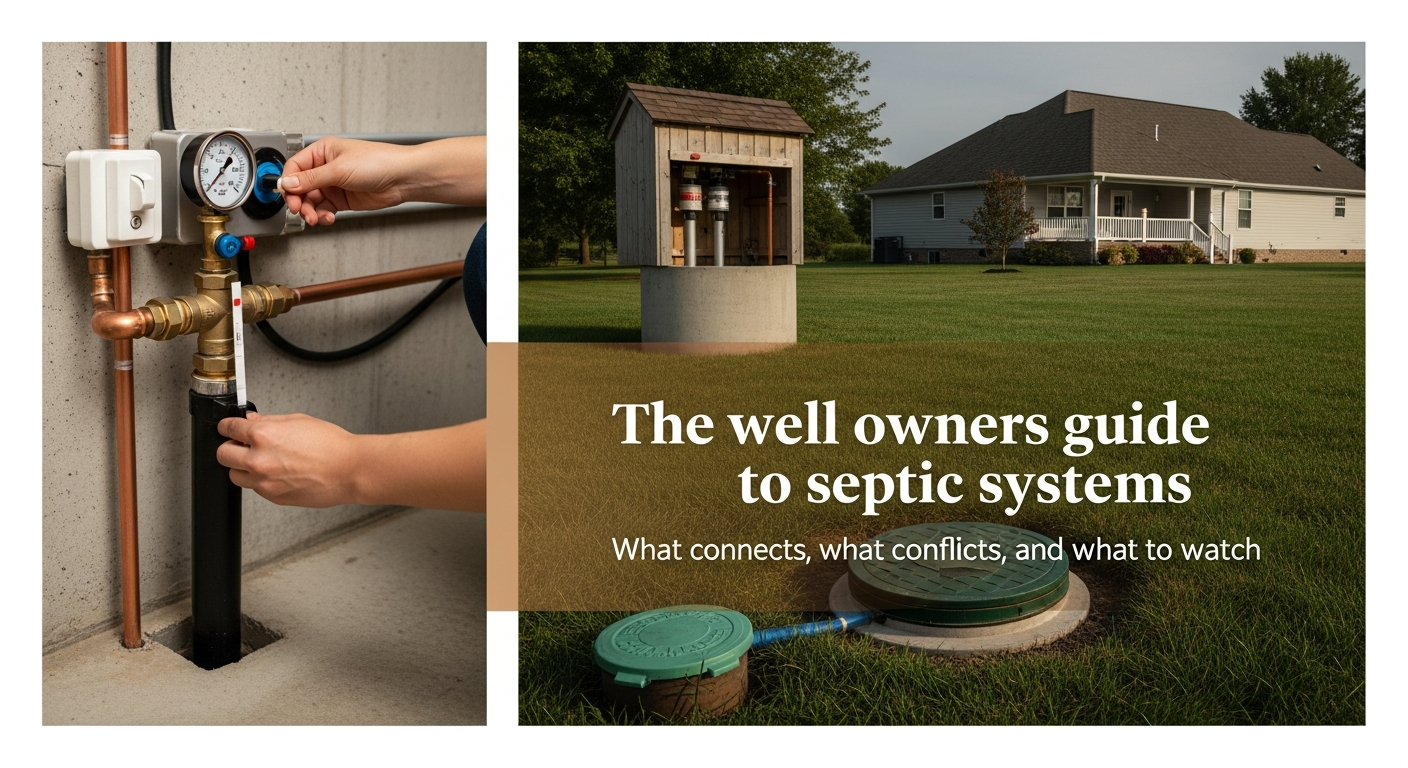
The well owner's guide to septic systems: what connects, what conflicts, and what to watch
Updated February 13, 2026 — 12 min read
If your home has a private well and a septic system, you’re running two underground systems that most people never think about in the same sentence. One pulls water in. The other pushes wastewater out. On most rural properties, they’re close enough that a problem with one can quietly become a problem with the other.
About 21 million U.S. households use both a private well and a septic system, according to EPA estimates. That’s roughly one in six American homes operating a closed loop where the water they drink comes from the same ground that absorbs their wastewater. The distance between those two systems, the condition of both, and what you’re sending down your drains all determine whether that loop stays safe.
I didn’t think about any of this until my second year on well water, when a spring water test came back with nitrate levels at 7 mg/L — below the EPA maximum of 10, but higher than the year before and high enough to make me pay attention. Turned out my septic tank hadn’t been pumped in seven years. That’s what kicked off the research that eventually became this guide.
Here’s what every well-and-septic homeowner needs to understand: the setback distances that keep these systems safe, the contamination pathways that bypass those distances, what your water softener and iron filter are actually doing to your septic system, and which water tests catch problems before they become emergencies.
The closed loop on your property
Your well pump pulls groundwater up from an aquifer — an underground layer of rock, sand, or gravel that holds water. Your septic system takes the wastewater from your house, lets solids settle in the tank, and sends the liquid effluent out through perforated pipes in the drain field. Soil bacteria in the drain field break down the remaining contaminants before the water filters back into the ground.
That filtered water eventually rejoins the groundwater. When the system works, the soil between your drain field and your well provides enough distance and biological activity to clean the effluent before it reaches your drinking supply. When it doesn’t work — distance is too short, the soil is too porous, or the septic system is failing — contaminated effluent reaches your well.
This isn’t theoretical. A USGS study of groundwater near septic systems found detectable levels of nitrate and pharmaceutical compounds in wells located within 100 meters of drain fields, even in areas with properly functioning systems. The soil filter works, but it needs distance and time to do its job.
Setback distances: how far apart they need to be
Every state sets minimum distances between wells and septic components. These aren’t guidelines or suggestions. They’re building codes, and violating them can affect your property’s value, insurability, and your family’s health.
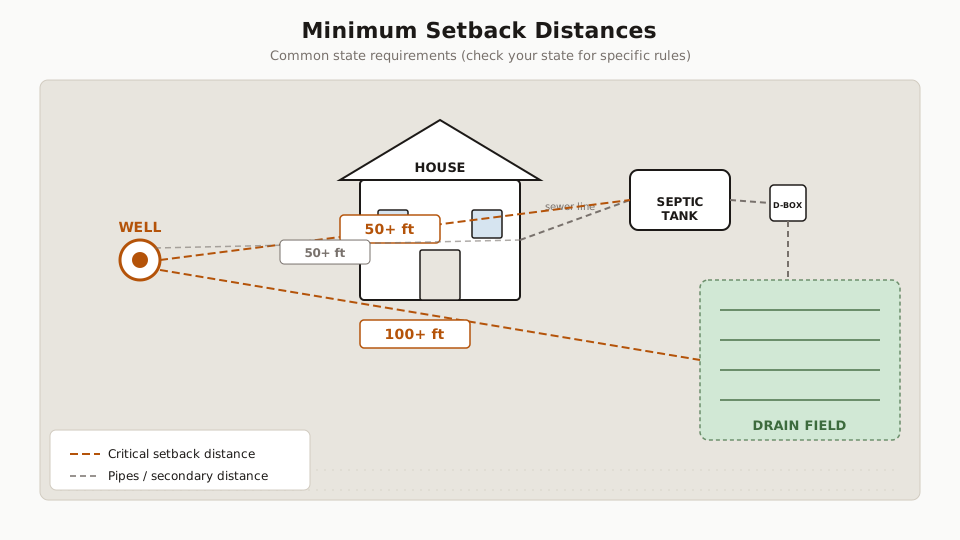
The most common state minimums:
| Component | Minimum distance from well | Notes |
|---|---|---|
| Septic tank | 50 feet | Some states require 75-100 feet |
| Drain field (leach field) | 100 feet | Higher risk — where effluent contacts soil |
| Distribution box | 100 feet | Usually same as drain field |
| Sewer line (house to tank) | 50 feet | The pipe connecting your house to the septic tank |
| Property line | 10-25 feet | Varies by county |
These are minimums. Several states go further:
- Montana requires 100 feet from well to septic tank and 100 feet to the drain field.
- North Carolina requires 100 feet between the well and any part of the septic system, and the well must be upslope from the drain field.
- Texas requires 50 feet to the tank and 100 feet to the drain field for standard systems.
- Michigan requires 50 feet to the tank and 50 feet to the absorption field, though many counties enforce stricter local rules.
How far should a well be from a septic tank? The short answer is at least 50 feet from the septic tank and 100 feet from the drain field. But that’s just the minimum in most states. If your soil is sandy, your water table is high, or your well is downslope from the drain field, those minimums may not provide enough protection. Some states and counties enforce stricter requirements based on local soil conditions and geology.
If your property was built before current codes took effect, you may be grandfathered in. Legal, but not necessarily safe. A well 35 feet from a drain field met 1970s code in some states, but it’s closer than any modern health department would approve. If you’re in this situation, test your water more often — every six months instead of annually — and test specifically for the contaminants that indicate septic influence (more on that below).
Warning
If you’re buying a property with a well and septic system, measure the distances before you close. Your home inspector may not check this. Pull up the septic system’s as-built diagram — your county health department should have it on file — and compare it against the well location. Discovering a setback violation after closing means relocating a well or a drain field. That starts at $5,000 and can exceed $30,000.
How septic contamination reaches your well
Contamination doesn’t tunnel through solid rock. It follows specific pathways, and knowing those pathways tells you what to look for.
Inadequate separation distance. The soil between your drain field and well doesn’t have enough depth or horizontal distance to filter the effluent. Sandy soils are the worst offenders — they drain fast and filter poorly. Clay soils filter better but can create saturated drain fields. Loam is the sweet spot for both filtration and drainage.
A failing septic system. When a tank hasn’t been pumped in a decade, the drain field is saturated, or roots have invaded the distribution pipes, untreated or partially treated sewage reaches your groundwater at concentrations the soil can’t handle. A properly functioning septic system produces relatively clean effluent. A failing one pushes something much closer to raw sewage into the ground.
Well casing defects. A cracked casing, a missing or damaged well cap, or an improperly grouted annular space (the gap between the casing and the drilled hole) can allow surface water to run down the outside of the casing and into your water supply. If your septic system sits upslope, surface runoff after heavy rain can carry contaminants straight to the wellhead. This pathway is the one you can fix yourself — inspect and replace a damaged cap, and make sure the ground slopes away from the casing. The spring inspection section of the well owner’s annual maintenance checklist walks through exactly how to do this.
Shared fracture zones in bedrock wells. Groundwater in bedrock moves through fractures, not through solid rock. If the same fracture network connects your drain field and your well’s water-bearing zone, contaminants can travel in hours or days instead of the months or years that soil filtration normally provides.
What water softener brine does to your septic system
If you have hard well water and a water softener, your softener’s regeneration cycle flushes salty brine water into your septic system. This is the most common concern for well-and-septic households, and the answer is more nuanced than the internet makes it sound.
The salt question. The claim that softener salt kills septic bacteria gets repeated everywhere. Research tells a different story. A study conducted by the Water Quality Association at the University of Wisconsin found that typical softener brine concentrations did not significantly inhibit septic system bacteria. The bacteria in a septic tank are more resilient to salt than most people assume.
There’s a caveat. If your softener is oversized, miscalibrated, or regenerating on a timer instead of actual demand, it dumps more brine than the study accounted for. A demand-initiated softener regenerates only when the resin is actually depleted — less brine per month than a timer-based unit running on a fixed schedule regardless of usage.
The hydraulic overload question. This is the bigger issue. When your softener regenerates, it can dump 40 to 80 gallons of water into your septic tank in a single cycle. That’s a surge that pushes effluent through the tank faster than normal, potentially flushing solids into the drain field before they’ve settled. Over years, this can clog drain field soil.
Practical tip
If your softener regenerates on a fixed timer (every three days whether it needs to or not), switch to a demand-initiated model that regenerates based on actual water usage. You’ll use less salt, less water, and your septic system will get smaller, less frequent brine dumps. If replacing the unit isn’t in the budget, set the timer to regenerate during low-use hours — early morning works best — so the brine discharge doesn’t compete with peak household water use for tank capacity.
Iron filter backwash and your drain field
Iron filters that use oxidation media — birm, catalox, greensand — need periodic backwashing to flush accumulated iron and manganese particles out of the filter bed. That backwash water goes wherever your filter drain line goes, which in most well-and-septic homes means the septic system.
The issue isn’t chemical. Iron won’t poison your septic bacteria. The issue is physical. Oxidized iron particles are dense and don’t break down biologically. Over years, they accumulate in the bottom of your septic tank as inert sludge, reducing the tank’s effective volume and forcing more frequent pumping. If the particles make it past the tank and into the drain field, they can contribute to biomat buildup — the biological and mineral layer that clogs drain field soil over time.
Some homeowners route iron filter backwash to a separate dry well instead of the septic system. A dry well for this purpose is a gravel-filled pit that costs a few hundred dollars to install and eliminates the issue entirely. Check your local codes first — some counties regulate where you can discharge filter backwash.
Water volume matters more than you think
Every gallon that goes down a drain ends up in the septic tank. The more water you push through the system, the less time solids have to settle, and the more effluent your drain field has to absorb.
The EPA estimates that the average American uses 82 gallons of water per day at home. For a family of four, that’s 328 gallons per day flowing into a septic tank that might hold 1,000 gallons total. The tank’s job is to hold wastewater long enough for solids to settle — 24 to 48 hours of retention time. Heavy water usage cuts that retention time and pushes partially treated effluent into the drain field.
This is where your well and septic systems create a feedback loop nobody talks about. High-efficiency fixtures don’t just save water. They extend your septic system’s life and reduce the chance that poorly treated effluent reaches your groundwater. A high-efficiency toilet uses 1.28 gallons per flush versus an older model’s 3.5 to 5 gallons. Over a year, for a family of four, that’s thousands of fewer gallons hitting your septic tank.
Fix running toilets immediately. A single running toilet can dump 200 gallons per day into your septic system — a constant, invisible hydraulic overload that overwhelms the settling process and your drain field’s absorption capacity.
What to test for (and how often)
If you have a well and a septic system on the same property, your annual water test should go beyond the standard panel. You need specific indicators of septic influence.
Test annually for:
- Total coliform bacteria and E. coli. The primary indicators of fecal contamination. Any positive E. coli result means there’s a direct pathway from a waste source to your water supply. Don’t wait on this — act immediately.
- Nitrates. Septic effluent is high in nitrogen compounds that convert to nitrate in soil. The EPA maximum contaminant level is 10 mg/L. Levels between 3 and 10 mg/L in a well near a septic system should be watched closely. They suggest some septic influence even if you’re below the legal limit.
- Nitrites. Elevated nitrites can indicate fresh contamination that hasn’t fully converted to nitrate yet. A spike suggests a more recent or closer contamination source.
Test every 3-5 years for:
- Pharmaceutical and personal care product compounds. Labs like Tap Score and SimpleLab offer these as add-on panels. Detectable levels of caffeine, acetaminophen, or other common household compounds in your well water are a strong indicator of septic influence — they’re present in household wastewater and aren’t fully removed by soil filtration.
Test immediately if:
- Your septic system backs up, overflows, or shows signs of failure (wet spots over the drain field, sewage odors in the yard, unusually green grass in lines over the drain field)
- Flooding reaches your wellhead
- Your water suddenly tastes or smells different, especially after heavy rain
Practical tip
When you test your well water, take the sample from the tap closest to where the well line enters your house — before it passes through any treatment equipment. You want to know what’s in the raw water, not what’s left after your filter and softener have had a pass at it. That untreated sample tells you whether your septic system is influencing your well.
The shared maintenance calendar
Your well and septic system belong on the same maintenance schedule. When you do your annual well maintenance, add septic to the checklist:
- Every 3-5 years: Have your septic tank pumped. EPA recommends this range for a typical household. If you have a water softener or iron filter discharging into the system, lean toward every 3 years.
- Every spring: Walk your drain field. Look for wet spots, sewage odors, or suspiciously green grass growing in lines over the pipes. Grass loves nitrogen-rich effluent, so a bright green stripe over your drain field means something is surfacing.
- After every pump-out: Ask the pumper about sludge levels. If you’re exceeding 30% solids at the three-year mark, you’re either overdue for pumping or you’re putting too much water through the system.
The well and the septic system are two halves of the same water cycle on your property. Keep them far apart, give them both regular attention, and test the water that comes back from the ground. That’s the whole strategy.
If you don’t have your seasonal maintenance schedule set up yet, the annual maintenance checklist covers the well side of it. If your well and septic are closer than you’d like, make sure your well casing height meets code — a short casing near a septic system is one of the worst combinations for contamination risk. And if your water test turns up contaminants, the filtration guide matches each problem to the right treatment.
If you’re buying or selling a home with both a well and septic system, the inspection process is more involved than a standard home sale. The well-to-septic distance, system condition, and water test results all become negotiation points. We’ll cover that in a future guide on buying and selling homes with private wells.
Related guides
Understanding your well system: pumps, pressure tanks, and the hardware that keeps water flowing
A plain-English technical reference for every major component in a residential well system, from the submersible pump at the bottom to the pressure switch on the wall, with realistic lifespans, costs, and what you can fix yourself.
14 min read
The beauty guide for well owners: hair, skin & laundry
Hardness, iron, manganese, and copper can wreck hair, irritate skin, and stain laundry. This guide shows how to tell which one is hitting your house and what actually fixes it.
12 min read
Arsenic in well water: health risks and removal methods
Arsenic in well water is invisible and tasteless. Here's what 10 micrograms per liter means, why arsenic III vs. V matters, and which treatment methods actually work.
9 min read