Septic tank additives for well owners: which ones work (and which are a waste)
Updated February 14, 2026 — 7 min read
Most septic tank additives don’t work. The EPA, University of Minnesota, Kansas State, and Washington State have all studied them, and the conclusion is consistent: biological additives provide no measurable benefit to a healthy septic system. Chemical additives are worse — they can kill the bacteria your system depends on and contaminate your well water. The real maintenance that prevents $3,000 to $15,000 drainfield failures is regular pumping, not a $10 monthly product.
That’s the short answer. The longer answer involves some nuance — particularly for well owners who are also running water softeners or iron filters that discharge into the septic system. Here’s what the research actually says and where the money is better spent.
If you’re looking for the broader picture on how your well and septic systems interact, the well-to-septic guide covers setback distances, contamination pathways, and the maintenance overlap between the two systems.
What the research says
The University of Minnesota ran the most rigorous study on this. They tested 48 septic tanks in a double-blind, 12-month field study, measuring sludge accumulation and bacterial populations quarterly. They tested RID-X, Liquid-Plumr, and a control group that got nothing.
The result: “No significant, positive long-term additive treatment effects occurred across all maintenance levels.” The bacterial populations in treated tanks were statistically identical to the untreated control. The additives didn’t reduce sludge, didn’t boost bacteria, and didn’t change anything measurable.
Kansas State found the same thing. Purdue found the same thing. The EPA updated its Septic Tank Additives Fact Sheet in September 2024 and stated it plainly: “Commercially available microbiological and enzyme additives are not necessary for a septic system to function properly when treating domestic wastewater.”
The reason is simple biology. A healthy septic tank already contains billions of anaerobic bacteria. They arrive with every flush. The EPA points out that adding more bacteria “creates conditions in which bacterial populations compete against each other, which can do more harm than good.”
The three types of additives (and which ones are dangerous)
Not all additives are created equal. There are three categories, and two of them can actively damage your system.
Chemical additives (strong acids and alkalis) are similar to drain cleaners. They’ll unclog a pipe, but they’ll also sterilize your septic tank for days, killing the bacteria that break down waste. When the bacteria die, raw sewage flows straight to your drainfield. They can also corrode concrete tanks. These are the worst products you can put in your system.
Organic solvents are marketed as grease removers. They destroy bacteria and contaminate groundwater. Multiple states have banned them. The EPA warns that organic solvents “pose a potential threat to soil structure and groundwater.” If you’re on a private well, that groundwater is your drinking water.
Biological additives (bacteria and enzymes) are what most people think of when they hear “septic additive” — products like RID-X, Green Gobbler, Cabin Obsession, and Bio-Clean. These contain bacterial cultures and enzymes (cellulase, lipase, protease, amylase) marketed as system boosters. They’re not harmful. They’re just unnecessary. The amount of bacteria in a dose of RID-X is insignificant compared to the billions already in your tank from normal use.
One concern that researchers have flagged: enzyme additives may break down solids too aggressively, creating finer suspended particles that are more likely to float out of the tank and clog your drainfield. That’s the opposite of what you want.
What you’re actually spending
| Product | Annual cost |
|---|---|
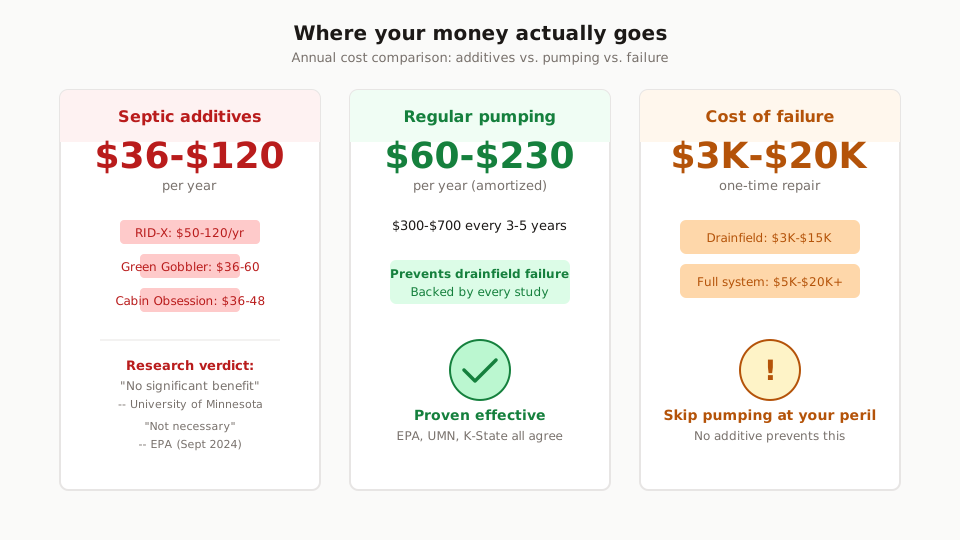
| RID-X | $50-$120 |
| Green Gobbler | $36-$60 |
| Cabin Obsession | $36-$48 |
| Roebic K-37 | $12-$36 |
| Bio-Clean | ~$50 |
That’s $36 to $120 per year on products that peer-reviewed research says do nothing for a healthy system.
For comparison, a septic pumping costs $300 to $700 every three to five years. Amortized, that’s $60 to $230 per year — and pumping actually prevents drainfield failure. A drainfield replacement runs $3,000 to $15,000. A complete system replacement can hit $20,000.
The math is obvious. Spend the money on pumping.
The one scenario where an additive might make sense
There’s a narrow exception. If your septic tank’s bacterial population has been genuinely disrupted — not just theoretically threatened, but actually killed off — reintroducing bacteria could speed recovery.
This can happen after prolonged antibiotic use by a household member (weeks to months, not a single course), after accidentally dumping large quantities of bleach or antibacterial cleaners into the system, or after shock chlorinating your well if significant chlorinated water enters the septic tank.
But even here, the system will recover on its own within days to weeks from the bacteria arriving in normal wastewater. An additive might speed that recovery marginally. No research has demonstrated that it produces measurably better outcomes than simply waiting.
If you’re shock chlorinating your well
Don’t run more than 100 gallons of chlorinated water into the septic system. When flushing chlorine from your plumbing after a well shock, run the first flush through an outdoor hose onto the ground (away from the septic system, streams, and ponds). This protects your septic bacteria while clearing the chlorine from your water lines.
The real concern for well owners: what you’re discharging
If you have a water softener or an iron filter discharging backwash into your septic system, that’s worth more attention than any additive.
Water softener brine creates two problems. First, the salt doesn’t kill septic bacteria — an NSF study found that brine discharge didn’t harm bacterial populations, and bacteria may actually prefer slightly saline conditions over very hard water. But the brine does disrupt settling. Salt water changes the way solids separate in the tank, which can send suspended solids into your drainfield and cause premature clogging. Second, salt corrodes concrete tanks over time, shortening the tank’s lifespan.
Iron filter backwash is generally safe for septic systems. The exception is greensand filters that use potassium permanganate for regeneration. A properly adjusted system produces dilute concentrations that won’t harm septic bacteria. But a concentrated slug of permanganate — from an over-dosed system or a maintenance error — can kill bacteria and damage soil biology in the drainfield.
The best practice for either: if your property layout allows it, route water treatment backwash to a separate drywell instead of the septic system. This eliminates the risk entirely. If a separate drywell isn’t practical, make sure your softener uses demand-initiated regeneration (regenerates only when needed, not on a timer) and your iron filter isn’t over-dosing its regenerant.
The well-to-septic guide covers the full picture on how water treatment discharge affects your septic system, including the softener brine question in more detail.
States that regulate additives
Washington State has the strictest rules. Since 1996, it’s been illegal to sell or use septic additives that haven’t been reviewed by the Department of Health. But even Washington’s approval only means the ingredients are “unlikely to cause harm” — it’s explicitly “not an endorsement” of whether the product works.
Massachusetts regulates additives under Title 5 and maintains an approved list. Florida requires manufacturers to submit toxicity testing data and issues letters of “no objection” (not approval). Multiple states ban organic solvents for septic use.
No state requires homeowners to use additives.
What actually prevents septic failure
Pump on schedule. Every three to five years for a typical household (two to four people, 1,000-gallon tank). Smaller households can go five to seven years. Larger families or smaller tanks may need pumping every two to three years. Budget $300 to $700 per pumping. This is the single most effective thing you can do.
Get inspections. The EPA recommends every one to three years. An inspector measures sludge and scum layers, checks for leaks, verifies baffles, and tests drain flow. Budget $250 to $500.
Watch what goes in. Don’t flush wipes, feminine products, or grease. Minimize antibacterial soaps and bleach. Don’t pour paint, solvents, or medications down the drain.
Protect the drainfield. Don’t drive or park on it. Don’t plant trees near it. Divert roof drains and surface water away from it. Spread laundry loads across the week instead of running six loads on Saturday.
Your well delivers your drinking water. Your septic system processes your waste 50 to 200 feet from where that water comes from. Keeping both systems healthy isn’t about buying products — it’s about understanding how they work and maintaining them on a schedule.
The annual maintenance checklist covers the well side of that schedule. For the septic side, call your pumper, get on a three-to-five-year rotation, and put the $120 a year you would have spent on RID-X toward the pumping bill instead.
Related guides
Do Well Water Filters Remove PFAS? What Actually Works
A practical, evidence-led guide to PFAS filtration for private wells: test first, choose a certified technology, size it correctly, and retest the water.
7 min read
Why does my well water smell like rotten eggs? (and how to fix it)
Hydrogen sulfide causes that rotten egg smell in well water. Here's how to diagnose whether it's sulfur bacteria, your water heater anode rod, or your well itself -- and the treatment that actually fixes each one.
10 min read
Well water problems: troubleshooting no water, low pressure, rotten egg smell, and more
A diagnostic flowchart for every common well water symptom -- no water, low pressure, sputtering, brown water, sulfur smell (rotten eggs), and cycling pumps -- with step-by-step triage to identify whether it's the pump, tank, switch, or well itself.
12 min read