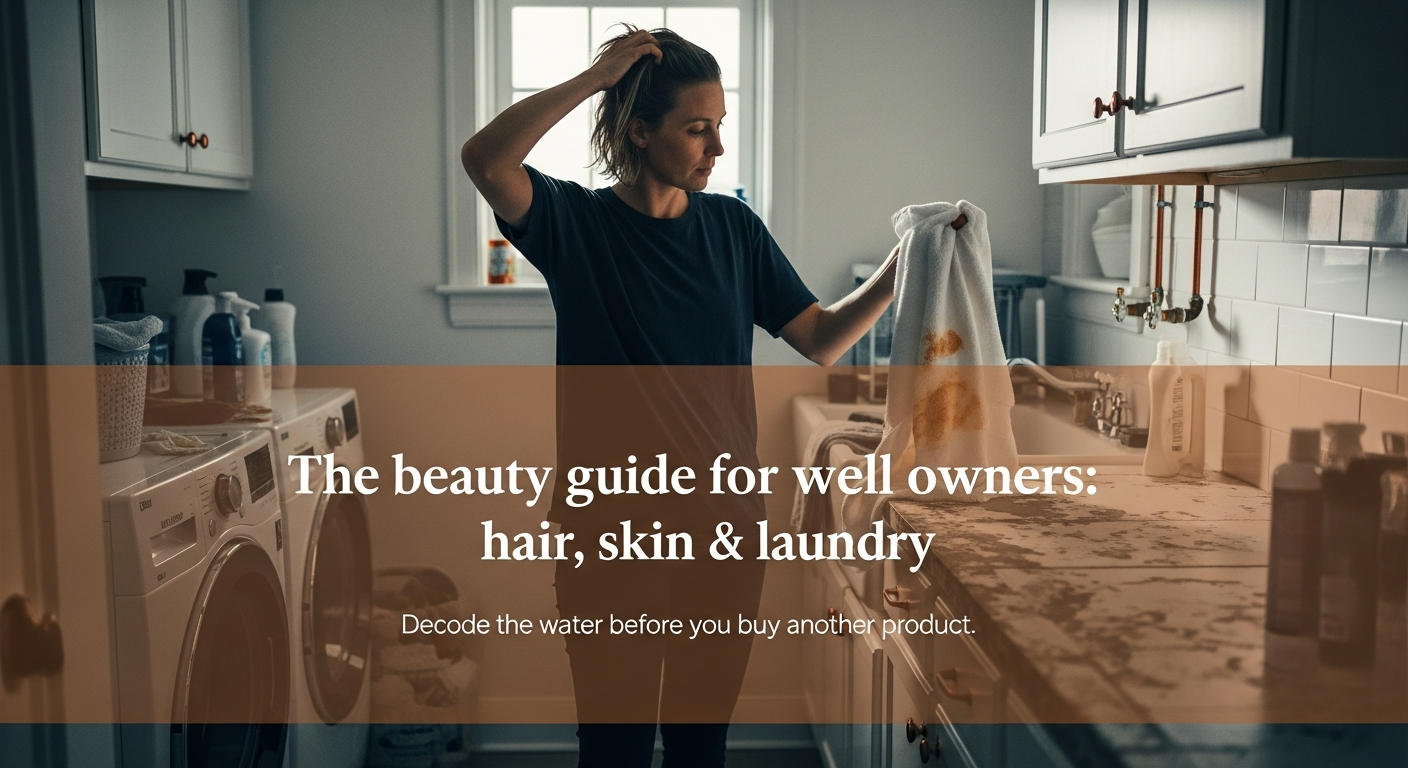
The beauty guide for well owners: hair, skin & laundry
Updated May 13, 2026 — 12 min read
Well water beauty problems usually are not beauty problems. They are water chemistry problems. Hardness leaves a mineral film on hair and skin, iron stains towels and white shirts orange, and acidic water can pull copper into the water until blonde hair turns green. The bottle on your shower shelf might manage the symptom. It will not fix the water.
I learned that the expensive way. I rotated shampoos, body washes, and stain removers for months before a lab report showed the real pattern: hard water, measurable iron, and pH low enough to start teasing copper out of the plumbing. Once I had the numbers, the mess finally made sense.
Key takeaway
If your hair feels like straw, your eczema flares after showers, or your white towels keep turning orange, start with a lab test for hardness, iron, manganese, pH, and copper. Those five numbers tell you whether you need a softener, an iron filter, an acid neutralizer, or just a better maintenance routine while you save up for the whole-house fix.
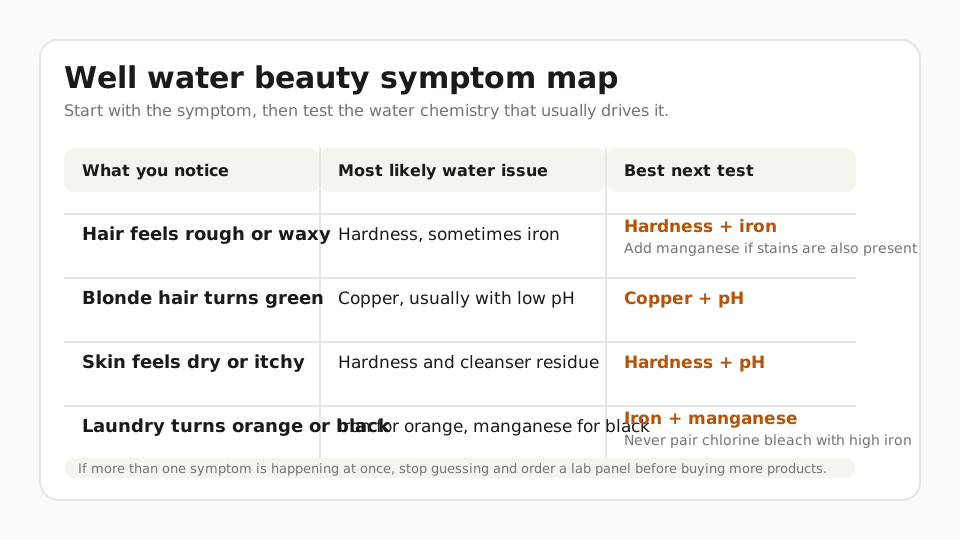
The fast symptom map
| What you notice | Most likely culprit | What helps this week | What fixes it long term |
|---|---|---|---|
| Hair feels rough, waxy, or impossible to condition | Hardness, sometimes iron | Chelating shampoo, citric acid rinse | Water softener, plus iron treatment if needed |
| Blonde or gray hair turns green | Copper, usually from acidic water | Vitamin C or Malibu C treatment | Raise pH and stop the copper source |
| Skin feels tight, itchy, or eczema flares after showers | Hardness and soap residue | Shorter lukewarm showers, syndet cleanser, thick moisturizer | Salt-based softener |
| White laundry turns yellow or orange | Iron | Stop using chlorine bleach, use Iron Out or citric acid | Iron filter, or a softener for low iron |
| Black or charcoal smudges on fabric and fixtures | Manganese | Stain treatment and retest | Manganese-capable oxidizing filter |
What the water is actually doing
Hardness coats hair and skin
Hard water is mostly calcium and magnesium. On paper that sounds harmless. In a shower, those minerals react with cleansers and leave a film behind.
That film is why hair starts feeling heavy, rough, or weirdly sticky even when it is technically clean. The research here is more nuanced than internet scare posts make it sound. A 2013 International Journal of Trichology study did not find a statistically significant drop in tensile strength after 30 days of washing hair in moderately hard water. But scanning electron microscopy work showed calcium and magnesium do accumulate on the hair shaft, and a later trichology study found hard water reduced hair strength and increased breakage. The practical takeaway is simple: not every hard-water household wrecks hair overnight, but mineral buildup is real, and once it builds up enough you feel it.
Skin gets hit too. A 2018 Journal of Investigative Dermatology study found that washing with hard water left more surfactant residue on skin, increased transepidermal water loss, and caused more irritation, especially in people with atopic dermatitis and filaggrin-related barrier problems. When the water was softened by ion exchange, that extra irritation dropped off.
If your symptoms are “my hair never feels soft” and “my skin feels squeaky, dry, or itchy after every shower,” hardness is suspect number one.
Iron and manganese stain anything porous
Iron and manganese are classic well-water nuisance contaminants. Penn State Extension notes that water with dissolved iron can look clear at first and then turn orange-brown as it hits oxygen. That is why a load of whites can come out of the washer with a yellow tint even though the tap water did not look rusty going in.
Iron is the laundry killer most people notice first. The EPA secondary standard is 0.3 mg/L, and the University of Georgia Extension says staining is likely at about that level. Manganese starts causing black or dark gray staining around 0.05 mg/L. Those are aesthetic thresholds, not health emergencies, but they are high enough to ruin towels, pillowcases, toilet bowls, and sometimes light hair.
One more thing that catches people off guard: chlorine bleach and iron are a terrible combination. UGA’s laundry guidance is blunt on this point. High-iron water plus chlorine bleach can permanently stain laundry. If your whites keep getting more orange after you “treat” them, stop bleaching them.
Low pH turns copper into a hair problem
When blonde hair turns green, people blame chlorine because that is the pool story everyone knows. On well water, copper is the usual culprit.
The copper often does not come from the aquifer itself. It comes from acidic water slowly dissolving copper plumbing, brass fittings, or pump components. Blue-green stains on sinks or tubs are the clue most people miss. If you have those stains plus blonde hair going dull or green, do not keep buying purple shampoo and hoping for a miracle. Check pH and copper.
This is one of those problems that feels cosmetic until it is not. If the water is corrosive enough to color hair, it is also chewing at your plumbing.
Sulfur and slime are side issues, but they matter
Rotten egg odor, black slime, and oily-looking films are not “beauty” issues in the usual sense, but they often show up in the same houses. They make hair smell off, leave residue on the scalp, and add one more thing your skin has to deal with.
If your shower water smells like sulfur, or if you are wiping black slime off fixtures, route that problem through the rotten egg guide and the iron bacteria filter guide. Do not assume a nicer shampoo is going to solve a bacterial or sulfur problem.
What each symptom usually means
Hair that feels like straw
If hair feels rough, tangles more easily, or stops responding to conditioner, think hardness first and iron second. That is especially true if faucets also spot up quickly or soap refuses to lather well. The full breakdown is in Is well water ruining your hair?, and if you want product-level triage while you figure the water out, the best shampoos for hard well water guide covers the chelating shampoos that actually do something.
My rule of thumb is this: if a clarifying shampoo helps for one wash and then the problem is right back, the water is winning.
Blonde hair that turns green
This one is more specific. Green or blue-green tint on blonde, gray, or highlighted hair points to copper far more often than hardness. The detailed fix is in Why well water turns blonde hair green, but the short version is strip the copper off the hair now, then find out whether low pH is pulling copper from the plumbing.
If your first-draw water sample shows more copper than a sample taken after running the tap for a couple of minutes, that is a strong sign the plumbing is the source.
Skin that feels dry, tight, or angry after every shower
Some of this is normal winter skin. Some of it is not. If showers consistently make your skin feel worse, and eczema flares cluster around heavy shower days, hardness belongs on your shortlist. Well water and eczema: the hard water connection goes deep on the skin-barrier side of this.
The same houses that struggle with rough hair often struggle with itchy skin because the underlying problem is the same mineral film plus cleanser residue. Different symptom, same chemistry.
Towels and sheets that never look clean
Orange or yellowed whites point to iron. Black or inky gray marks point to manganese. If the stains mostly show up when the softener runs out of salt, that tells you something too.
Real homeowners describe this exactly the way you would expect on forums. On Garage Journal, one poster dealing with high-iron well water described orange underwear and socks showing up whenever the softener ran low. That is more useful than any ad copy from a filter company because it captures the real-world pattern: the problem is not random, and it tracks with treatment performance.
If laundry is your pain point, go straight to Removing orange iron stains from white laundry. It will save you a pile of ruined towels.
Start with the right panel
The CDC says private well owners should test at least once a year for total coliform bacteria, nitrates, total dissolved solids, and pH. For hair, skin, and laundry complaints, add hardness, iron, manganese, and copper. The testing guide walks through lab options and sample collection.
What to test before you buy anything
If you are dealing with beauty or laundry symptoms, these are the five numbers that matter most:
| Parameter | Why it matters | When it usually starts showing up in daily life |
|---|---|---|
| Hardness | Mineral film on hair and skin, poor soap performance, scale | Complaints often start above 7 gpg (about 120 mg/L) |
| Iron | Orange stains on fabric, fixtures, and sometimes light hair | Staining often starts around 0.3 mg/L |
| Manganese | Black or charcoal staining, dingy laundry | Trouble often starts around 0.05 mg/L |
| pH | Low pH makes water corrosive and pulls metals from plumbing | Below 7.0 is where copper and corrosion questions get louder |
| Copper | Green hair, blue-green staining, metallic taste | Cosmetic trouble can show up below the EPA action level |
Hydrogen sulfide belongs on the list too if there is odor. Any detectable rotten egg smell is worth chasing because it changes how the water feels and how treatment should be sequenced.
Do not skip the lab test because you “already know” the water is hard. Hardness is often only part of the story. A softener will not fix copper corrosion. A shower filter will not solve iron stains. An iron filter will not solve tannins or low pH. The water test stops you from buying the wrong answer.
What helps right now and what actually solves it
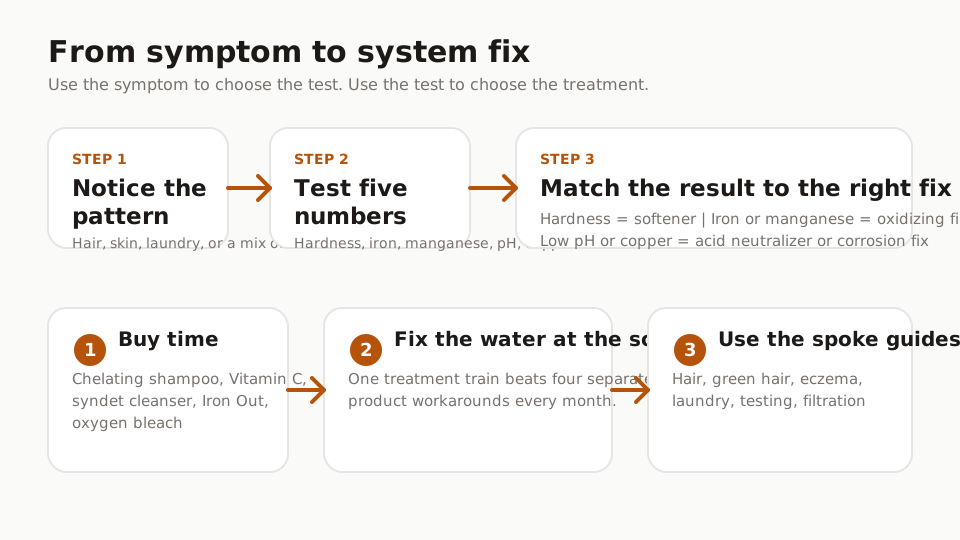
Temporary fixes that buy you time
These are worth using while you figure the water out:
- Chelating shampoo if hair feels coated or stiff
- Vitamin C or Malibu C if blonde hair already picked up a green cast
- Syndet cleanser, shorter lukewarm showers, and heavy moisturizer for irritated skin
- Iron Out, citric acid, or lemon juice treatments for stained whites
- Oxygen bleach instead of chlorine bleach for laundry in iron-prone water
Those are good management tools. I use them. They just are not the end of the story.
Whole-house fixes that stop the cycle
If the same water is messing with your shower, your skin, your laundry, and your fixtures, treat the water instead of treating four symptoms separately.
- Salt-based softener: the right answer for hardness. Not TAC. Not a salt-free conditioner. If the goal is softer hair, happier skin, and fewer spots on everything, you need ion exchange that actually removes calcium and magnesium.
- Iron or manganese filter: the right answer when staining persists or the numbers are too high for a softener alone.
- Acid neutralizer: the right answer when low pH is dissolving copper or eating plumbing.
- A proper treatment train: the filtration guide matters here because order matters. Iron ahead of the softener. Neutralization before copper-corrosion symptoms turn into pipe problems. Sulfur and bacteria handled with the right oxidizing or disinfection step.
This is also where I get opinionated. Most shower filters sold to hard-water households are chlorine products wearing a hard-water costume. If your problem is calcium, magnesium, iron, or copper, a trendy shower head filter is a Band-Aid at best and marketing at worst.
When the whole-house fix is worth the money
Stop buying one-off workarounds and start planning a system fix if any of these are true:
- Your hardness is above 7 gpg and both hair and skin are complaining
- Iron is above 0.3 mg/L and you are seeing orange stains on fixtures or laundry
- Manganese is above 0.05 mg/L and the stains are dark gray or black
- pH is low, blue-green stains are appearing, or blonde hair keeps turning green
- More than one symptom category is happening at once
That is the moment where the math changes. A softener or filter system may feel expensive up front, but so is replacing towels, buying specialty shampoos, running stain rescue loads, and staying annoyed all year.
For brand-level shopping, the Aquasana vs. SpringWell vs. Culligan comparison is useful after you know your water numbers. Not before.
Where to go next
Use this guide as the hub, then jump to the spoke that matches your real problem:
- Hair feels dry, rough, or heavy: Is well water ruining your hair?
- You need a product fix while you save for treatment: 5 best shampoos for hard well water
- Blonde or gray hair is turning green: Why well water turns blonde hair green
- Skin is flaring after showers: Well water and eczema: the hard water connection
- Whites and towels are turning orange: Removing orange iron stains from white laundry
- You are ready to diagnose the water itself: The ultimate guide to testing your well water
- You are ready to spec equipment: How to choose the right filtration system for your well water
Your next move is to order the water test, not another beauty product. Once you know your hardness, iron, manganese, pH, and copper numbers, the right fix gets a lot less mysterious.
Related guides

Understanding your well system: pumps, pressure tanks, and the hardware that keeps water flowing
A plain-English technical reference for every major component in a residential well system, from the submersible pump at the bottom to the pressure switch on the wall, with realistic lifespans, costs, and what you can fix yourself.
14 min read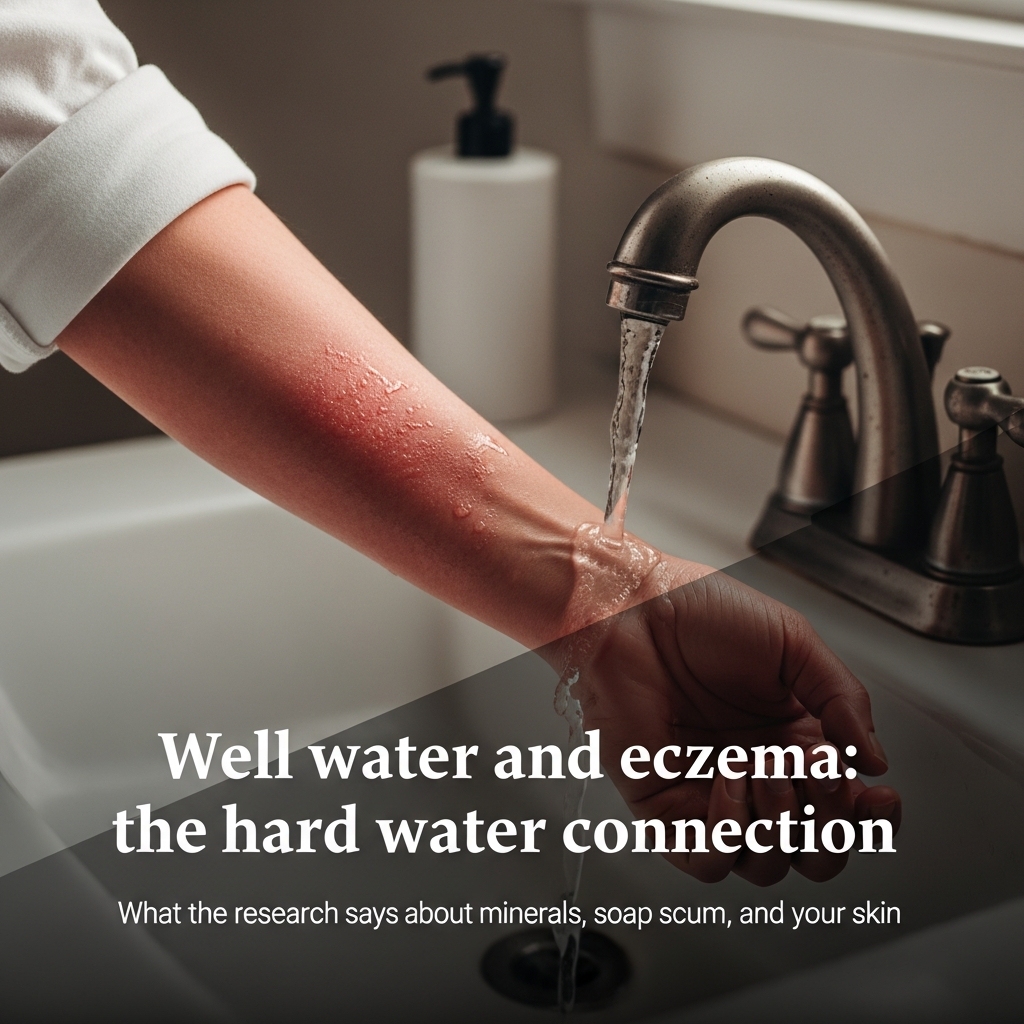
Well water and eczema: the hard water connection
Hard well water leaves soap residue on your skin that damages the barrier, increases moisture loss, and triggers eczema flare-ups. Here's the science and what actually fixes it.
9 min read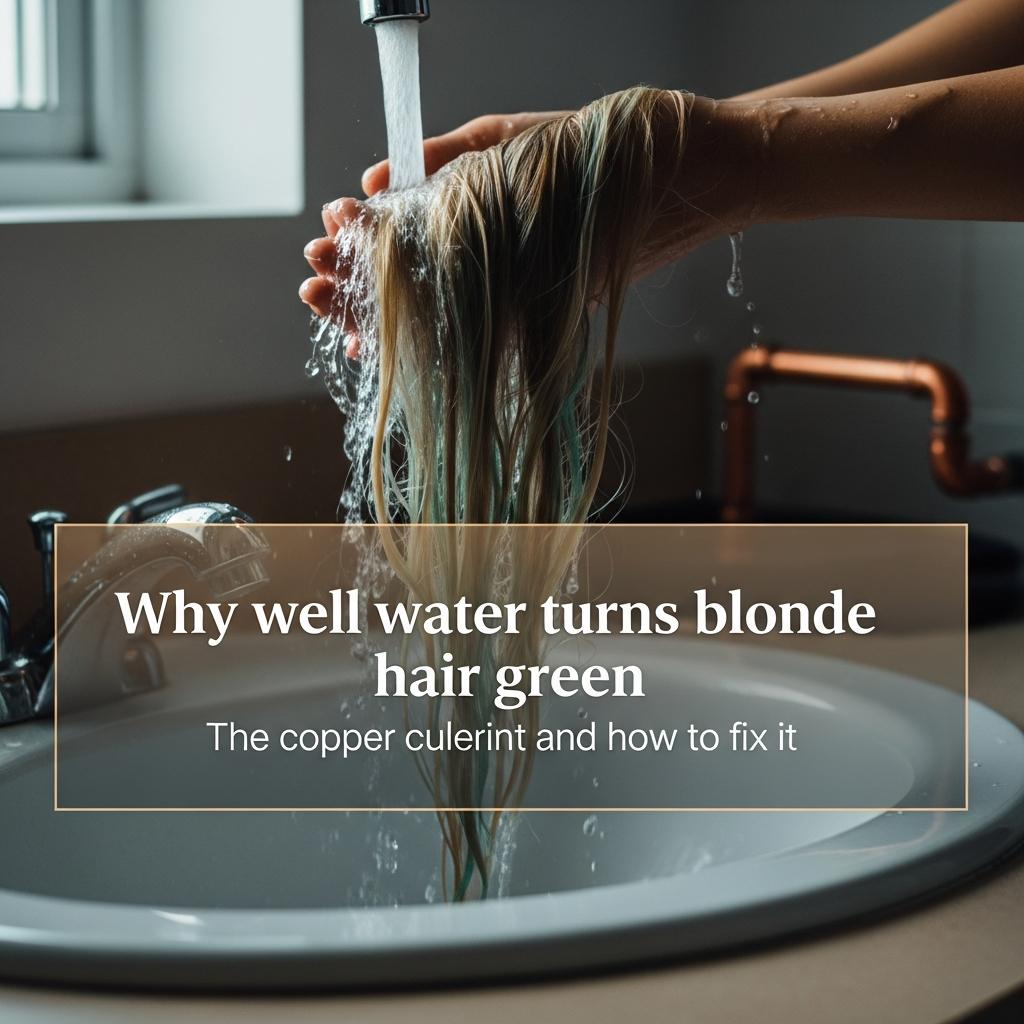
Why well water turns blonde hair green (and how to fix it)
Copper in well water bonds to bleached and blonde hair, turning it green. Here's the science behind it, how to strip the green out, and how to stop it from coming back.
9 min read