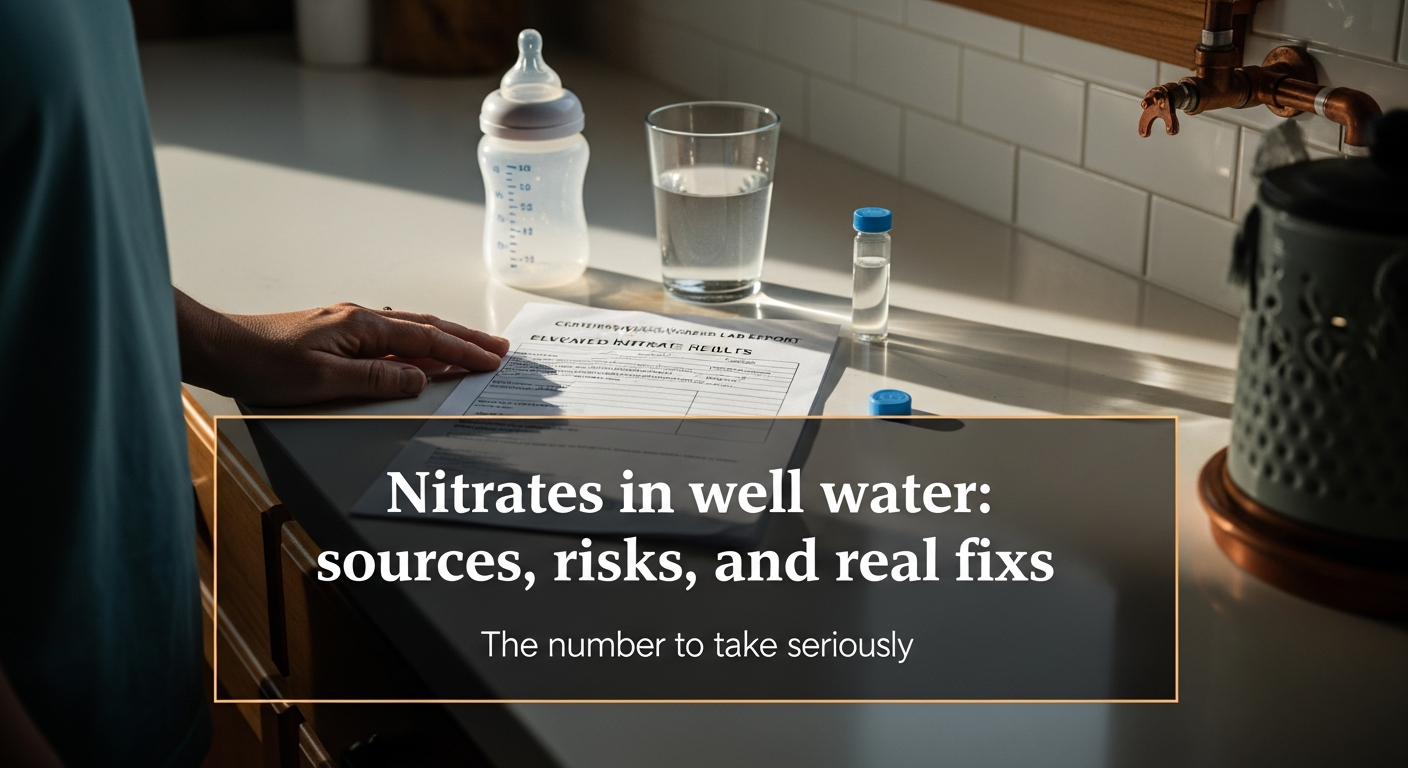
Nitrates in well water: sources, risks, and real fixes
Updated April 1, 2026 — 9 min read
Nitrates in well water usually come from fertilizer, manure, septic leakage, or shallow groundwater that is too connected to the surface. If your lab report shows nitrate above 10 mg/L as nitrogen, stop using that water for drinking, cooking, and infant formula until you have a safe-water plan. The fix for most homes is either an under-sink reverse osmosis unit or a nitrate-specific anion exchange system, but the first move is always the same: confirm the number with a certified lab and inspect the well for the contamination pathway.
Key takeaway
Nitrate is the contaminant that fools people because the water still looks and tastes normal. Boiling does not remove it. A standard softener does not remove it. And if there is a baby in the house, you do not wait around hoping the next test comes back lower.
Why nitrate is a bigger deal than it looks
Iron announces itself. Sulfur stinks. Tannins turn the water the color of weak tea. Nitrate does none of that.
It is colorless, odorless, and tasteless, which is why people usually find it only after a home inspection, a county lab panel, or a baby on the way finally pushes testing to the top of the list. The Minnesota Department of Health notes that the EPA drinking water standard is 10 mg/L measured as nitrogen. That number exists to protect infants from methemoglobinemia, the oxygen-starvation problem better known as “blue baby syndrome.”
If there is a bottle-fed baby under six months old in the house, nitrate stops being an abstract water-quality discussion and turns into a same-day problem. And because private wells are not regulated the way public systems are, nobody is monitoring that risk for you.
Where nitrate usually comes from
This is the part most lab reports do not explain well enough.
Nitrate moves through soil easily. It does not stick around near the surface the way people assume. The Oregon State Extension well water guide puts it plainly: when there is more nitrogen in the soil than plants can use, water carries the extra downward until it reaches groundwater.
In real houses, the usual suspects are:
- Row-crop fertilizer or heavily fertilized lawns uphill from the well
- Livestock manure, feedlots, or horse facilities
- Septic systems and leach fields
- A shallow well, dug well, or damaged casing that lets surface water influence the aquifer
The USGS has found that nitrate problems are most common in shallow domestic wells in agricultural areas, especially where fertilizer use, septic systems, and livestock all stack on top of each other. That tracks with what well owners describe on homeowner forums too. The pattern is always the same: “The water looks fine. The house has always used this well. Then the lab says nitrate is 12 or 18 and suddenly everybody is scrambling.”
One useful rule of thumb from Minnesota health guidance: nitrate below about 3 mg/L can be natural in groundwater, but once numbers climb above that, a human-made contamination source is usually in the picture. That does not tell you which source. It tells you to stop pretending there is no source.
How to read the lab result without getting tripped up by units
Nitrate reports confuse people because labs do not always use the same wording.
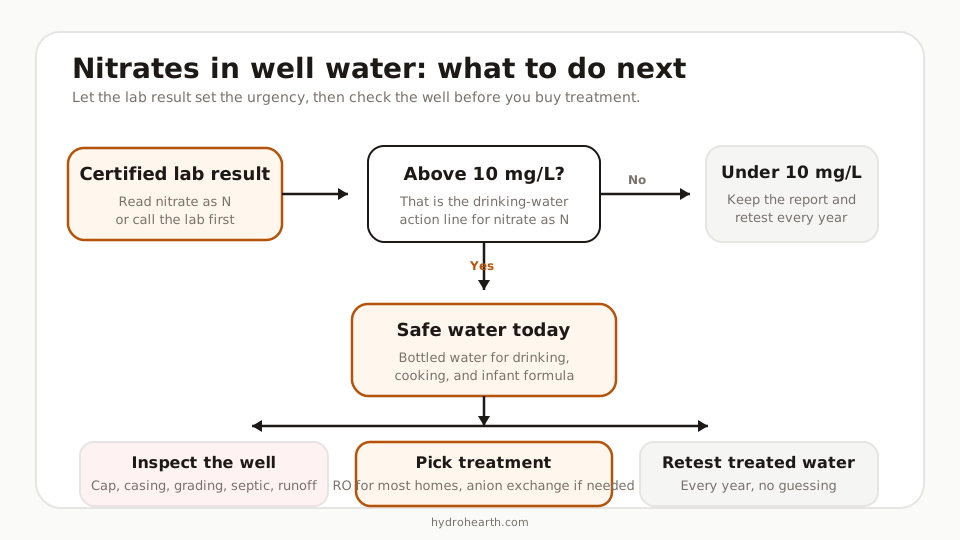
Most labs report nitrate as nitrogen. That is the one tied to the federal drinking water limit:
- Nitrate as nitrogen (NO3-N): 10 mg/L is the action line
- Nitrite as nitrogen (NO2-N): 1 mg/L is the separate nitrite limit
- Nitrate as nitrate (NO3): 45 mg/L is the same threshold expressed in a different unit
If your report says “nitrate-nitrogen,” “nitrate as N,” or “NO3-N,” use the 10 mg/L benchmark. If it says just “nitrate” with no “as N,” look for the lab notes or call them before you panic. A lot of confusion comes from people comparing 12 mg/L “as nitrate” to a 10 mg/L “as nitrogen” standard. Those are not apples to apples.
What to do if the result is over 10 mg/L
Keep this simple.
Use a safe alternate source for drinking and cooking right now. Bottled water is fine. Hauled water is fine if you know it is from a safe source. What is not fine is continuing to mix infant formula with contaminated well water because you have not picked a filter yet.
And do not boil it. The Minnesota Department of Health is explicit on this: boiling makes nitrate more concentrated, not less.
Then do three things in order:
- Confirm the number with a certified lab if the first result came from a strip, a sales test, or an old report.
- Inspect the well and the property for the source. Think casing defects, a bad well cap, standing water around the casing, nearby manure handling, or a septic field too close to the well.
- Run a broader panel if you have not already. Nitrate problems often travel with bacteria risk or broader surface-water influence. The ultimate guide to testing your well water covers what to order and how to collect the sample without ruining it.
If you are in a real-estate deal and nitrate comes back high, do not treat it like a small nuisance item. It is a repair-credit or well-rehab conversation. The private well inspection checklist covers how to handle that before closing instead of inheriting the mess.
Related
If nitrate is high and you also have coliform or E. coli, you may be looking at a broader surface-water or septic contamination problem. Start with the coliform guide after you lock down safe drinking water.
The treatment options that actually remove nitrate
Homeowner forums are full of people discovering this the expensive way: a hardness softener is not a nitrate system, and a carbon pitcher is definitely not a nitrate system.
These are the treatment methods worth talking about.
1. Point-of-use reverse osmosis
For most houses, this is the cleanest answer. You put a certified RO unit under the kitchen sink and use it for drinking, cooking, coffee, and formula water. You do not need whole-house nitrate treatment just to flush toilets and take showers.
Why RO works:
- It removes nitrate at the tap where the health exposure actually happens
- It usually costs less than whole-house nitrate treatment
- It also helps with other dissolved contaminants like arsenic and PFAS
What to watch:
- Buy a unit certified for nitrate or nitrite reduction, not just taste and odor
- Check the NSF treatment standards and look for the specific reduction claim, usually on systems built to NSF/ANSI 58
- Retest the treated water yearly, because membranes and cartridges do not last forever
2. Nitrate-specific anion exchange
This is the whole-house option when nitrate is high enough, persistent enough, or important enough that you want every drinking tap protected without adding RO units around the house.
Anion exchange is similar in concept to a softener, but it is not the same media and not the same job. It swaps nitrate ions out of the water, usually using chloride during regeneration. When it is designed and maintained correctly, it works well. When it is installed casually because “it kind of looks like a softener,” it goes sideways fast.
This route makes sense when:
- The nitrate problem is chronic
- You want full-house drinking-water protection
- A pro has actually tested the rest of the water chemistry first
What to watch:
- It increases chloride in the treated water
- Competing ions in the water can affect performance
- You need ongoing maintenance and treated-water testing
3. Distillation
Distillation works. It is just slower and less convenient for most families than RO. If you need a small amount of very clean water each day and do not mind the pace, it is a valid option. Most homeowners still end up with RO because it is easier to live with.
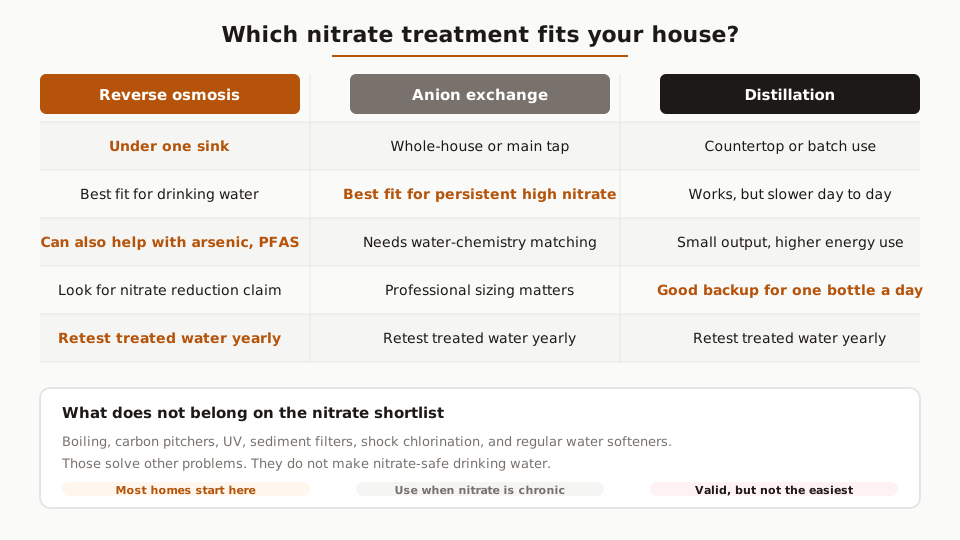
The Oregon State nitrate treatment guide lists reverse osmosis, distillation, and anion exchange as the treatment options that remove nitrate. That is the short list. If a contractor is pitching something outside that list, ask for treated-water lab results, not a sales speech.
If your water has multiple problems at once, the well water filtration guide covers how nitrate treatment fits into a larger treatment train without creating pressure-drop or maintenance headaches.
What does not work
This is where people burn money:
- Boiling
- Pitcher filters
- Standard carbon filters
- UV systems
- Sediment cartridges
- Regular water softeners
- Shock chlorination
The Garage Journal and Terry Love pattern shows up here all the time: somebody already owns a softener, assumes that means the nitrate problem is handled, then finally sends a sample to a real lab and finds out the number barely moved. That is not bad luck. That is the wrong technology.
Fixing the source so the number does not keep coming back
Treatment protects the kitchen tap. It does not solve the reason nitrate reached the well in the first place.
That source work usually means some combination of:
- Repairing a damaged cap, casing, or grading problem around the wellhead
- Moving fertilizer, manure, or chemical storage farther from the well
- Inspecting and repairing an aging septic system
- Drilling a deeper replacement well into a better protected aquifer if the current well is shallow and chronically vulnerable
The UMass nitrate fact sheet also makes a point that well owners miss: if septic is on the suspect list, test for bacteria too. Nitrate and fecal contamination can share the same pathway.
Your next step
If your latest nitrate result is over 10 mg/L as nitrogen, switch to safe drinking water today and line up a confirmatory lab test if you need one. Then inspect the well and the property before you spend a dime on equipment.
For most homes, the practical fix is an under-sink RO unit certified for nitrate reduction, plus source control so the well stops pulling contamination in the first place. If the nitrate number is high, persistent, and tied to the aquifer itself, get quotes for nitrate-specific anion exchange too. Just do not keep drinking it while you think it over.
Related guides
Best filters for iron bacteria (slime): why standard softeners fail
Iron bacteria coat your pipes and equipment with orange slime that standard softeners can't touch. Here are the filtration systems that actually work -- and why.
11 min read
Testing well water for PFAS: what you need to know before you order a kit
Standard well water tests don't detect PFAS. Here's how to test for forever chemicals, which lab kits actually work, what the results mean, and when you should be concerned.
11 min read
The beauty guide for well owners: hair, skin & laundry
Hardness, iron, manganese, and copper can wreck hair, irritate skin, and stain laundry. This guide shows how to tell which one is hitting your house and what actually fixes it.
12 min read