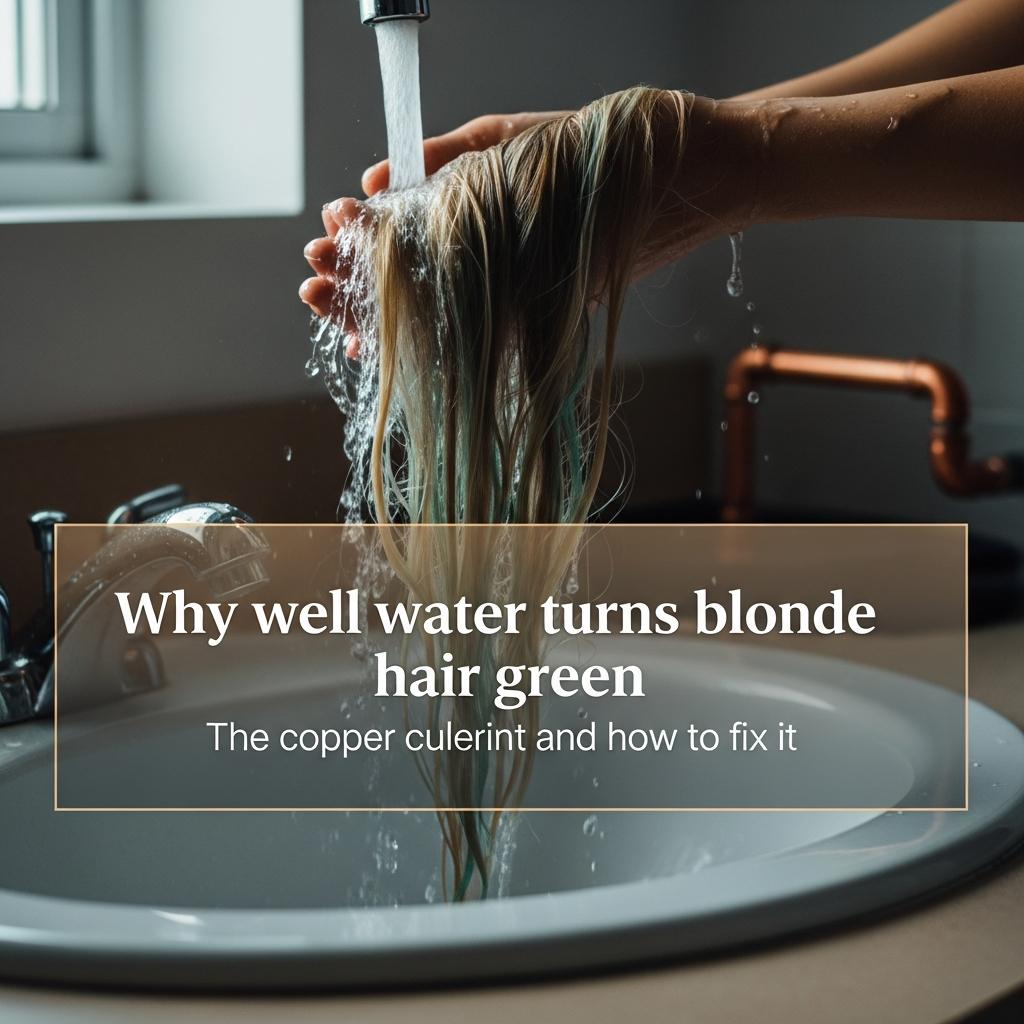
Why well water turns blonde hair green (and how to fix it)
Updated February 27, 2026 — 9 min read
It’s copper, not chlorine. Copper dissolved in your well water bonds to the protein in your hair, oxidizes, and turns green — the same chemical reaction that turned the Statue of Liberty from shiny bronze to green over decades. Your hair is doing the same thing, just faster.
If your blonde or highlighted hair has picked up a green or blue-green cast since you moved to well water, the fix has two parts: strip the copper that’s already deposited on your hair, then stop the copper from reaching your hair in the first place. The stripping part takes an afternoon. The prevention part depends on why copper is in your water.
Why copper, and why blonde hair specifically
A 1978 study settled this question definitively. Researchers soaked hair in chlorinated water, copper-containing water, and a combination of both. Only the samples exposed to copper turned green. Chlorine alone did nothing to the color.
Here’s what happens at the molecular level: copper ions (Cu2+) in your water bind to keratin, the protein that makes up your hair. They latch onto specific chemical groups — carboxyl, amino, and disulfide bonds. Once attached, the copper oxidizes and forms green copper compounds on the surface of the strand. The same chemistry that produces verdigris on old copper roofs.
Blonde and light-colored hair gets hit hardest for two reasons:
The green shows. Dark hair absorbs copper at the same rate, but you can’t see a green tint against a brown or black background. On blonde hair, it’s obvious.
Bleached hair has more binding sites. A 2020 study confirmed that bleaching and highlighting break disulfide bonds in the hair shaft, which creates more attachment points for copper ions. Chemically processed blonde hair is essentially a copper magnet compared to virgin hair. If you color, highlight, or lighten your hair, you’re more vulnerable than a natural blonde — and a natural blonde is more vulnerable than someone with darker hair simply because the tinting shows.
How copper gets into well water
Copper in your well water usually comes from one of three sources, and figuring out which one determines the right fix.
Corroded copper plumbing. This is the most common cause. If your home has copper pipes or brass fittings and your well water is acidic (pH below 7.0), the water slowly dissolves copper from the pipe walls. The lower your pH, the more aggressive the corrosion. A well with pH 6.0 will leach significantly more copper than one at pH 6.8.
Naturally occurring copper in groundwater. Less common, but it happens. Copper-bearing minerals in the bedrock dissolve into the aquifer over time. This is more typical in areas with granite geology or near old mining operations.
Well pump components and brass fittings. Submersible well pumps and the brass fittings in your pressure tank system contain copper alloys. Acidic water corrodes these too.
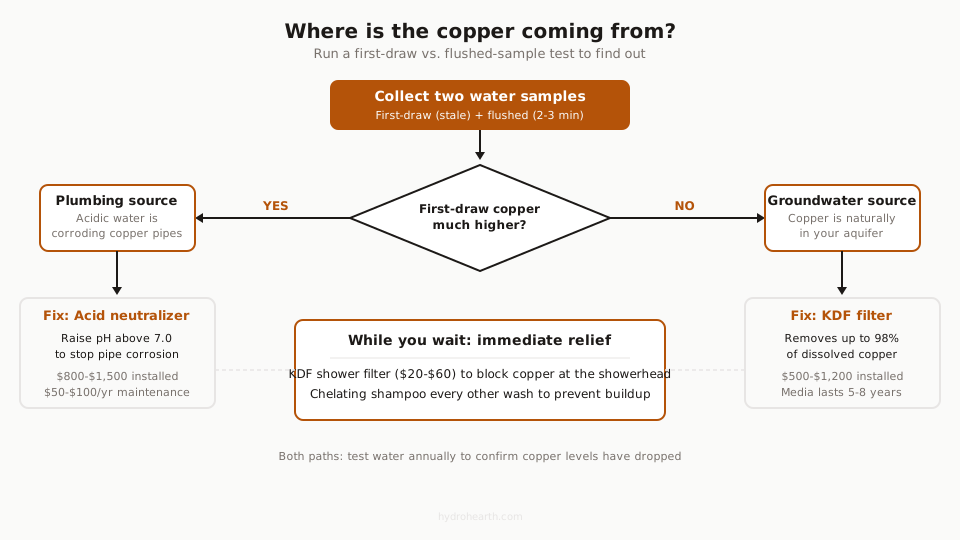
Here’s a quick diagnostic: run your faucet for 30 seconds and collect a sample. Then collect a second sample after running the water for 2-3 minutes. If the first sample has significantly more copper than the second, your plumbing is the source — the water sitting in contact with the pipes overnight picked up copper. If both samples are similar, the copper is in the groundwater itself.
What levels cause green hair
The EPA’s action level for copper in drinking water is 1.3 mg/L (1.3 ppm). That’s the threshold where utilities have to take corrective action. But hair discoloration starts well below that.
| Copper level | What you’ll notice |
|---|---|
| 0.1 - 0.3 ppm | Blue-green staining on fixtures; subtle hair tinting after weeks of daily washing |
| 0.3 - 0.5 ppm | Noticeable green cast on blonde hair within 1-2 weeks of daily showering |
| 0.5 - 1.0 ppm | Obvious green tint; hair feels dry and coated; color-treated hair fades faster |
| 1.0+ ppm | Rapid discoloration; skin may feel dry or irritated; fixtures stain quickly |
Your water can be “safe to drink” by EPA standards and still turn your hair green. The cosmetic threshold is much lower than the health threshold.
If you’re also seeing blue-green stains on your sinks, tubs, or toilet bowls, that’s the same copper making its presence visible on porcelain. The staining often shows up before the hair discoloration does, so it’s an early warning sign worth paying attention to.
How to strip green from your hair
The green tint isn’t surface dirt. The copper is chemically bonded to your hair protein, so you need a chelating agent — a chemical that grabs metal ions and pulls them off. Regular shampoo won’t touch it.
Malibu C Crystal Gel Treatment
This is the professional standard for mineral removal. Each packet contains a concentrated vitamin C complex that chelates copper, iron, calcium, and other metals from the hair shaft.
How to use it: Shampoo first with a clarifying shampoo, then apply the packet mixed with a small amount of water to damp hair. Work it through thoroughly. Cover with a processing cap and leave it on for 30-45 minutes (some stylists use a warm dryer to accelerate it). Rinse, then deep condition. One treatment handles moderate buildup. Severe cases may need two treatments a week apart.
Cost: About $6-8 per packet. You can buy a box of 12 for around $32. For maintenance after the initial stripping, one treatment per month keeps copper from re-accumulating.
DIY vitamin C treatment
This is the budget alternative to Malibu C, and it works on the same chemistry — ascorbic acid chelates copper.
Crush 15-20 vitamin C tablets (1,000 mg each, unflavored) into a fine powder. Mix with 2-3 tablespoons of clarifying shampoo to form a paste. Apply to damp hair, work through, and leave on for 30-60 minutes under a shower cap. Rinse thoroughly and follow with a deep conditioner. The ascorbic acid can be drying, so the conditioner step isn’t optional.
A bottle of 100 vitamin C tablets costs $8-12 at any pharmacy. That’s 5-6 treatments for the price of one Malibu C packet. The tradeoff is convenience and consistency — the commercial product is formulated for hair, while DIY requires more trial and error with the ratio.
The ketchup method (yes, really)
This one comes straight from forum threads and swim team parents. Ketchup works for two reasons: the tomato paste contains citric acid, which chelates copper, and the red pigment helps neutralize the green tint visually.
Apply ketchup generously to dry hair, focusing on the green sections. Leave it on for 15-20 minutes. Rinse thoroughly and shampoo twice. It works for mild to moderate green tinting. It will not fix severe copper deposits that have built up over months.
Fair warning: it works, but your bathroom will smell like a burger joint. Most forum users who’ve tried it say they switched to Malibu C or vitamin C after the first ketchup session because the smell was miserable, but the results were real.
Chelating shampoo for ongoing maintenance
After stripping the green, switch to a chelating shampoo for regular use to prevent re-accumulation. These shampoos contain EDTA (ethylenediaminetetraacetic acid) or citric acid that bind to metal ions during each wash.
The same chelating shampoos that work for general mineral buildup work for copper specifically:
- Malibu C Hard Water Wellness Shampoo (~$24 for 9 oz) — sulfate-free, effective, professional-grade
- Ion Hard Water Shampoo (~$12 for 12 oz) — EDTA-based, more affordable for daily or every-other-day use
A gentle chelating shampoo used every other wash prevents copper from accumulating. That’s more effective than waiting until you see green and doing an emergency stripping treatment.
Lemon juice: works for mild cases
Fresh lemon juice is a gentle chelator. Squeeze 2-3 lemons, apply the juice to damp hair, leave it on for 5-10 minutes, and rinse. The citric acid breaks down copper deposits on the surface. For mild green tinting after a few weeks of well water exposure, this may be enough. For established green from months of accumulation, you’ll need the stronger treatments above.
Don’t combine lemon juice with extended sun exposure if your hair is bleached or highlighted. Lemon juice plus UV light has a bleaching effect that can damage already-processed hair.
The real fix: treat the water, not the hair
Stripping treatments and chelating shampoos manage the symptom. If you want to stop the green from coming back, you need to address the copper in your water.
Step 1: test your water
Get a lab test that includes copper, pH, hardness, and alkalinity. A basic metals panel from a certified lab runs $30-150. You need to know two things: how much copper is in the water and whether acidic pH is causing it.
Run the first-draw / flushed-sample test described above. If your first-draw copper is significantly higher than the flushed sample, your plumbing is the source and pH correction is the fix.
For a full rundown of testing options, the complete testing guide covers certified labs, mail-in kits, and how to read your results.
Step 2: fix the pH (most common fix)
If your water’s pH is below 7.0, it’s dissolving copper from your plumbing. A calcite acid neutralizer raises the pH by dissolving calcium carbonate into the water as it passes through. This is a passive system that requires no electricity and no chemicals — you just add calcite media every few months as it dissolves.
Cost: $800-$1,500 installed. Annual maintenance: $50-100 in calcite refills. One thing to know: a calcite neutralizer will increase your water’s hardness, because it’s adding calcium. If your water is already hard, you might need a water softener downstream. The filtration guide covers how to sequence these systems correctly.
Forum users on Terry Love Plumbing reported pH going from 6.2 to 7.0 after installing a calcite neutralizer, with blue-green staining disappearing within weeks. That tracks with the chemistry — once the water stops dissolving copper from your pipes, the copper level drops to near zero.
Step 3: filter the copper directly (if it’s in your groundwater)
If your copper is naturally occurring in the groundwater (both first-draw and flushed samples are similar), a KDF filter removes it at the point of entry. KDF (Kinetic Degradation Fluxion) media uses a zinc-copper alloy that removes dissolved copper through a redox reaction. KDF-85 is the grade designed for well water with heavy metals, and it removes up to 98% of dissolved copper.
A whole-house KDF filter runs $500-$1,200 installed. The media lasts 5-8 years depending on your water volume and copper concentration. Some whole-house filtration systems include KDF as one stage in a multi-stage setup.
Interim fix: shower filter
While you’re getting the whole-house treatment sorted, a KDF-based shower filter gives you immediate relief. These screw onto your shower pipe in 5 minutes and reduce copper before it contacts your hair.
A basic KDF shower filter costs $20-60. They need replacement cartridges every 6-9 months ($10-20 each). These won’t solve the problem for your whole house, but they’ll protect your hair while you address the root cause.
Just make sure you’re buying a KDF filter, not a standard carbon shower filter. Carbon filters are designed to remove chlorine (a city water problem) and do nothing for dissolved metals. The hair damage guide covers why most expensive shower filters marketed on social media are useless for well water.
When green hair is a health warning
Green hair is annoying. But copper in your water has health implications beyond cosmetics. At levels above 1.3 ppm, copper causes nausea, vomiting, and stomach cramps. Chronic exposure at elevated levels can damage your liver and kidneys. People with Wilson’s disease are particularly sensitive and can experience toxicity at much lower levels.
If your hair is turning green, your copper level is high enough to pay attention to. Get your water tested. If the lab results come back above 1.3 mg/L, that’s an immediate fix-it situation, not just a vanity problem. Copper from corroded plumbing also means your pipes are deteriorating, and pinhole leaks aren’t far behind.
Think of the green hair as your water sending you a message. The annual maintenance checklist includes monitoring for aesthetic changes like staining and discoloration — catching them early prevents both cosmetic headaches and plumbing failures.
Your next move: test your water for copper and pH. If the green is already there, grab a Malibu C packet or crush some vitamin C tablets and strip it this weekend. Then fix the water so you never have to do it again.
Related guides
How to treat tannins in well water
Tea-colored well water usually means tannins, not iron. Here's how to confirm it, rule out a well problem, and choose the treatment that actually works.
9 min read
Well water during power outages: backup systems and emergency protocols
How to keep water flowing from a private well during a power outage -- generator sizing, battery backup, hand pumps, and the $35 prep that buys you 100 gallons.
11 min read
Arsenic and radon: the New England well water guide
If your private well is in New England, arsenic and radon belong on your testing list. Here's what to test, how state guidance differs, and what to do with the results.
10 min read