Do Well Water Filters Remove PFAS? What Actually Works
Updated October 2, 2026 — 7 min read
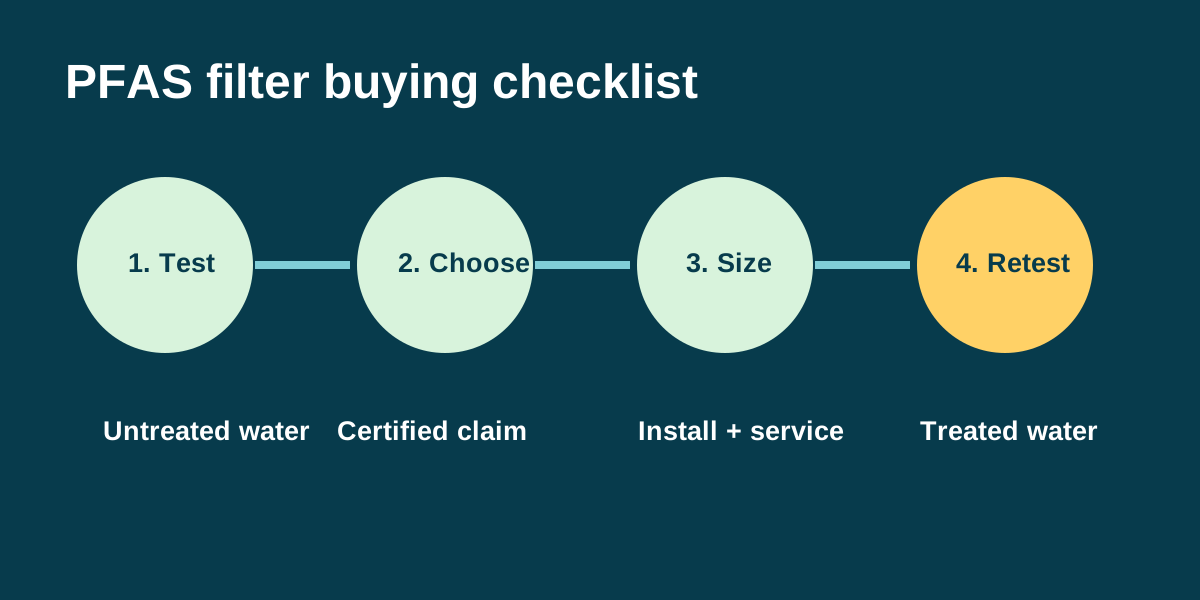
Yes, a well-water filter can reduce PFAS—but not every filter will, and a generic “carbon filter” label is not proof. Start with a laboratory result, choose a technology and model certified for the specific PFAS reduction claim you need, then retest the treated water. On a private well, that sequence matters more than buying the biggest system you can fit in the basement.
The EPA notes that private wells are not regulated under the federal drinking-water rules and recommends using a state-certified laboratory when PFAS is a concern. Its private-well PFAS guidance is a sensible starting point for understanding your local options.
First: learn what is actually in the water
PFAS is a family of chemicals, not one contaminant. A test report may list individual compounds, a method, detection limits, and a sampling date. Keep the whole report. A sales page cannot tell you whether a filter is a good match until you know what you are trying to reduce and at what level.
If you have not sampled yet, use our guide to testing well water for PFAS to plan the collection and read the result. If a result suggests an immediate concern, use your state health department, local environmental agency, or a qualified water professional to discuss interim drinking-water options while you decide on treatment.
The technologies worth comparing
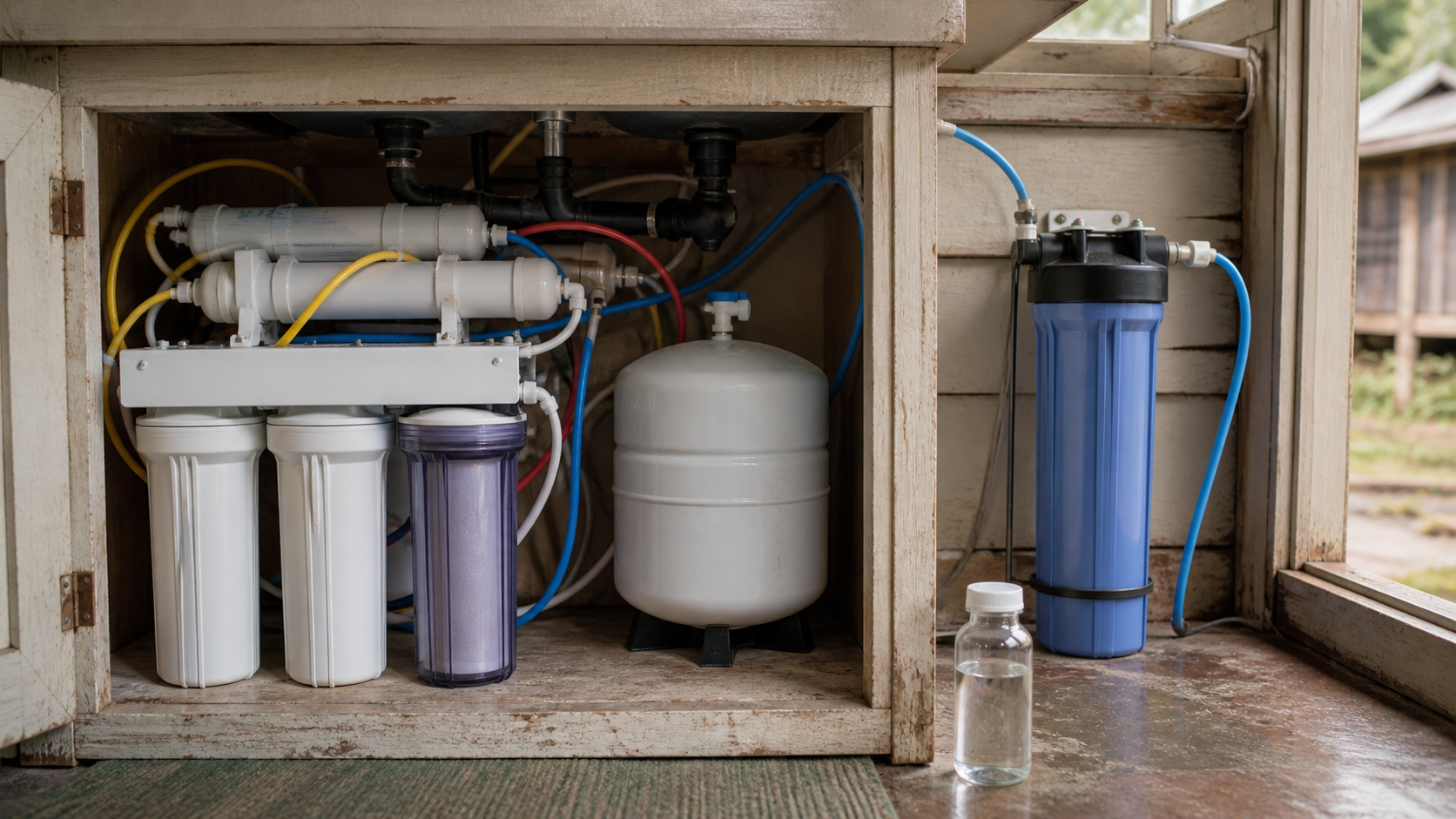
EPA identifies several approaches that can reduce PFAS in drinking water, including granular activated carbon (GAC), ion exchange, and reverse osmosis (RO), in its household filter guidance. At the household level, the best choice depends on the specific compounds, concentration, water chemistry, flow needs, budget, and waste-water constraints.
For a drinking-water tap, point-of-use RO is often one option to evaluate. For whole-house treatment, a properly designed carbon or anion-exchange system may be part of the conversation. “May be” is doing important work there: treatment design should follow testing, not the other way around.
Read the certification claim, not just the brand name
EPA’s filter-certification guide advises shoppers to look for independent certification. For the kinds of products it discusses, that commonly means an NSF/ANSI 53 claim for a point-of-use filter or NSF/ANSI 58 for reverse osmosis. Confirm the exact model and the exact PFAS reduction claim in the certifier’s current listing.
Certification is a reduction claim, not a promise that the treated water meets every health benchmark. EPA’s page dates its warning about certification not yet matching the drinking-water limits to April 2024. Do not turn that dated statement into a claim about every current certification. Check the exact model in the current NSF listing or the relevant certifier’s directory, including the named compounds, reduction level, and rated conditions. Treat an NSF/ANSI 53 or 58 listing as one part of a test-and-retest decision, not as a universal “PFAS safe” label.
Ask these questions before purchase:
- Does the model’s certification cover PFAS reduction, rather than only taste, odor, or lead?
- Is the certified flow and capacity realistic for the water you plan to treat?
- What other well-water conditions—iron, manganese, sediment, hardness, bacteria—could interfere with the system?
- What does replacement media, membrane service, and disposal cost over the first few years?
- Who will test the water after installation?
An RO system can also create a concentrate stream. EPA notes that RO produces waste water, so installation and drain planning are part of the decision. For a broader decision framework, see when whole-house reverse osmosis is overkill for a well.
Capacity and maintenance are part of the treatment claim
A filter’s performance is tied to its tested conditions and useful life. Sediment can foul equipment, hard water can complicate the treatment train, and carbon or other media eventually needs service. Do not turn the initial test result into a “set it and forget it” purchase.
Ask the supplier to show, in writing, the system’s required prefiltration, expected service interval, replacement cost, flow limitations, and the certified claim for the exact model. Then compare those assumptions with the actual household: how many people use the water, whether the filter serves one drinking tap or the whole house, and what else is present in the water. A small point-of-use system may be a thoughtful drinking-water solution; it may not be a practical answer for every shower, appliance, and outdoor tap.
If a whole-house system is proposed, request a design explanation that distinguishes drinking-water protection from broader water-quality goals. That makes it easier to compare bids without treating every extra tank as evidence of better PFAS reduction.
Retesting is how you know the plan worked
Installers and manufacturers can explain their equipment. Only before-and-after water results tell you what your system did in your water. Save untreated and treated reports, dates, filter changes, and any service records. Then schedule the next test before the first replacement reminder gets ignored.
This is also a good time to put PFAS in context. A complete well-water testing plan can identify other conditions that affect treatment selection and household use.
Your next step
Send the complete lab report to the treatment supplier, request the exact model’s current certification and maintenance requirements, and arrange treated-water testing before buying. Keep the next sampling date with the filter-change schedule.
Related guides
How to choose the right filtration system for your well water
A water-chemistry-first guide to well water filtration by contaminant -- iron bacteria, sulfur, PFAS, manganese, and more. How to test your water, read the results, match each problem to the right filter technology, and build a treatment train that solves your specific issue.
14 min read
How to test well water yourself (step by step)
Use home strips for trend checks. Use your own hands to collect a clean sample for the lab when the result affects health or treatment decisions.
8 min read
Well water during power outages: backup systems and emergency protocols
How to keep water flowing from a private well during a power outage -- generator sizing, battery backup, hand pumps, and the $35 prep that buys you 100 gallons.
11 min read