Is whole-house reverse osmosis overkill for well water?
Updated May 15, 2026 — 7 min read
Short answer: For most well owners, yes. Whole-house reverse osmosis is usually overkill if your real problem is hardness, iron, manganese, sulfur, nitrate, arsenic, or PFAS. In most houses, the smarter setup is targeted whole-house treatment for nuisance issues plus a point-of-use RO unit at the kitchen sink for drinking and cooking water.
Whole-house RO is not a fancy version of a regular filter. It is closer to a small treatment plant. When it is the right answer, it can be a great answer. But if you install it to solve a one-tap drinking-water problem, you are paying to purify toilet water, shower water, and hose bib water that never needed that level of treatment in the first place.
Key takeaway
Start with a certified lab result, then ask a blunt question: do you need cleaner drinking water at one sink, or low-mineral water at every tap in the house? Those are different jobs, and whole-house RO is the expensive answer to only one of them.
Why most well owners should not start with whole-house RO
The Water Quality Association’s point-of-use versus point-of-entry guide makes a useful distinction: some contaminants are mainly an ingestion problem, while others affect the whole house through staining, odor, scaling, or corrosion. That sounds basic, but it is the whole ballgame.
If your lab report shows arsenic, nitrate, or PFAS, the first priority is safe drinking and cooking water. Virginia Cooperative Extension’s nitrate treatment guide says reverse osmosis removes nitrate, but also notes RO systems treat a relatively small volume at a time and are usually most practical at one faucet. EPA says the same thing for residential RO: point-of-use systems can remove contaminants such as PFAS and arsenic without forcing you to purify every gallon that hits the washing machine.
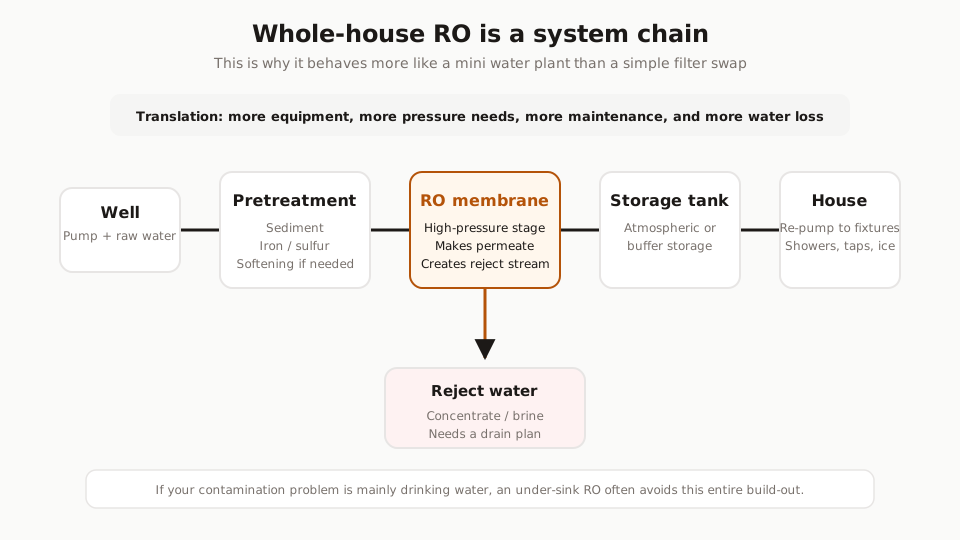
If your problem is hardness, iron, manganese, sulfur smell, or sediment, whole-house RO is usually the wrong first hammer. Those are treatment-train problems. The fix is usually a softener, iron filter, sulfur system, sediment filter, or some combination of those — not a membrane setup designed to strip out nearly everything. If your shower glass spots up, your towels turn orange, or your basement smells like sulfur, start with the filtration guide, not a whole-house RO sales pitch.
What whole-house RO asks from your well
This is the part sales pages glide past. RO works, but it is demanding.
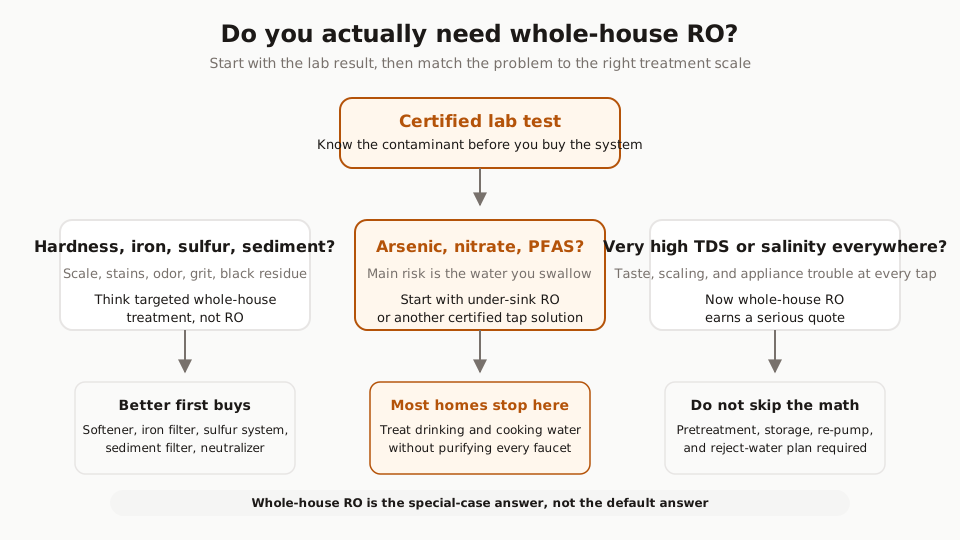
Virginia Cooperative Extension notes that only about 10 to 20 percent of the water entering a residential RO system becomes treated water. The other 80 to 90 percent becomes wastewater. EPA’s WaterSense program puts the same point in homeowner terms: a typical residential point-of-use RO unit can send five gallons or more down the drain for every gallon it makes. That is manageable at one sink. It becomes a much bigger conversation when you start talking about whole-house flow on a private well.
RO also wants pressure. VCE notes these systems work best with higher water pressure and often need pretreatment and post-treatment to run correctly. In plain English, the membrane wants clean feed water, steady pressure, and somewhere for the reject stream to go. On a well, that usually means pretreatment upstream, a storage tank, and a repressurization pump downstream.
That is why whole-house RO often turns into a chain of equipment instead of one blue tank in the corner. If your well yield is already marginal, adding a treatment step that turns a large share of pumped water into reject water deserves hard math, not wishful thinking. And if you are on septic, ask exactly where that reject stream is going before you sign anything.
When whole-house RO actually makes sense
Whole-house RO is not crazy. It is just a niche answer.
It starts making sense when the whole supply is the problem, not just the drinking tap. Think very high TDS or salinity, brackish water, sodium-heavy water that tastes bad everywhere, or a contaminant mix so broad that low-mineral water is useful for drinking, cooking, ice, showers, and appliance protection all at once.
It can also make sense when targeted technologies do not solve the combined problem cleanly. If you are stacking multiple systems and still ending up with mineral-heavy water everywhere, whole-house RO may be the cleaner final answer.
But I would not move forward without three things in writing:
- the raw-water lab panel
- the treated-water performance target
- the plumbing plan showing pretreatment, storage, repressurization, and reject-water handling
The better first move for common well problems
| If your test shows | Start here instead | Why |
|---|---|---|
| Hardness | Water softener | You need scale control and real soft water, not purified bath water |
| Iron, manganese, or sulfur | Oxidation and filtration | These are classic whole-house nuisance problems better solved upstream |
| Nitrate | Point-of-use RO or nitrate-specific anion exchange | Drinking and cooking water matter most |
| Arsenic | Point-of-use RO after proper speciation | One contaminant at one tap is often the efficient fix |
| PFAS | Certified RO or carbon at the tap, matched to the lab result | Start with the exposure you actually swallow |
| Sediment only | Cartridge or spin-down filtration | No reason to run gritty water through an RO membrane |
Stop obsessing over remineralization first
People love to jump straight to the “dead water” argument. Fair enough. RO-treated water can taste flat because it strips minerals out. If taste bothers you, a remineralization cartridge or blended drinking-water setup can fix that at the tap.
But if you are still deciding whether you need RO at one faucet or the whole house, remineralization is not the first question. The first questions are water waste, well yield, feed pressure, pretreatment, and whether the contaminant is actually a whole-house problem. Get those wrong and the taste debate never matters, because the system choice was wrong from day one.
Start with the lab result, not the sales pitch
CDC says private well owners should test at least yearly for total coliform bacteria, nitrates, total dissolved solids, and pH, then add locally relevant contaminants such as arsenic based on where they live. That is your starting point.
Once you have the numbers, the path usually gets simpler:
- nuisance water across the whole house -> build the right whole-house treatment train
- health contaminant mostly tied to drinking water -> price point-of-use RO first
- extreme dissolved-mineral water everywhere -> now whole-house RO earns a serious look
Your next move is to get a certified lab test if you do not already have one. Then read the full filtration guide. Whole-house RO should be the conclusion of the process, not the opening bid.
Related guides

Understanding your well system: pumps, pressure tanks, and the hardware that keeps water flowing
A plain-English technical reference for every major component in a residential well system, from the submersible pump at the bottom to the pressure switch on the wall, with realistic lifespans, costs, and what you can fix yourself.
14 min read
Best UV water purifiers for well water (bacteria defense)
The best UV purifier for well water is a Class A unit sized to your real peak flow and installed after pretreatment. Here are the systems I would actually buy.
12 min read
How to test well water yourself (step by step)
Use home strips for trend checks. Use your own hands to collect a clean sample for the lab when the result affects health or treatment decisions.
8 min read