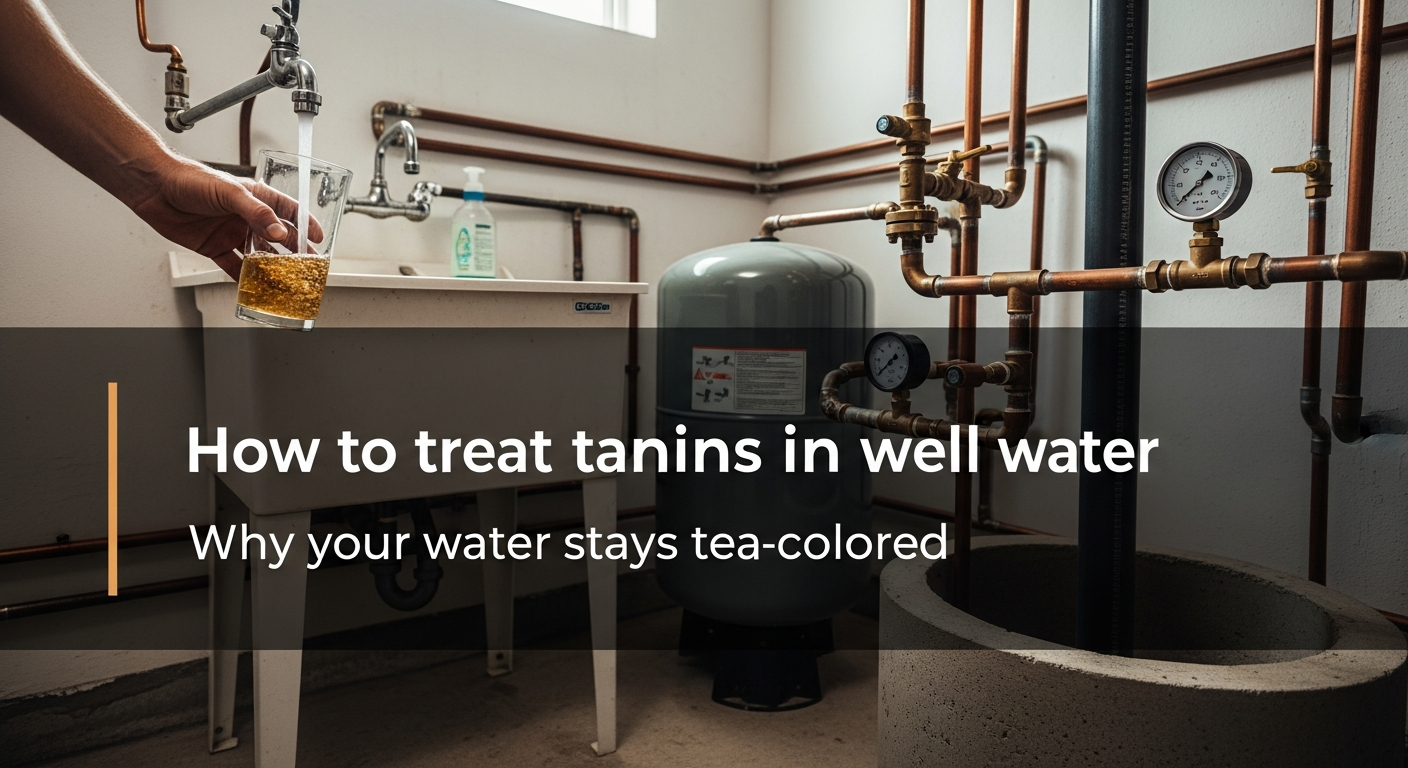
How to treat tannins in well water
Updated March 27, 2026 — 9 min read
Tannins are dissolved organic compounds from decaying leaves, peat, and surface water. If your well water looks yellow or tea-colored and stays that way even after sitting, you’re probably dealing with tannins, not iron. The fix is usually a tannin-specific filter or activated carbon, but if the color change happened suddenly after heavy rain, inspect the well first. A broken cap or shallow surface-water leak is a well problem, not a filter-shopping problem.
Key takeaway
If the water turns orange after sitting, think iron. If it stays tea-brown from the moment it hits the bucket, think tannins. And if that color showed up out of nowhere after a storm, test for bacteria and inspect the well before you spend money on treatment.
What tannins in well water actually are
Tannins are natural organic compounds released as water moves through peaty soil, wetlands, leaf litter, and other decaying vegetation. They often show up in shallow wells, dug wells, or any well influenced by nearby surface water. The EPA treats color as a nuisance issue rather than a primary health standard, and says most people find water objectionable above 15 color units.
That nuisance label is only half the story. The tannins themselves are usually an aesthetics problem: yellow water, musty or woody taste, stained fixtures. But the same pathway that carries tannins into a well can also carry surface contamination. That’s why sudden tannin problems deserve a well inspection, not just a catalog search.
How to tell tannins from iron, rust, and sediment
The fastest field test is a white bucket and 30 minutes of patience. Fill it with cold water straight from the tap and let it sit on a counter.
| What you see | Most likely cause | What it usually means |
|---|---|---|
| Water is tea-yellow right away and stays that color | Tannins | Dissolved organics from peat, leaves, or surface-water influence |
| Water starts clear and turns orange later | Ferrous iron | Dissolved iron oxidizing after it hits air |
| Water is orange or cloudy immediately | Ferric iron or rust | Iron particles already formed |
| Water is cloudy and drops grit to the bottom | Sediment, clay, or silt | Mechanical filtration problem, not tannins |
If your softener or iron filter isn’t touching the yellow color, that’s another clue. Standard iron equipment is built for metals. Tannins are organic molecules. Different chemistry, different fix.
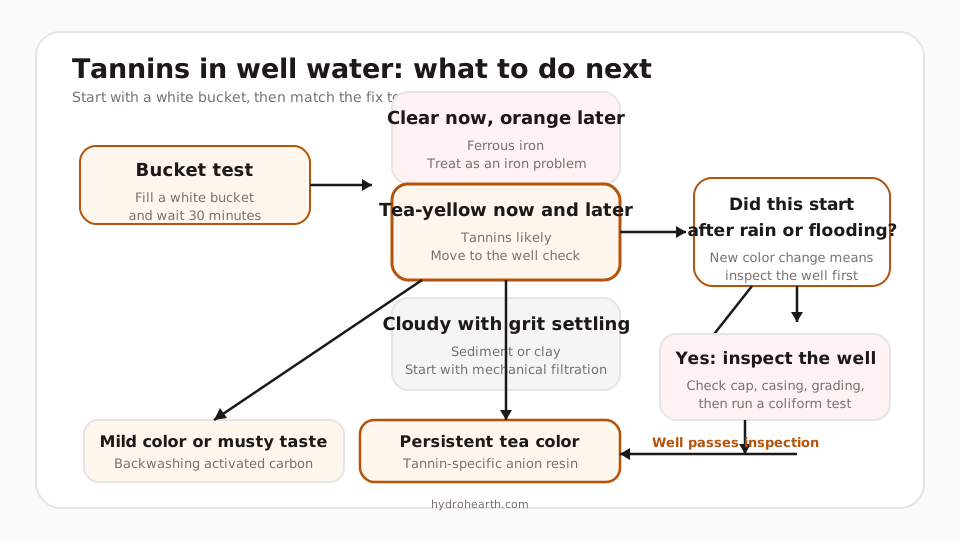
If the color changed suddenly, inspect the well before you buy treatment
The water turns brown after a storm, the treatment company says “iron,” and the new filter changes nothing. If your tannin problem is new, ask these questions first:
- Did it start after heavy rain, snowmelt, or a flood?
- Is the well shallow, dug, or located near woods, wetlands, or a low spot in the yard?
- Is the well cap cracked, loose, or sitting too close to grade?
- Has anyone checked the casing height or the sanitary seal recently?
Don’t treat a contamination pathway like a color problem
A plain carbon filter can make tannin water look better, but it does nothing to fix a bad well cap, a leaking casing joint, or coliform getting into the well. If the water color changed suddenly, run a bacteria test and inspect the well structure before you size any treatment equipment.
The treatment options that actually work
Once you’ve confirmed the well itself is sound, there are three realistic paths.
1. Backwashing activated carbon
Activated carbon works best when tannins are relatively mild and your main complaint is color, musty taste, or earthy odor. The EPA notes that granular activated carbon removes many of the compounds that cause color and odor issues, and in a whole-house setup it is the simplest way to clean up light organic contamination.
The catch is capacity. If the water is dark tea-brown or the tannin load is high, the media exhausts faster and you end up chasing color with frequent changeouts or a bigger backwashing tank.
Carbon also isn’t where you start if bacterial safety is unknown. If you’re not sure whether the well is sanitary, solve that first.
2. Tannin-specific anion exchange resin
This is the workhorse when tannins are persistent, obvious, and confirmed on a lab test. A tannin unit looks a lot like a water softener, but it is not a standard softener. Softener resin swaps positively charged minerals like calcium and magnesium. Tannin units use anion resin to target negatively charged organics.
Three details matter:
- Pretreatment matters. Sediment, iron, and other junk in the water foul resin fast.
- High sulfate or high TDS can reduce performance because those ions compete for resin capacity.
- Shock chlorination is hard on resin. If you disinfect the well, bypass the tannin unit.
If a contractor proposes “just add a softener,” push back. A regular cation softener is not a tannin system.
3. Chlorination followed by activated carbon
This route makes sense when you have tannins plus a second problem: bacteria, odor, or significant organic loading that benefits from oxidation. Extension guidance commonly pairs continuous chlorination with downstream carbon when organic color and nuisance contamination show up together.
It works, but it is more maintenance. For simple tannin color in an otherwise sanitary well, it is usually more system than you need.
What usually does not work
These are the dead ends that waste the most money:
- Sediment filters. Tannins are dissolved. A cartridge only catches particles.
- Standard iron filters. Great for iron. Usually useless on straight tannin color.
- Air injection by itself. Helpful for iron and hydrogen sulfide, not for dissolved tannins.
- A regular water softener. It may change hardness, but the yellow color often stays right where it is.
If your water has both iron and tannins, treatment can get tricky fast. That’s where the full filtration guide helps, because the treatment train order matters.
What to test before you size a system
Don’t buy a tannin filter based on color alone. Run a proper water test and include:
- Color or tannins, if your lab offers it
- Iron and manganese
- pH
- Total dissolved solids or conductivity
- Sulfate, if you’re considering anion resin
- Coliform and E. coli if the problem is new, seasonal, or linked to rain
The ultimate testing guide walks through where to get a certified lab panel and how to collect the sample without ruining it. That’s your cheapest insurance against buying the wrong equipment.
Your next step
Run the bucket test today. If the water stays tea-colored and the problem is longstanding, get a lab panel and start comparing carbon versus a tannin resin system. If the color showed up suddenly, go outside and inspect the well before you do anything else. A filter can polish water. It cannot fix a well that’s pulling swamp water through a bad seal.
Related guides
Why does my well water smell like rotten eggs? (and how to fix it)
Hydrogen sulfide causes that rotten egg smell in well water. Here's how to diagnose whether it's sulfur bacteria, your water heater anode rod, or your well itself -- and the treatment that actually fixes each one.
10 min read
Arsenic and radon: the New England well water guide
If your private well is in New England, arsenic and radon belong on your testing list. Here's what to test, how state guidance differs, and what to do with the results.
10 min read
How to replace a well cap (and why a damaged cap is an emergency)
A cracked or loose well cap is the most common pathway for bacteria, insects, and surface water to enter your well. Here's how to inspect yours, measure for a replacement, and install it yourself.
6 min read