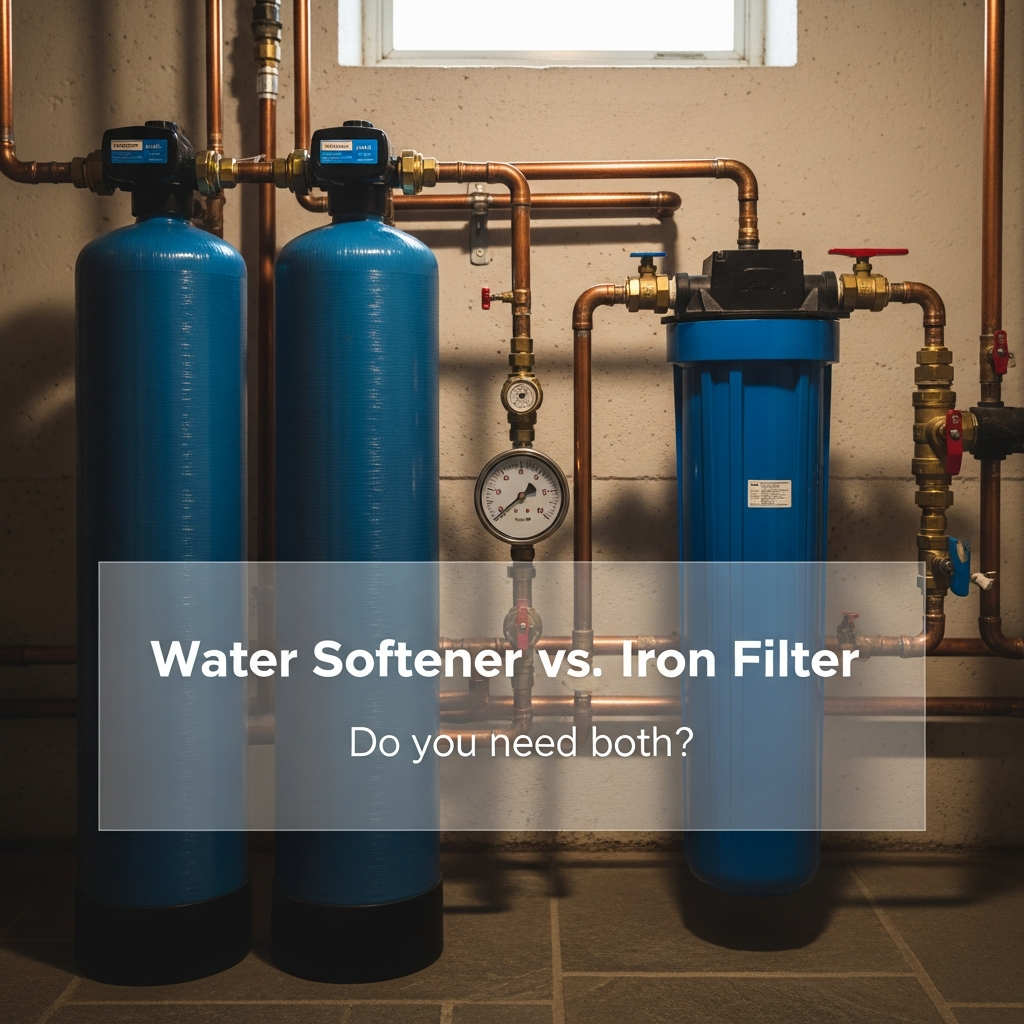
Water softener vs. iron filter: do you need both?
Updated March 9, 2026 — 10 min read
If your well water is hard AND has iron above 1 ppm, you probably need both. A water softener removes hardness minerals (calcium and magnesium) through ion exchange but fouls when iron exceeds about 1 mg/L. An iron filter oxidizes dissolved iron into solid particles and traps them, but it does nothing for hardness. They solve different problems, and one can’t do the other’s job.
The most common mistake I see on well water forums: a homeowner notices orange staining, buys a water softener, and watches it fail within six months. The resin bed coats with iron, the softener stops softening, and now they need both a new iron filter AND resin replacement. That’s $1,500-$2,000 in wasted money because they skipped a $150 water test.
Here’s how each system works, when you need one versus the other, and when you genuinely need both.
How a water softener handles iron (and where it breaks)
A water softener works by ion exchange. Resin beads inside the tank are loaded with sodium ions. When hard water flows through, calcium, magnesium, and dissolved ferrous iron ions have a stronger attraction to the resin than sodium does. The resin grabs the hardness and iron ions and releases sodium into the water. When the resin is full, a salt brine flushes through to recharge it.
The key word there is “dissolved.” A softener can only exchange ions that are in solution. That means ferrous iron — the clear, invisible, dissolved form — at low concentrations.
Here’s where the numbers matter:
| Iron level | What happens in a softener |
|---|---|
| Below 0.5 ppm | Softener handles it fine with regular resin cleaner |
| 0.5 - 1.0 ppm | Manageable, but regenerate every 2-3 days and use resin cleaner monthly |
| 1.0 - 3.0 ppm | The danger zone. Each 1 ppm of iron eats 4-5 grains per gallon of softening capacity. At 2 ppm, you’ve cut your softener’s effective capacity in half |
| 3.0+ ppm | The resin fouls. Period. No amount of resin cleaner will keep up |
That capacity tax is the part most people miss. If your water has 20 GPG hardness and 2 ppm iron, you need to size the softener for 30 GPG of compensated hardness — not 20. The iron consumes resin capacity at roughly 4-5 GPG per 1 ppm.
And there’s another trap. Ferrous iron can convert to ferric iron (the solid, rust-colored kind) anywhere oxygen is present — inside your pressure tank, inside the softener head, even in pipe joints with small air pockets. When that happens, the solid particles coat the resin beads physically instead of exchanging chemically. Salt regeneration can’t flush off particles that are stuck to the bead surface. The resin is now fouled, and your softener is producing hard, iron-stained water.
How an iron filter works
An iron filter uses a two-step process: oxidation, then filtration.
Dissolved ferrous iron is invisible. You can’t filter what you can’t see. The oxidation step converts dissolved iron into solid ferric iron particles. Then a media bed traps those particles. The system backwashes periodically to flush the accumulated solids and recharge.
The main oxidation methods:
Air injection (AIO). An air pocket at the top of the tank oxidizes iron as water passes through. No chemicals needed. Best for iron up to 7-15 ppm with pH above 7.0. The SpringWell WS1 is the most popular residential AIO — our brand comparison has the full breakdown.
Greensand filters. The media itself (manganese dioxide-coated sand) oxidizes iron on contact. Requires periodic regeneration with potassium permanganate — a purple chemical that stains anything it touches. Handles lower pH better than AIO and works on manganese.
Birm. A catalytic media that uses dissolved oxygen already in the water to speed up iron oxidation. No chemicals, no regeneration beyond backwashing. But it’s pH-sensitive: won’t work below 6.8 for iron, below 7.5 for manganese. And it can’t touch hydrogen sulfide.
Katalox Light. A newer zeolite-based media with a manganese dioxide coating. Filters down to 3 microns, handles high iron, and weighs less than the older heavy-duty media. Lighter weight means it backwashes with less water — a real advantage if your well pump only produces 7-10 GPM.
An iron filter does one thing well: it gets iron (and usually manganese and sulfur) out of the water. It does not remove hardness. If you have hard water, the scale buildup in your pipes, water heater, and fixtures will continue untouched by even the best iron filter.
When you need a softener only
If your water test shows hardness above 7 GPG but iron below 0.5 ppm (and no iron bacteria), a softener alone is enough. Use a resin cleaner like Iron Out or ResCare every 3-4 months as insurance, and make sure the softener regenerates at least every three days when any iron is present. Iron that sits on resin longer than three days starts to oxidize in place, becoming much harder to flush during regeneration.
This is the simplest scenario. Buy a decent softener, keep it fed with salt, and maintain the resin.
When you need an iron filter only
If your iron is above 0.3 ppm (enough to stain fixtures) but your hardness is below 7 GPG, you don’t need a softener at all. An iron filter handles your iron problem, and your water isn’t hard enough to cause scale or soap issues.
This is common in some parts of the Southeast and Pacific Northwest where the groundwater is naturally soft but runs through iron-rich formations.
When you need both (and the order matters)
This is the most common well water scenario in the Midwest, Appalachian region, and parts of the Northeast: hard water with significant iron. If your water test shows hardness above 7 GPG AND iron above 1 ppm, you almost certainly need both systems.
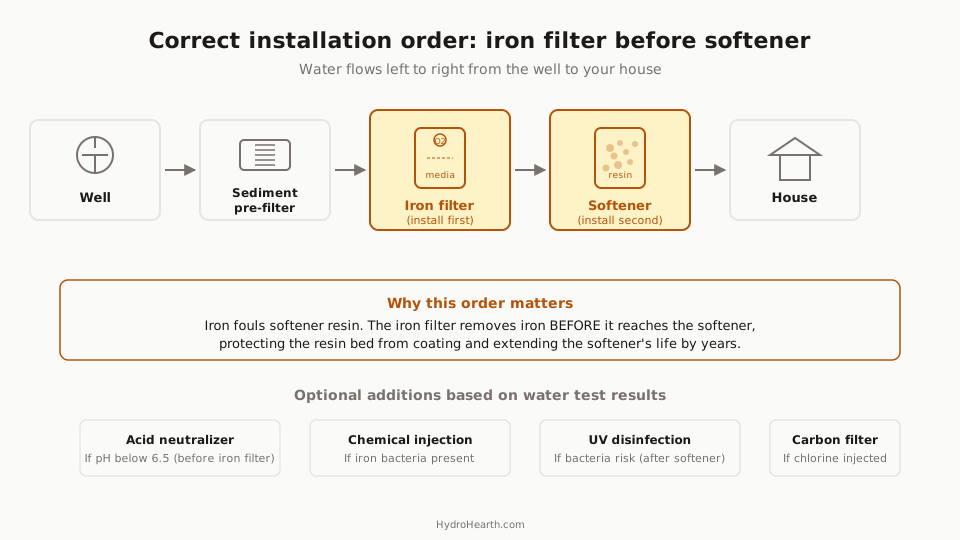
The installation order is non-negotiable: iron filter first, softener second.
The iron filter removes iron before the water reaches the softener. This protects the softener resin from fouling. If you reverse the order, the softener sees all that iron, the resin fouls, and you’re back to the same problem as running a softener alone.
Here’s what common water chemistry scenarios look like:
Hard water + moderate iron (1-5 ppm). Iron filter (air injection or greensand) drops iron to below 0.3 ppm, then the softener handles the remaining hardness. A combined system runs $1,200-$2,500 for DIY equipment or $3,000-$7,000 professionally installed.
Hard water + iron + hydrogen sulfide. That rotten egg smell means H2S is present alongside your iron problem. An air injection system handles both — the air pocket oxidizes iron and H2S simultaneously. Follow it with the softener. If H2S is above 3 ppm, you may need chemical injection instead of passive air injection.
Hard water + iron bacteria. This is the tough one. If you see slimy orange goo in your toilet tank — not just staining, but actual gelatinous buildup — you have iron bacteria, and neither a standard iron filter nor a softener will solve it alone. The bacteria colonize both systems. You need chlorine or hydrogen peroxide injection upstream to kill the bacteria, a contact tank for dwell time, then the iron filter, then the softener, then a carbon filter to strip the chlorine residual. That treatment train runs $5,000-$10,000 installed. There’s no cheap shortcut for iron bacteria.
The iron types that change everything
Not all iron is the same, and the type you have determines what equipment works.
Ferrous iron (clear water iron). Your water looks clear at the tap. Fill a white bucket, let it sit for 20-30 minutes, and it turns orange as oxygen converts the dissolved iron to solid particles. This is the most common type and the one that softeners can handle at low levels. Iron filters handle it at any level.
Ferric iron (red water iron). Water comes out visibly orange or rusty. The iron has already oxidized. A sediment filter catches it since the particles are solid. A softener absolutely cannot handle it — the particles coat the resin on contact instead of exchanging through ion exchange.
Organic iron (tannin-bound). Water has a tea-brown or yellowish tint. Iron is bound to organic molecules from decaying vegetation. Neither standard softeners nor standard iron filters remove it well. You need a specialized tannin filter or chemical oxidation followed by filtration. This is common in shallow wells near swamps, bogs, or heavily wooded areas.
If your laundry is staining orange, you probably have ferrous iron — it’s clear at the tap but oxidizes in the washing machine. The warm water, agitation, and alkaline detergent accelerate the reaction.
The bucket test for iron type
Fill a clean white bucket with cold well water straight from the tap. If it’s clear immediately but turns orange within 30 minutes, you have ferrous iron. If it’s orange or cloudy from the start, you have ferric iron or a mix. If it’s tea-brown and never turns orange, suspect tannins. This 30-minute test tells you more about your treatment options than any amount of online advice.
What it costs (honestly)
Treatment companies love quoting equipment prices. Nobody wants to talk about the ongoing costs. Here’s the full picture.
| Water softener | Iron filter (AIO) | Both systems | |
|---|---|---|---|
| Equipment (DIY) | $500-$1,400 | $600-$2,000 | $1,200-$2,500 |
| Professional install | $1,200-$3,800 | $1,200-$3,500 | $3,000-$7,000 |
| Annual salt | $60-$150 | $0 | $60-$150 |
| Annual maintenance | $30-$60 (resin cleaner) | $20-$60 (sediment pre-filter) | $50-$120 |
| Media replacement | $150-$400 every 10-15 yr | $200-$500 every 5-15 yr | Both |
| Annual operating total | $100-$250 | $50-$100 | $150-$300 |
If you’re handy with plumbing, the DIY route saves $1,000-$3,000. Both systems install similarly to a water heater — cut into the main line after the pressure tank, connect bypass valves, run a drain line for backwash. A Fleck 5600SXT valve on a softener and a Fleck 2510SXT on an iron filter is the most common DIY combo. Forums are full of homeowners who did both in a weekend.
The maintenance difference matters over time. A softener needs salt every month and resin cleaner every few months. An air injection iron filter needs almost nothing — just a sediment pre-filter change every few months and the occasional check that the air draw valve is working. Over five years, a softener costs $500-$1,250 in salt and consumables. An AIO iron filter costs $100-$300. The softener is the higher-maintenance system by far.
Five mistakes that waste money
1. Buying a softener for an iron problem. The single most expensive mistake. Softener resin fouls, staining continues, and now you need resin replacement plus an iron filter. Get a water test before you buy anything.
2. Ignoring iron bacteria. If the orange buildup in your toilet tank is slimy and gelatinous — not just a dry rust ring — you have living organisms, not just mineral iron. A standard iron filter won’t kill them. Read the iron bacteria guide before spending money on equipment.
3. Choosing the wrong filter media for your pH. Birm needs pH above 6.8 for iron and above 7.5 for manganese. If your water is acidic (common in granite regions), Birm does nothing. You need an acid neutralizer first or a media that works at lower pH, like greensand or Katalox Light.
4. Undersizing the system for backwash. Your iron filter needs a minimum flow rate during backwash to properly expand the media bed and flush out accumulated iron. A 12-inch tank with heavy media like Pro-OX might need 15-20 GPM of backwash flow. If your well pump only produces 7-10 GPM, the media channels and compacts. Choose lighter media (Katalox Light or Birm) or a smaller tank if your well has limited flow.
5. Not regenerating the softener often enough. With iron present, regenerate every 2-3 days maximum. Iron that sits on resin for a week starts to oxidize in place, permanently bonding to the bead. The standard 7-10 day regeneration schedule that works for hardness-only water will destroy your resin when iron is in the mix.
The decision in 60 seconds
Pull out your water test results. You need three numbers: hardness (GPG), iron (ppm), and pH.
- Hardness above 7 GPG, iron below 0.5 ppm: Softener only. Use resin cleaner quarterly.
- Hardness below 7 GPG, iron above 0.3 ppm: Iron filter only. Match the media to your pH.
- Hardness above 7 GPG, iron above 1 ppm: Both. Iron filter first, softener second.
- Any iron level + slimy orange goo: You have iron bacteria. Neither system alone will work. Start with chlorine or peroxide injection.
If you don’t have a water test, that’s your first move. A certified lab panel costs $100-$300 and tells you exactly what equipment you need. Our testing guide walks through how to collect the sample and where to send it. And the filtration guide has the full treatment train blueprint for building a multi-stage system that handles whatever your test results throw at you.
Related guides
Aquasana vs. SpringWell vs. Culligan: the honest well owner's review
A side-by-side comparison of Aquasana, SpringWell, and Culligan whole house well water filtration systems -- what each actually handles, what it doesn't, and which one matches your water chemistry.
14 min read
Pressure tank air charge: how to check it and why it matters
A 2-minute tire gauge check on your pressure tank's air charge can fix short cycling and pressure drops. Here's the step-by-step process.
6 min read
Understanding your well system: pumps, pressure tanks, and the hardware that keeps water flowing
A plain-English technical reference for every major component in a residential well system, from the submersible pump at the bottom to the pressure switch on the wall, with realistic lifespans, costs, and what you can fix yourself.
14 min read