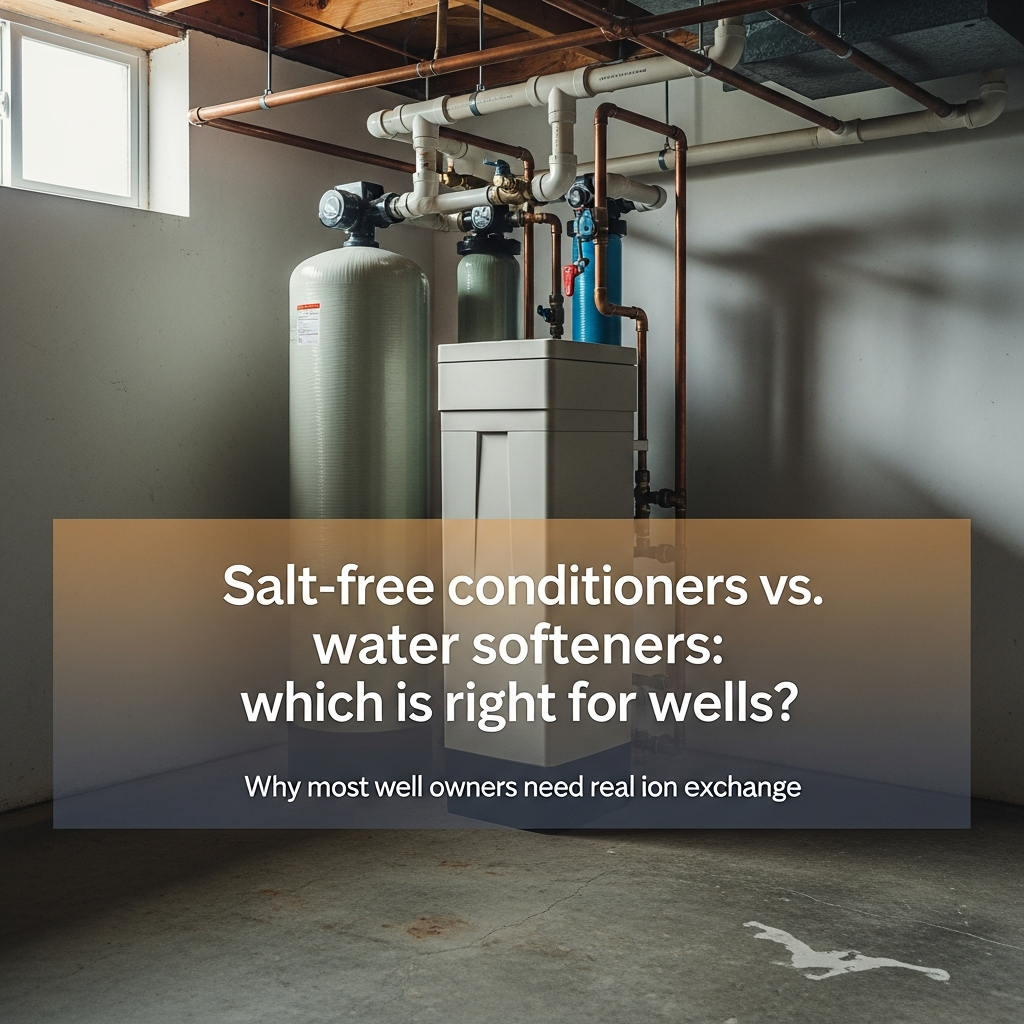
Salt-free conditioners vs. water softeners: which is right for wells?
Updated March 16, 2026 — 7 min read
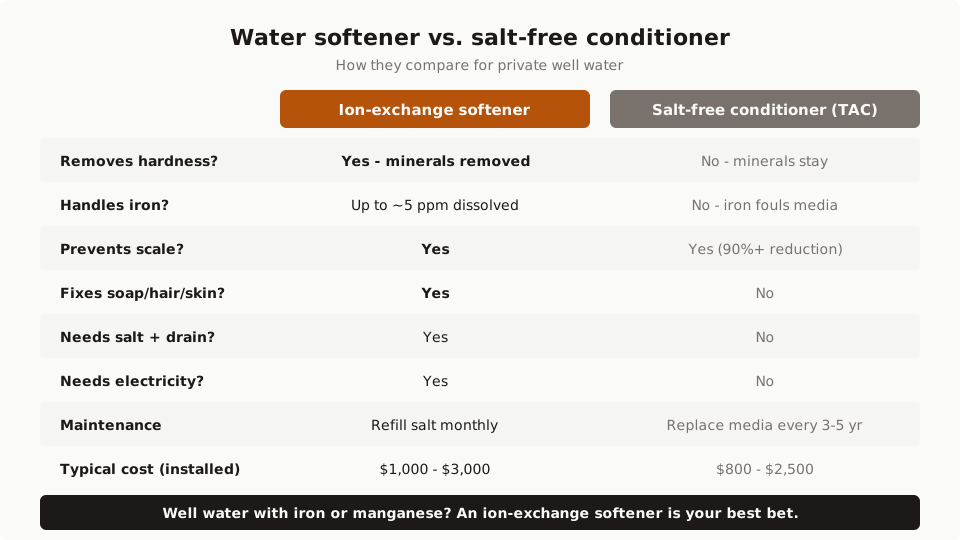
Short answer: If you’re on well water, you almost certainly need a real ion-exchange water softener, not a salt-free conditioner. Salt-free systems prevent scale buildup in pipes, but they don’t remove hardness minerals. That means your soap still won’t lather right, your laundry will still feel crunchy, and your hair will still take a beating. Worse, the iron and manganese common in well water will foul a salt-free system’s media within months.
That said, salt-free conditioners aren’t a scam. They do exactly what they’re designed to do. The problem is that what they do isn’t what most well owners actually need.
What a water softener actually does
A traditional water softener uses ion exchange. Water flows through a tank of resin beads charged with sodium ions. As the hard water passes through, calcium and magnesium ions stick to the resin, and sodium ions release into the water in their place. The hardness minerals are physically removed from your water supply.
When the resin beads fill up with calcium and magnesium, the system regenerates by flushing salt brine through the tank. The sodium knocks the hardness minerals off the resin, they wash down the drain, and the cycle starts over.
This is real softening. The minerals are gone. Your water tests soft. Your soap lathers. Your water heater doesn’t build up scale. Your hair stops getting that straw-like mineral coating.
The tradeoffs: you need a drain line, you need electricity, you need to keep the salt tank filled (40-80 lbs of salt per month for a typical household), and you add a small amount of sodium to your water. For most well owners, those tradeoffs are worth it.
What a salt-free conditioner actually does
A salt-free “softener” isn’t a softener at all. The industry uses that term because it sells better, but what you’re buying is a conditioner.
Most salt-free systems use Template Assisted Crystallization (TAC). Water passes through a tank of specialized media beads. Those beads provide a surface where dissolved calcium and magnesium form tiny crystals. Those crystals detach from the beads and flow through your plumbing as suspended particles instead of dissolved ions.
The crystals are stable. They pass through your pipes and water heater without sticking to surfaces, so you get less scale buildup. An Arizona State University study found TAC reduced scale formation by over 90%.
That sounds great until you realize what it doesn’t do.
The part salt-free sellers don’t emphasize
TAC doesn’t remove minerals from your water. They’re still there, just in a different form. That means:
- Soap scum is still a problem. Hardness minerals still interfere with soap and detergent. You’ll still get film on shower doors, spots on dishes, and stiff laundry.
- Skin and hair issues persist. The calcium and magnesium deposits that irritate eczema-prone skin and coat your hair are still present. They’re crystallized, not removed.
- Fixture spotting continues. Water that evaporates on faucets and shower glass still leaves mineral residue behind. It’s just not adhered as aggressively to pipe interiors.
- Your water still tests hard. A hardness test after a salt-free conditioner will read exactly the same as before. Nothing was removed.
Why salt-free systems fail on most well water
Here’s where it gets worse for well owners specifically. Most well water contains some level of iron and manganese. Even low concentrations of these metals coat the TAC media, blocking the nucleation sites where crystallization happens. Once those sites are fouled, the system stops working.
Salt-free conditioner manufacturers know this. Most include fine-print warnings about iron and manganese limits, typically under 0.3 ppm iron and 0.05 ppm manganese. For context, the average private well in the U.S. exceeds those thresholds. If you haven’t tested your well water recently, start there before buying any treatment system.
A real water softener handles dissolved iron reasonably well up to about 5 ppm through the same ion exchange process. Above that, you’ll want a dedicated iron filter upstream of your softener.
When a salt-free conditioner actually makes sense
Salt-free isn’t always the wrong answer. It works in a few specific situations:
- City water connections where the water is already treated, iron-free, and you just want to prevent scale in your tankless water heater or plumbing.
- Low-hardness well water (under 10 grains per gallon) with no detectable iron or manganese, where scale prevention is your only concern.
- Areas that ban salt-based softeners. Some municipalities in California and other states restrict ion exchange systems because the brine discharge impacts water recycling. A TAC conditioner is your best option where regulations rule out softeners.
- Properties with no drain access. Softeners need a drain line for regeneration. If your well house or utility room doesn’t have one and adding plumbing isn’t practical, salt-free is the workaround.
The bottom line for well owners
If your well water is hard and contains any measurable iron or manganese, a salt-free conditioner won’t solve your problems. You need ion exchange. Buy a properly sized softener, keep the salt tank filled, and your water heater, plumbing, appliances, skin, and hair will thank you.
If you’re not sure what’s in your water, get it tested first. You need to know your hardness level (in grains per gallon), iron concentration, manganese level, and pH before choosing any treatment system. Those four numbers dictate everything.
Already have a softener and still fighting iron stains? Your softener might be undersized, your iron levels might exceed what ion exchange can handle alone, or you might need a dedicated iron filtration stage upstream. That’s a different problem with a different fix. Start with a fresh water test and go from there.
Related guides

Buying a house with a private well: the inspection checklist
What to inspect, test, and negotiate before closing on a home with a private well. Flow rates, water quality, pump age, septic distances, and the contingency clause that protects you.
12 min read
How to choose the right filtration system for your well water
A water-chemistry-first guide to well water filtration by contaminant -- iron bacteria, sulfur, PFAS, manganese, and more. How to test your water, read the results, match each problem to the right filter technology, and build a treatment train that solves your specific issue.
14 min read
Is whole-house reverse osmosis overkill for well water?
Whole-house reverse osmosis makes sense on a few bad wells, but for most homes it is an expensive, high-waste answer to a one-tap problem.
7 min read