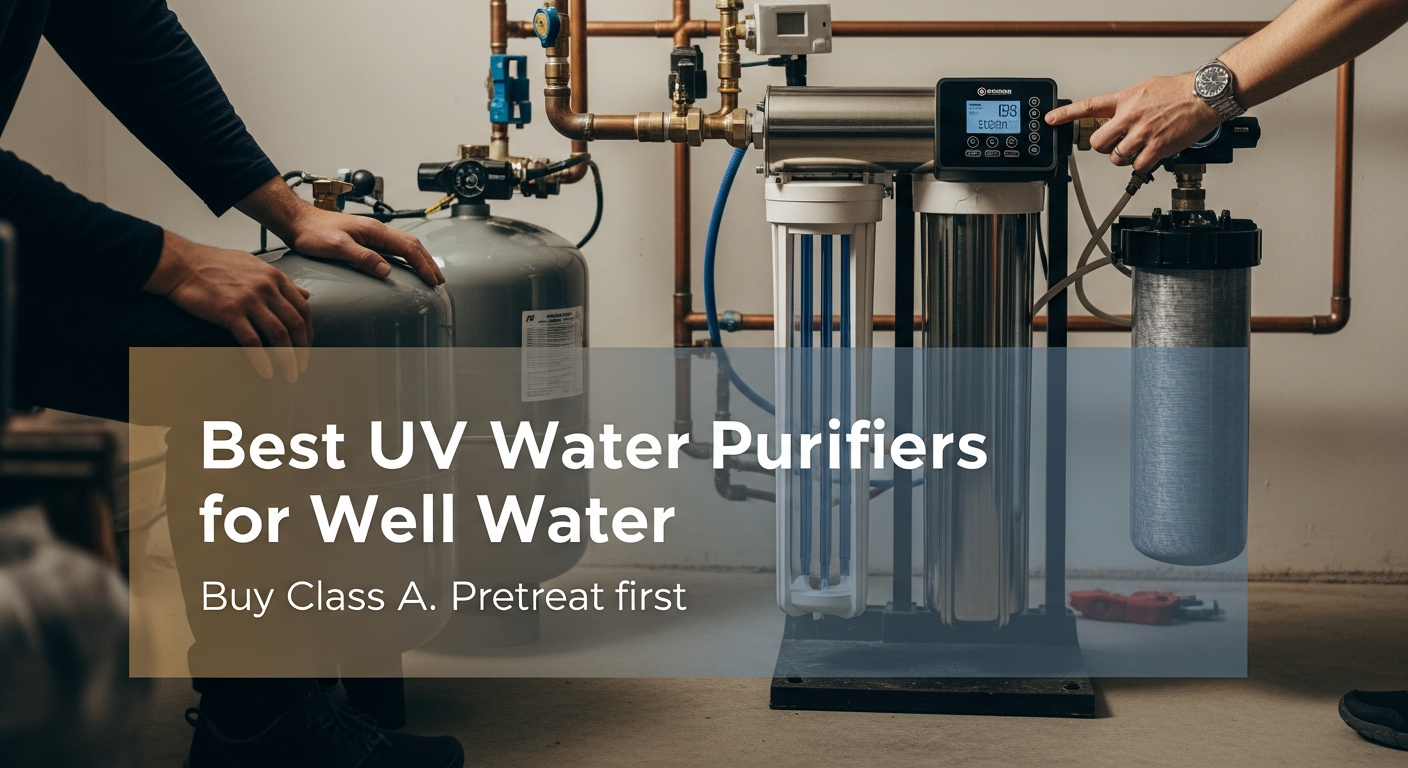
Best UV water purifiers for well water (bacteria defense)
Updated April 22, 2026 — 12 min read
If your well has a bacteria risk, buy a Class A UV system with a real sensor, an alarm, and enough flow for your actual peak demand. My top picks right now are the VIQUA PRO10 for most houses, the VIQUA PRO20 for bigger families and multi-bath homes, and the Luminor BLACKCOMB HO 6.1 A if you want compact high-flow Class A performance.
Skip the cheap Class B stainless tube if this is raw well water. And do not install UV until sediment, iron, manganese, tannins, and hardness are under control first. That is where most well owners waste money.
Key takeaway
For untreated well water, my buying rule is simple: Class A, sized to simultaneous indoor use, with pretreatment ahead of it and UV installed last. If the water is cloudy or it is coating everything with iron slime, fix that before you buy the light.
What UV actually fixes, and what it does not
CDC says UV works best with pre-filtration and can disinfect bacteria, viruses, and parasites. It does not remove chemicals. So if your real problem is arsenic, nitrate, PFAS, or plain old hardness, a UV unit will not save you.
It also does not leave any residual disinfectant in the plumbing. That matters. UV can inactivate what passes through the chamber, but it does nothing for contamination introduced after the chamber or hiding in biofilm downstream. Penn State makes the same point in its coliform guidance: UV is a treatment tool, not a substitute for fixing a contaminated well or a bad plumbing setup.
That is why I like UV as the last barrier in a well-water treatment train. It is excellent insurance when the water is already physically clean. It is a lousy first move on dirty water.
The systems I would actually shortlist
Dealer pricing on UV gear is messy enough that I care more about certification and hardware than list-price screenshots. Here is how I would narrow the field.
| My pick | Rated Class A flow | Why I like it | Best fit |
|---|---|---|---|
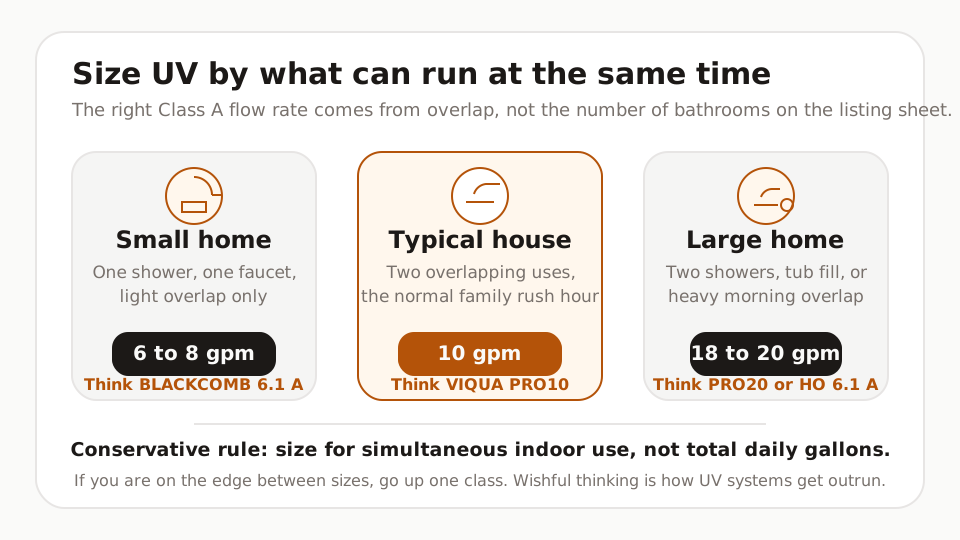
| VIQUA PRO10 | 10 gpm | NSF 55 Class A, UV sensor, flow meter, shutoff valve support, 2-year amalgam lamp | Typical 1-2 bath house |
| VIQUA PRO20 | 20 gpm | Same hardware stack as the PRO10, just with real flow headroom | 3-4 bath homes or heavy overlap |
| Luminor BLACKCOMB HO 6.1 A | Up to 18 gpm | Class A, continuous UV monitoring, compact high-output design, 10,000-hour lamp | Homes that need high flow in a smaller footprint |
| Luminor BLACKCOMB 6.1 A | Up to 7.9 gpm | True Class A performance for small homes and cabins | One-bath or light-demand setups |
VIQUA PRO10
This is the one I would start with for most households. VIQUA rates the PRO10 at 10 gpm at 40 mJ/cm2, which is the Class A line, not the softer Class B number that looks good in marketing. The current PRO page also shows the features I want to see on a raw-well installation: a UV sensor, a flow meter, and a solenoid option so the system can stop water flow if UV performance drops.
The other big advantage is the lamp. VIQUA’s current PRO line uses an amalgam lamp rated for up to 2 years, not the usual one-year cycle. Less fiddly. Less chance you forget it until a reminder alarm starts screaming at 10 PM.
If your house is a normal 2-bath setup and you are not filling a giant tub while the dishwasher and laundry are both running, the PRO10 is the cleanest answer.
VIQUA PRO20
The PRO20 is what I would use when the PRO10 feels a little too close to the edge. Same Class A certification. Same 2-year lamp. Same sensor and dose-monitoring logic. Just more breathing room at 20 gpm.
This is the better fit for bigger families, larger homes, and anyone who knows there will be overlap. Two showers and a faucet is one thing. Two showers, a tub filler, and a teenager starting laundry is another.
Oversizing a little is smart. Oversizing wildly is not. You want margin, not a unit meant for a dentist office.
Luminor BLACKCOMB HO 6.1 A
If I wanted a Class A alternative outside the VIQUA PRO line, this is the one I would look at first. Luminor’s current NSF Class A HO 6.1 A line goes up to 18 gpm, uses continuous UV monitoring, and runs a 10,000-hour high-output lamp.
That makes it appealing when you need more flow than a smaller Class A unit can give you, but you do not want to jump all the way to a much bigger commercial-style setup. It is a practical middle ground.
Luminor BLACKCOMB 6.1 A
For a smaller house, cabin, or lightly used well, the standard-output BLACKCOMB 6.1 A is a legit option. The Class A version tops out at 7.9 gpm, which is enough for modest demand but not enough for a house that stacks water use.
This is the mistake I see a lot: people buy the smaller unit because the sticker price looks better, then wonder why the system hits its limit when two fixtures run together. UV sizing punishes wishful thinking.
Why I do not trust Class B for raw well water
This is the line that matters. NSF explains that Class A systems are for contaminated water. Class B systems are for reducing nuisance bacteria in water that is already considered microbiologically safe.
That is why the current VIQUA VH410-V makes me nervous for untreated wells even though it is a solid piece of hardware. It is Class B, not A. Same story with Pentair’s current Standard UV line, which Pentair itself describes as NSF 55 Class B.
Could a Class B unit help on a safe water source or a very specific intermittent issue? Sure. Would I make it the main microbiological barrier on an untreated private well? No.
One more current-market note: Pentair’s Premium UV line is listed as discontinued on Pentair’s site right now. That alone knocks it off my shortlist for a new install.
The pretreatment numbers that matter more than the brand name
Every decent residential UV manual ends up drawing roughly the same lines. VIQUA’s current PRO manual and Luminor’s current BLACKCOMB documentation both land in this zone:
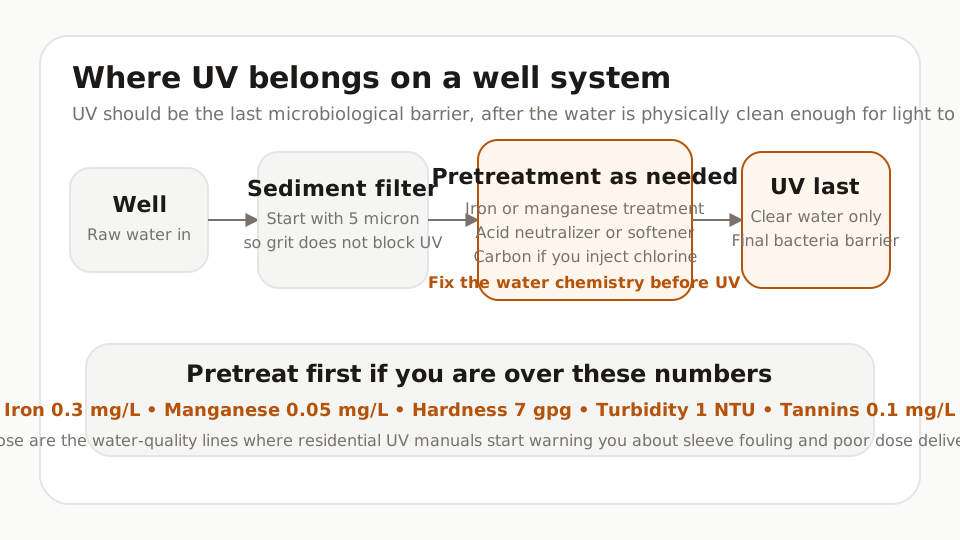
- Hardness: 120 ppm / 7 gpg max
- Iron: 0.3 mg/L max
- Manganese: about 0.05 mg/L max
- Tannins: about 0.1 mg/L max
- Turbidity: about 1 NTU max
- UV transmittance: 75% minimum
That is not random fine print. Those numbers tell you what kind of water can actually let UV light do its job. Once iron, manganese, or hardness starts coating the quartz sleeve, or suspended junk starts shadowing bacteria in the water, the brand on the stainless chamber matters a lot less than the fact that the light cannot reach what it is supposed to hit.
The State Hygienic Laboratory at the University of Iowa says particles above about 5 microns can shield bacteria from UV, and Penn State says UV is not recommended when total coliform exceeds 1,000 colonies per 100 mL or fecal coliform exceeds 100 per 100 mL. That lines up with what well owners say on the forums too. The pattern is always the same: “I installed UV and it worked great until the sleeve fouled up.” That is not a UV failure. That is a pretreatment failure.
If your water is leaving orange staining, black slime, tea color, or rotten-egg odor, start with the chemistry:
- Water softener vs. iron filter
- Best filters for iron bacteria
- How to treat tannins in well water
- Why your well water smells like rotten eggs
Where UV belongs in the treatment train
For well water, UV goes last.
You want the water physically clean before it reaches the chamber. That usually means a sediment stage first, then any iron or manganese treatment, then a neutralizer or softener if the chemistry calls for it, then UV as the final microbiological barrier before the house.
That is also why Pentair recommends a 5-micron sediment prefilter ahead of UV. It is cheap insurance, and it keeps you from cooking dirt onto the sleeve.
Before you buy
If you do not have a recent bacteria test plus a basic chemistry panel, start with the ultimate guide to testing your well water. UV sizing only makes sense once you know whether the water is clear enough for UV in the first place.
When UV is the wrong answer
- Iron bacteria or sulfur bacteria. Pentair says UV is not recommended for iron or sulfur bacteria because the protective slime layer blocks penetration. That is a chlorine or peroxide conversation, not a simple UV one.
- Repeated bad bacteria tests from a structurally bad well. If the cap is compromised, the casing is cracked, or runoff keeps getting in, UV is a bandage over a construction problem. Read the coliform guide first.
- Chemical contamination. UV does nothing for PFAS, arsenic, nitrate, or the rest of the issues in the common contaminants guide.
- Very dirty or storm-cloudy water. If turbidity jumps after rain, fix the source and upstream filtration first.
The decision in 30 seconds
If you want the short version, here it is.
Buy a Class A unit. Size it for what can run at the same time inside the house, not the most flattering number in the brochure. Put pretreatment ahead of it. Install UV last. Replace the lamp on schedule, not when it finally dies.
If that sounds annoyingly strict, good. A UV purifier is one of the few well-water upgrades where half-doing it buys you the false confidence that gets people sick. Test first, size it honestly, and treat the water chemistry before you ask a light to finish the job.
Related guides

Pressure tank air charge: how to check it and why it matters
A 2-minute tire gauge check on your pressure tank's air charge can fix short cycling and pressure drops. Here's the step-by-step process.
6 min read
Coliform bacteria in well water: what it means and immediate steps
A positive coliform test means a contamination pathway exists, not that your water is toxic. Here's how to read the results, when to worry, and a step-by-step action plan.
10 min read
The beauty guide for well owners: hair, skin & laundry
Hardness, iron, manganese, and copper can wreck hair, irritate skin, and stain laundry. This guide shows how to tell which one is hitting your house and what actually fixes it.
12 min read