
Buying a house with a private well: the inspection checklist
Updated February 25, 2026 — 12 min read
About 23 million U.S. homes get their water from a private well. If you’re buying one of them, nobody is going to hand you a water quality report. There’s no utility company monitoring the system. The EPA’s Safe Drinking Water Act covers public systems serving 25 or more people — your private well isn’t one of them. Every test, every inspection, every maintenance decision is on you the moment you sign closing papers.
I learned this the hard way. The home inspector on my first well property glanced at the pressure tank, said “looks fine,” and moved on. No flow rate test. No water quality test. No check on the pump’s age. Three months after closing, the pressure switch failed, and I discovered the submersible pump was 18 years old — past its expected lifespan. Replacing it cost $1,800 and a week without running water. A proper well inspection before closing would have caught both issues and given me leverage to negotiate.
Here’s the checklist I wish I’d had.
Get the well contingency clause into your purchase agreement first
Before you schedule a single inspection, make sure your purchase agreement includes a well water inspection contingency. This clause gives you the right to test the well and water quality, review the results, and walk away or negotiate repairs if the results are unsatisfactory.
Without this clause, you’re stuck. You can test the water all you want, but if the results come back with arsenic at twice the EPA limit or a pump that’s about to die, you have no contractual mechanism to demand the seller fix anything — or to back out without losing your earnest money.
Most states with significant well-served populations have standard addendum forms for this. Virginia’s NVAR Form K1360 is a common template — it sets a specific deadline for the inspection, puts the cost on the buyer, and gives both parties a window to negotiate if problems turn up. Connecticut has a similar well/septic rider built into their standard real estate forms. New Jersey goes the furthest: the Private Well Testing Act requires sellers to test for 43 parameters before closing, and the sale can’t proceed until both buyer and seller have reviewed the results.
If your state doesn’t have a standard form, ask your real estate attorney to draft one. The key elements:
- Testing deadline — how many days after contract ratification you have to complete the inspection
- Who pays — almost always the buyer for water quality testing, sometimes the seller for physical well inspection
- What constitutes “unsatisfactory” — any result exceeding EPA maximum contaminant levels, flow rate below a specified GPM, or equipment in need of imminent replacement
- Remedy options — seller repairs, price reduction, or buyer’s right to terminate
This is non-negotiable. If a seller won’t agree to a well contingency, that tells you something.
The physical well inspection
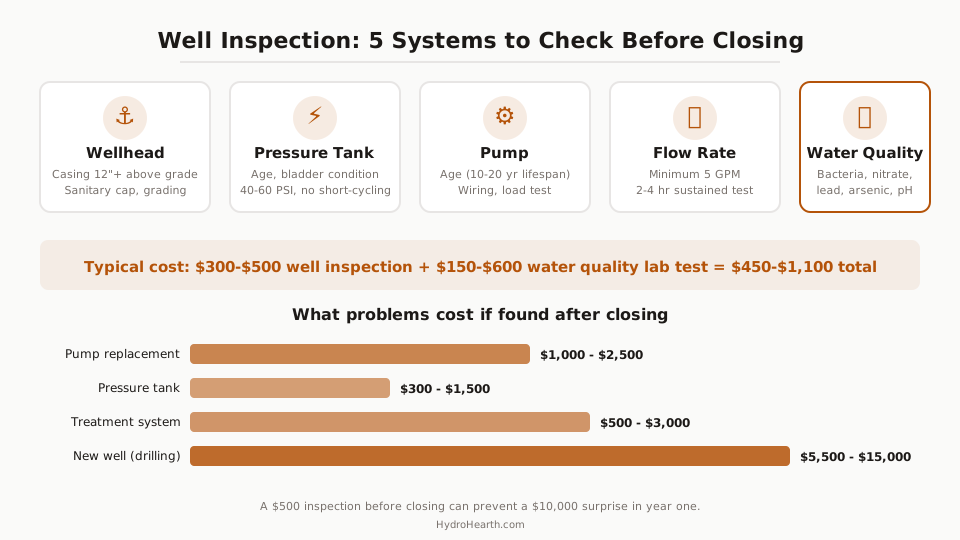
A standard home inspection doesn’t cover the well system in any meaningful way. Most home inspectors will look at the pressure tank, note whether the water runs, and check a box. You need a dedicated well inspection from a licensed well driller or well inspector. This costs $300 to $500 in most markets and covers the entire system from the wellhead to the pressure tank.
Here’s what the inspector should evaluate — and what you should verify they actually checked.
The wellhead and casing
Walk outside and look at the well yourself. You’re checking three things:
Casing height. The well casing — the pipe sticking up out of the ground — should extend at least 12 inches above the finished grade around it. Most state codes require this. If the casing sits at ground level or below, every rainstorm pushes surface water directly toward your drinking supply. This is the most common contamination pathway in residential wells, and a casing extension costs $300 to $800 to fix.
Well cap condition. The cap should be a vermin-proof, sanitary well cap — not a loose-fitting lid, a coffee can, or a piece of plywood (I’ve seen all three). It should be bolted down, with a screened vent and a rubber gasket that seals against the casing. Cracked caps, missing gaskets, or gaps around the wiring conduit are direct entry points for insects, rodents, and surface water. A new sanitary cap costs $30 to $75. A well cap replacement is a straightforward fix, but the contamination it prevents is serious.
Grading around the wellhead. The ground should slope away from the casing in all directions. If there’s a depression or settled area around the well, water pools against the casing during rain. This is one of the contamination pathways that Penn State Extension specifically flags in their well maintenance guidance.
The pressure tank
The pressure tank sits in the basement or utility room and stores water under pressure so the pump doesn’t cycle on and off every time you turn a faucet. Here’s what to check:
Tank age. Look for a manufacture date on the label. Bladder-style pressure tanks typically last 10 to 15 years. A tank older than 12 years is on borrowed time. Replacement runs $300 to $1,500 depending on size.
Waterlogging test. The inspector should tap the tank at different heights. A properly charged tank sounds hollow near the top (that’s the air cushion) and solid near the bottom (that’s the water). If it sounds solid all the way up, the bladder has failed and the tank is waterlogged. A waterlogged tank makes the pump cycle constantly, which kills the pump prematurely. The pressure tank air charge guide explains the mechanics, but the short version: a dead bladder means a dead tank, and the pump is working overtime until you replace it.
Pressure gauge reading. The gauge should read between 40 and 60 PSI during normal operation. Watch the pump cycle: the pressure switch should kick the pump on at the low setting (typically 30 or 40 PSI) and off at the high setting (50 or 60 PSI). If the pump cycles on and off rapidly — every few seconds instead of every few minutes — that’s short-cycling, and it points to a waterlogged tank or a failing pressure switch.
The pump
You probably won’t see the pump. If it’s a submersible (most modern wells), it’s sitting 100 to 300 feet underground at the bottom of the casing. What you can learn without pulling it:
Age. Ask the seller or check the well records. A submersible pump lasts 10 to 20 years depending on water quality and cycling frequency. If the seller can’t tell you when the pump was last replaced, assume it’s original to the well or the house — and price accordingly. The well pump and pressure tank guide covers realistic lifespans for every component.
Electrical. The inspector should check the wiring from the breaker panel to the pressure switch and the control box (if there’s a 3-wire system). Corroded connections, undersized wire, or a missing disconnect are safety issues and code violations.
Performance under load. Run multiple fixtures simultaneously — two showers, the dishwasher, a hose bib — and see what happens. Does the pressure hold? Does the pump keep up? If pressure drops dramatically or the water sputters, the pump may be undersized, the well yield may be low, or the drop pipe could have a leak.
The flow rate test
This is the single most important performance test for a well, and it’s the one most buyers skip. The flow rate tells you how much water the well can deliver per minute, and it determines whether the property can actually support your household.
What’s adequate. The Water Systems Council and most lending standards consider 5 gallons per minute (GPM) the minimum acceptable flow rate for a residential well. FHA and VA loans in many states require a minimum of 3 to 5 GPM depending on local requirements. In practice, 5 GPM is tight for a family of four. 8 to 10 GPM is comfortable. Below 3 GPM, you’ll notice it every time two people try to shower while the washing machine runs.
How it’s tested. A flow rate test runs water from the well at a measured rate for a sustained period — typically 2 to 4 hours. The inspector measures the GPM output and monitors whether the flow decreases over the test period. A well that starts at 8 GPM but drops to 2 GPM after 90 minutes has a recovery problem — the aquifer can’t refill the well as fast as you’re drawing from it.
Seasonal variation matters. Ask when the test was done. A well tested in April after spring rains might flow at 10 GPM but drop to 3 GPM in a dry September. If possible, get historical flow data or ask the seller about any periods of low water. TractorByNet forum discussions about residential well flow rates consistently point out that the depth drilled and how much water sits above the pump matter as much as the peak GPM number.
Low-flow workarounds. A well producing only 1 to 2 GPM isn’t automatically a deal-breaker if the property has adequate storage — large pressure tanks or a holding tank with a booster pump can buffer low-yield wells. But retrofitting storage adds $2,000 to $5,000 to the cost, and you should factor that into your offer.
If you’re financing with an FHA or VA loan: Your lender will likely require a flow rate test as part of the loan approval. Don’t wait for the lender to flag this — order the test yourself during the inspection period so you have time to negotiate if the results are marginal.
The water quality test
A flow rate test tells you how much water you’re getting. A water quality test tells you whether that water is safe to drink. You need both.
What to test for
At minimum, test for the parameters that the EPA recommends for private wells — and that most mortgage lenders require:
| Parameter | Why it matters | EPA limit |
|---|---|---|
| Total coliform & E. coli | Bacterial contamination pathway indicator | Absent (any positive = action needed) |
| Nitrate | Agricultural and septic contamination; dangerous for infants | 10 mg/L |
| pH | Below 6.5 corrodes pipes; above 8.5 affects taste and treatment | 6.5 - 8.5 |
| Lead | Old well components, brass fittings, solder | 15 ppb (action level) |
| Arsenic | Naturally occurring in bedrock; colorless, tasteless | 10 ppb |
| Iron | Staining, taste, clogs appliances | 0.3 mg/L (secondary) |
| Manganese | Black staining; health concern at high levels | 0.05 mg/L (secondary) |
| Hardness | Scale buildup, soap performance, appliance lifespan | No federal limit; >120 mg/L = hard |
| Total dissolved solids | General mineral content indicator | 500 mg/L (secondary) |
A basic bacteria and nitrate panel from a state-certified lab runs $40 to $150. A comprehensive panel covering heavy metals, VOCs, and secondary parameters runs $250 to $600. The ultimate guide to testing your well water covers every testing option in detail — which labs, which kits, how to read the results.
When to add PFAS testing
If the property is within 10 miles of a military base, airport, industrial facility, or fire training site, order a PFAS test. Standard water panels don’t check for PFAS — you need a dedicated test using EPA Method 533 or 537.1, which costs $150 to $350. The EPA finalized national PFAS drinking water standards in April 2024, setting maximum contaminant levels at 4 parts per trillion for PFOA and PFOS. Your private well isn’t federally regulated, but these limits are the health benchmark. Our PFAS testing guide walks through which kits work and how to interpret the results.
What the results mean for your purchase
If everything comes back clean, you’ve got a solid baseline for future annual testing. If something flags:
- Positive coliform: Not an emergency, but it means a contamination pathway exists. Shock chlorination fixes it if the source is identified and sealed. The well cap, casing, or grout seal is usually the culprit. Cost to fix: $100 to $800 depending on the root cause. Read the coliform guide for the full action plan.
- High nitrate: If above 10 mg/L, the well is receiving fertilizer or septic contamination. Check the distance to the nearest septic system. Reverse osmosis at the kitchen sink ($200 to $500) handles drinking water; fixing the contamination source is a separate problem.
- Arsenic or lead above EPA limits: These require treatment systems ($500 to $3,000 installed) and ongoing maintenance. Factor the cost into your offer.
- Iron above 0.3 mg/L: Common and treatable, but a whole-house iron filter costs $800 to $2,500. If you’re seeing orange staining at the property, this is why. The filtration guide matches each contaminant to the right treatment technology.
Distance from the septic system
If the property has both a well and a septic system — and most rural properties do — the distance between them determines whether the wastewater your household generates stays out of your drinking water.
Minimum setback distances vary by state but typically range from 50 to 100 feet between the well and any septic component:
| Component | Typical minimum distance from well |
|---|---|
| Septic tank | 50 feet |
| Drain field / leach field | 75 - 100 feet |
| Septic distribution box | 50 feet |
| Property line | 10 feet |
These aren’t suggestions. They’re code requirements in most jurisdictions, and a well that’s too close to a septic system is both a health risk and a potential obstacle to financing. A USGS study of groundwater near septic systems found detectable levels of nitrate and pharmaceutical compounds in wells within 100 meters of drain fields, even where systems were functioning properly.
The well and septic guide covers the full interaction between these two systems, including what your water softener discharge does to the drain field and which water tests catch septic contamination early.
What to check:
- Ask for a site plan or survey showing well and septic locations. If none exists, a surveyor can locate both for $200 to $500.
- Verify the septic system was inspected and pumped recently. A failed drain field near a well is the worst-case scenario.
- If the setback distance is short, your nitrate and coliform tests become even more important.
The well log and records
Ask the seller for the well driller’s log (also called a well completion report or well record). Most states require drillers to file these with the state geological survey or health department. If the seller doesn’t have it, you can often request a copy from your state agency.
The well log tells you:
- Total well depth — how deep the borehole goes
- Static water level — how high the water naturally sits in the casing (before pumping)
- Casing depth and material — steel vs. PVC, how deep the casing extends
- Yield at the time of drilling — the GPM the well produced when it was new
- Geology — what rock or soil the driller went through, which indicates the aquifer type
- Date drilled — the age of the well itself
This document is the well’s medical history. A well drilled 40 years ago with a steel casing in sulfur-heavy bedrock tells you a very different story than a 5-year-old well with PVC casing in clean sand and gravel. If the seller can’t produce any well records, that’s a yellow flag — not necessarily a deal-breaker, but it means you’re buying a system with an unknown history, and your inspection needs to be more thorough to compensate.
What to negotiate when the inspection finds problems
The whole point of the well contingency clause is giving you leverage when problems surface. Here’s how to think about negotiation:
Repair vs. credit. For well issues, a price credit or escrow holdback is usually better than asking the seller to make repairs. Well work requires specialized contractors (licensed well drillers, not general handymen), and you want to choose who works on the system you’ll be living with.
Replacement cost benchmarks:
| Component | Typical replacement cost |
|---|---|
| Submersible pump (including labor to pull and reinstall) | $1,000 - $2,500 |
| Pressure tank (bladder-style, 40-80 gallon) | $300 - $1,500 |
| Pressure switch | $150 - $300 |
| Well cap (sanitary) | $30 - $75 |
| Well casing extension | $300 - $800 |
| Shock chlorination (professional) | $100 - $400 |
| Water treatment system (varies by contaminant) | $500 - $3,000 |
When to walk away. A low flow rate with no practical storage solution, contamination from a source that can’t be eliminated (like an adjacent industrial site), or a well with major structural problems (collapsed casing, compromised grout seal) — these are situations where the cost and risk may exceed the value. A new well costs $5,500 to $15,000 depending on depth and geology. If the existing well needs to be abandoned and replaced, that number belongs in your negotiation math.
The pre-closing checklist
Pull all of this together into a single checklist you can hand to your well inspector and track yourself:
- Well contingency clause in the purchase agreement
- Dedicated well inspection by a licensed well driller or inspector ($300-$500)
- Wellhead inspection: casing height (12”+ above grade), sanitary cap, proper grading
- Pressure tank: age, bladder condition, proper air charge
- Pump: age, type, electrical connections, performance under load
- Flow rate test: sustained GPM over 2-4 hours (minimum 5 GPM)
- Water quality test: bacteria, nitrate, pH, lead, arsenic, iron, hardness, TDS
- PFAS test if near military base, airport, or industrial site
- Septic system location verified; setback distances meet code
- Well driller’s log and maintenance records obtained
- All results reviewed before contingency deadline expires
Every item on this list is something that’s cheap to check and expensive to discover after closing. A $500 well inspection and a $300 water test could save you from a $10,000 surprise in your first year of ownership.
Your next step: schedule the well inspection and water test as early in your inspection period as possible. Lab results for water quality take 5 to 10 business days, and you need time to negotiate if something comes back hot. Don’t wait until the week before your contingency expires. For a complete breakdown of what every well component does and what replacement actually costs, read the well pump and pressure tank guide.
Related guides
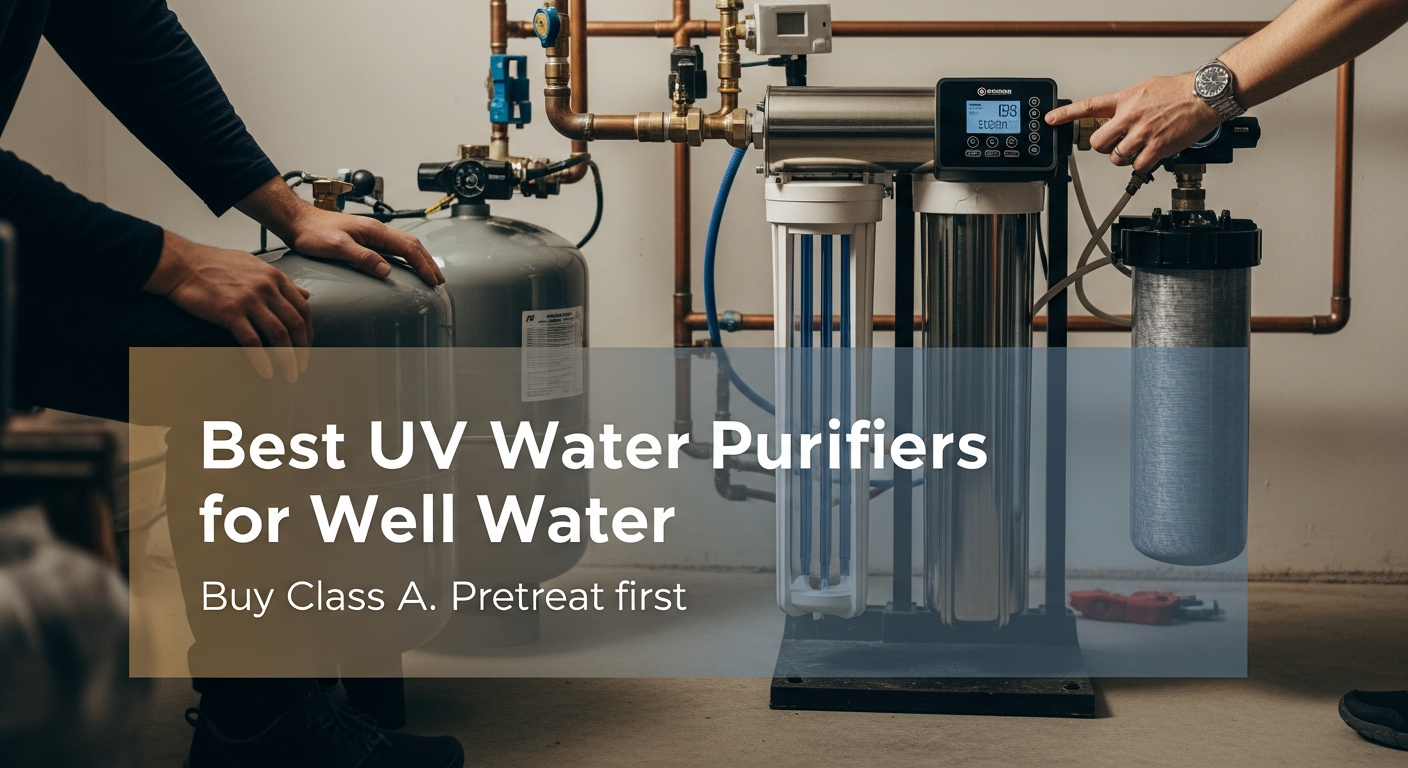
Best UV water purifiers for well water (bacteria defense)
The best UV purifier for well water is a Class A unit sized to your real peak flow and installed after pretreatment. Here are the systems I would actually buy.
12 min read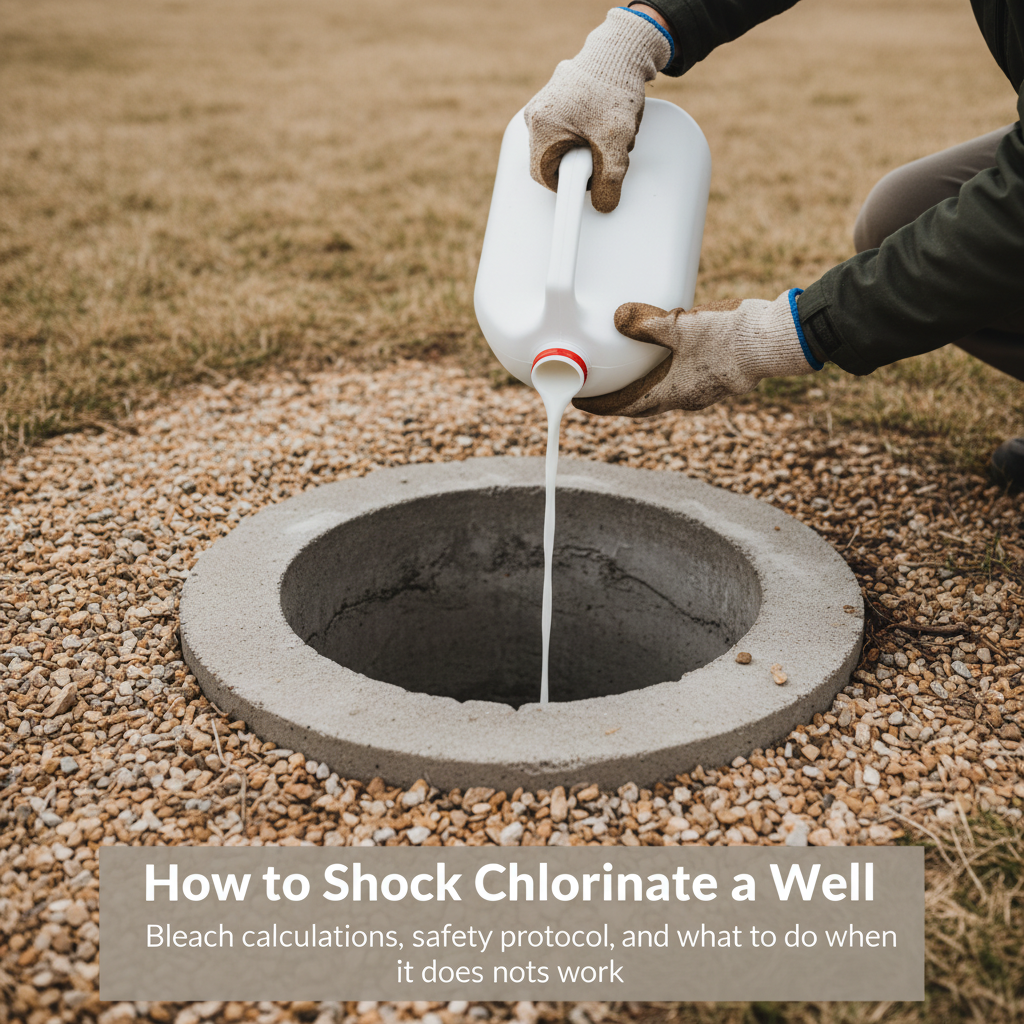
How to shock chlorinate a well: the complete protocol
Step-by-step guide to shock chlorinating your private well, including bleach calculations, safety precautions, and what to do when it doesn't work.
12 min read
The well owner's guide to septic systems: what connects, what conflicts, and what to watch
How your private well and septic system interact, including required setback distances, contamination pathways, water softener discharge impacts, and the water tests that catch problems early.
12 min read