Well water and eczema: the hard water connection
Updated March 6, 2026 — 9 min read
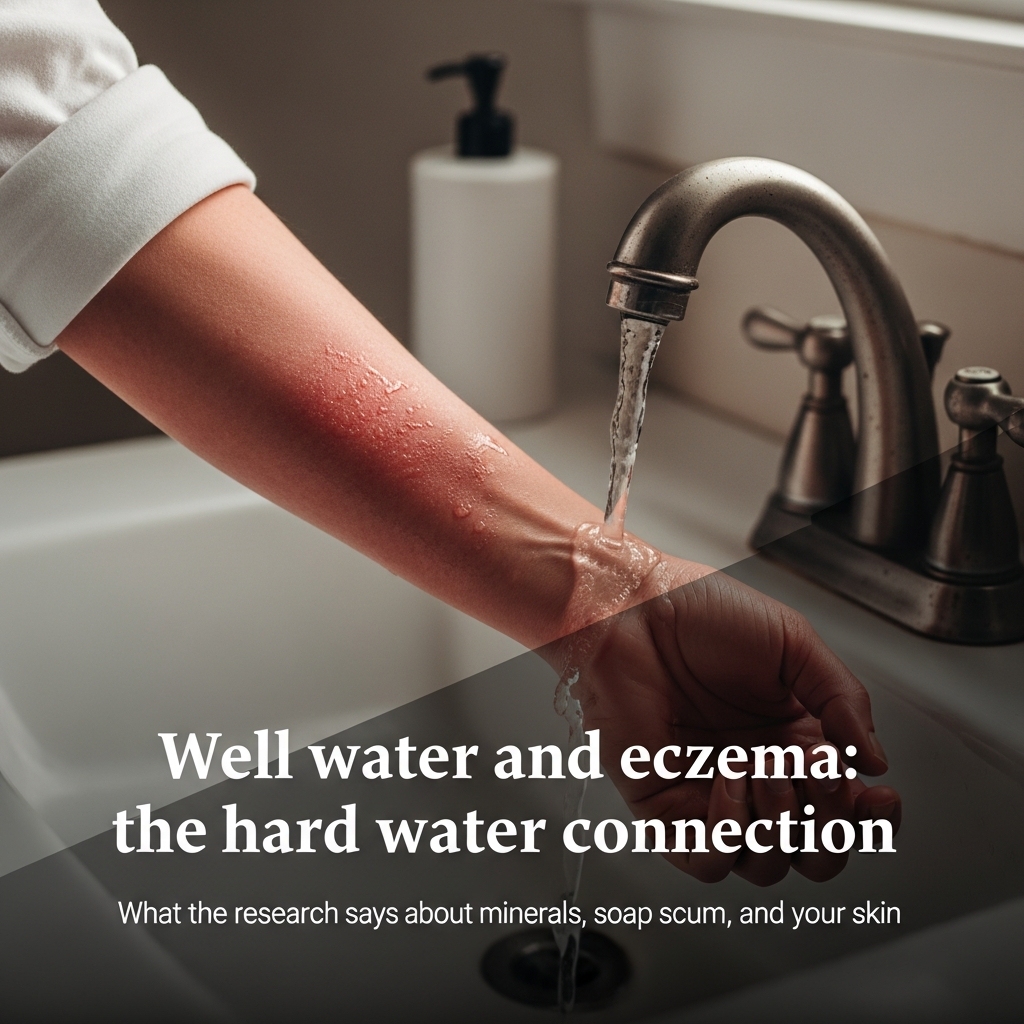
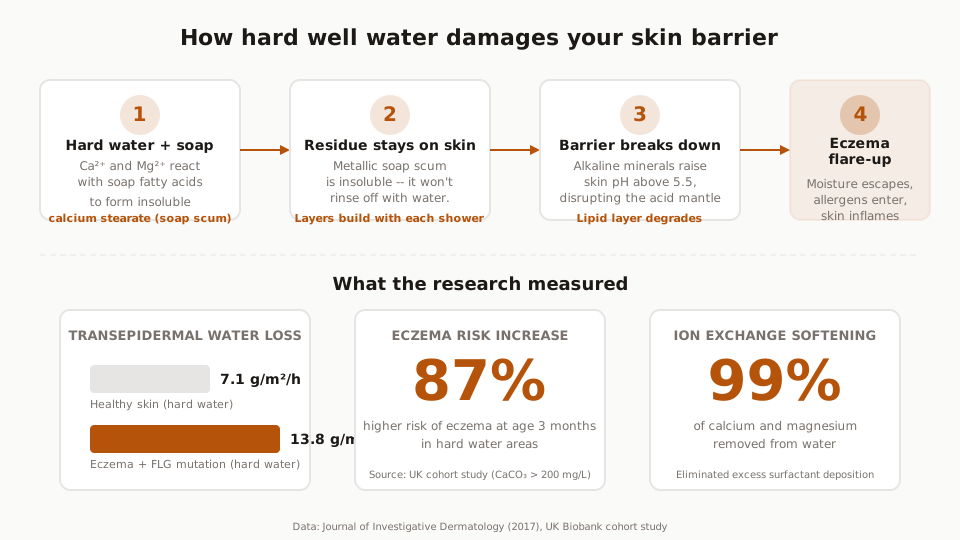
Hard well water makes eczema worse. The calcium and magnesium in your water react with soap to form an insoluble residue — metallic soap scum — that stays on your skin after you towel off. That residue disrupts your skin’s protective barrier, increases moisture loss, and gives irritants a direct path into the deeper layers of your skin. A 2017 study in the Journal of Investigative Dermatology measured this directly: people who washed with hard water retained significantly more soap on their skin, and their transepidermal water loss (the rate moisture escapes through the skin) nearly doubled compared to soft water.
If you’ve been managing eczema for years and nothing your dermatologist prescribes fully controls it, your well water might be the variable nobody’s testing.
How hard water damages the skin barrier
Your skin has a built-in defense system called the acid mantle — a thin film of sebum and sweat with a pH between 4.5 and 5.5. This slightly acidic layer does two things: it locks moisture in and keeps bacteria and allergens out. When functioning properly, it’s the reason you don’t get infections from every scraped knee or itch from every gust of dusty wind.
Hard water attacks this system from two directions.
First, it raises your skin’s pH. Calcium and magnesium are alkaline minerals. Water with 200+ mg/L of calcium carbonate (common in private wells) pushes your skin’s surface pH toward 7 or higher every time you shower. At that pH, the enzymes responsible for maintaining your skin barrier start working against you. They break down the lipids that hold skin cells together instead of building them up. The result is skin that cracks, flakes, and can’t hold onto moisture.
Second, it leaves soap on your skin. This is the bigger problem. When calcium ions in your water meet the fatty acids in bar soap or body wash, they form calcium stearate — the same chalky film you see on your shower door. That film coats your skin. It doesn’t rinse off because it’s insoluble in water. Every shower adds another layer.
The Sheffield University study that quantified this used 80 participants split into four groups: healthy skin with normal genes, healthy skin with filaggrin gene mutations, eczema patients with normal genes, and eczema patients with filaggrin mutations. They washed each person’s forearm with sodium lauryl sulfate (the primary surfactant in most body washes) dissolved in water at different hardness levels.
The results were stark. Hard water increased surfactant deposition on everyone’s skin. But the people with eczema and filaggrin mutations got hit hardest — their transepidermal water loss jumped to 13.84 g/m2/h after washing with hard water, compared to 7.12 g/m2/h in the healthy-skin group. That’s nearly double the moisture loss through the same area of skin.
When they repeated the experiment with ion-exchange softened water, the extra surfactant deposition disappeared.
The filaggrin connection (why genetics matter)
About 10% of the population carries a mutation in the filaggrin gene (FLG). Filaggrin is a protein your skin cells produce to build and maintain the barrier. People with FLG mutations already have a weaker skin barrier at baseline — their skin loses moisture faster and lets irritants through more easily.
For those people, hard water is a force multiplier. The combination of a genetically compromised barrier plus the constant chemical assault from soap scum creates a cycle that’s nearly impossible to break with lotions and prescriptions alone. A UK Biobank study of over 300,000 adults found that living in a hard water area increased eczema risk, and the association was strongest in people carrying filaggrin mutations.
You probably don’t know your filaggrin status, and that’s fine. You don’t need a genetic test to figure this out. If your eczema has been treatment-resistant and you live on a well with hard water, the water itself is a prime suspect regardless of your genotype.
Well water problems beyond hardness
City hard water contains calcium and magnesium. Well water often contains those plus iron, manganese, sulfur compounds, and sometimes bacteria — each with its own skin effects.
Iron above 0.3 ppm can oxidize on your skin during a hot shower, causing redness and irritation that looks like a mild rash. If you’re seeing orange stains in your laundry or toilets, the same iron is landing on your skin every time you shower. Unlike hardness minerals, iron doesn’t just sit on the surface. It reacts with oxygen and can trigger contact irritation in sensitive skin.
Manganese frequently accompanies iron in well water. At concentrations above 0.05 mg/L (the EPA’s secondary standard), manganese can cause skin irritation and leave a dark, sticky residue on skin and fixtures.
Hydrogen sulfide (the rotten egg smell) is a known skin irritant at concentrations as low as 0.5 ppm. It can cause redness, itching, and dryness. Low-level sulfur won’t cause eczema on its own, but it adds to the total irritant load on skin that’s already compromised by hard water.
This is why well water eczema is often harder to treat than city water eczema. You’re not dealing with one irritant. You’re dealing with three or four, all hitting the same damaged skin barrier every time you turn on the shower.
What doesn’t work (and why)
Shower filters
I covered this in the hair damage article, and the same truth applies for skin: shower filters that use KDF-55 and activated carbon do not remove calcium and magnesium. Those media are designed to remove chlorine, which is a city water problem. They can’t perform ion exchange at shower flow rates (2-2.5 GPM), so hardness minerals pass straight through.
Some brands claim their filters “reduce” hard water effects. What they actually do is convert a tiny fraction of dissolved calcium into precipitated calcium carbonate through localized pH changes near the KDF media. That’s not softening. Your skin still gets the same mineral load.
If your well water is hard and you’re spending $40-60 every six months on shower filter replacements, that money is wasted on the hardness problem. Shower filters are useful if your well has been recently shock chlorinated and you want to strip residual chlorine for a few weeks. They’re not a solution for ongoing hard water skin issues.
Heavy moisturizers as a standalone fix
Your dermatologist probably recommended a thick emollient like CeraVe or Vanicream. Those are good products. They reduce transepidermal water loss by creating a physical barrier on your skin’s surface. But they’re treating the symptom, not the cause.
If you’re showering in 250 mg/L hard water twice a day and then applying moisturizer, you’re spending 15-20 minutes under a mineral assault and then trying to repair the damage afterward. The math doesn’t work. You’ll get better results with a less expensive moisturizer and softer water than with the best cream in the world and hard water.
Soap-free cleansers (syndets)
Switching from bar soap to a soap-free syndet cleanser (like Dove Sensitive or Cetaphil Gentle Cleanser) reduces the soap scum problem because syndets don’t form metallic soap with calcium the way traditional soap does. This is a genuine improvement and worth doing.
But syndets still contain surfactants that deposit more heavily in hard water. The Sheffield study specifically tested sodium lauryl sulfate — a surfactant present in most syndets — and still found significantly increased deposition in hard water. So switching to syndet reduces the problem. It doesn’t eliminate it.
What actually works
Step 1: test your water
Before spending money on equipment, get a comprehensive water test. You need to know your hardness level (in grains per gallon or mg/L of calcium carbonate), iron concentration, manganese, pH, and sulfur. A certified lab test runs $100-$200.
This matters because the treatment system you need depends on what’s in the water. Hardness alone means a softener. Hardness plus iron above 2-3 ppm means you likely need an iron filter upstream of the softener. High sulfur means a separate treatment step. Guessing gets expensive.
Step 2: install a water softener
A salt-based ion exchange water softener removes 99%+ of calcium and magnesium from your entire house. Every shower, every sink, every faucet gets treated water. Systems run $800-$2,500 installed depending on your household size and water chemistry.
This is the single most impactful thing you can do for eczema triggered or worsened by hard water. The Sheffield study confirmed it: when they softened the water with ion exchange, the excess surfactant deposition went away. No extra soap scum, no elevated TEWL, no additional irritation.
The filtration guide covers how to size a softener for your household, and the Aquasana vs. SpringWell vs. Culligan comparison breaks down which brands handle well water best.
A note on salt-free conditioners: Salt-free systems (TAC or template-assisted crystallization) don’t remove calcium and magnesium. They change the crystal structure so the minerals don’t form scale on pipes. Your skin still gets the same mineral load. For eczema, you need actual ion exchange softening that physically removes the minerals from the water. Salt-free doesn’t cut it here.
Step 3: address iron and sulfur if present
If your water test shows iron above 0.3 ppm or detectable hydrogen sulfide, a softener alone won’t solve all your skin issues. You’ll need an iron filter (air injection oxidizer or chemical feed system) installed before the softener in your treatment train.
The order matters: iron filter first, then softener. Iron fouls softener resin, reducing its effectiveness and lifespan. The filtration guide has the full treatment train sequence.
Step 4: adjust your shower routine
While you’re waiting on equipment installation (or if a whole-house system isn’t in the budget right now):
Lower the water temperature. Hot water strips more natural oils from your skin and opens pores wider, allowing more mineral penetration. Lukewarm showers — 98-100°F instead of 110°F+ — reduce the damage significantly.
Shorten your showers. Every minute under hard water is more mineral deposition on your skin. Five minutes gets you clean. Fifteen minutes triples the exposure.
Switch to a syndet body wash. Dove Sensitive Skin, Cetaphil Gentle Cleanser, or Vanicream Gentle Body Wash. These won’t form metallic soap with calcium the way bar soap does. It’s not a full fix, but it reduces the soap scum load on your skin.
Apply moisturizer within 3 minutes of toweling off. Your skin absorbs emollients most effectively when it’s still slightly damp. CeraVe Moisturizing Cream, Vanicream Moisturizing Skin Cream, or plain petroleum jelly all work. The key is sealing in whatever moisture your compromised barrier managed to hold onto.
Rinse with a gallon of distilled water. This sounds extreme, but some eczema forum users swear by keeping a gallon of distilled water in the shower and doing a final rinse after turning off the hard water. It helps remove residual mineral soap from your skin. At $1.50 per gallon, it’s cheap enough to try.
When to see a dermatologist
Water treatment helps, but eczema is a medical condition. If your skin is cracked, bleeding, or showing signs of infection (oozing, crusting, increased warmth), you need medical treatment in addition to fixing your water. A dermatologist can prescribe topical corticosteroids, calcineurin inhibitors, or newer biologics that control the immune response driving eczema.
The goal isn’t to replace medical care with plumbing. It’s to remove the environmental trigger that’s undermining everything your dermatologist prescribes. Prescription creams work better when you’re not re-damaging your skin barrier twice a day in a hard water shower.
Your next step
Get your water tested. A $100-$200 lab test tells you exactly what minerals are in your water and at what concentrations. That single piece of data determines whether a softener alone solves your problem or whether you need a multi-stage treatment system. If your eczema has resisted every cream, diet change, and laundry detergent swap you’ve tried, your well water is the variable worth investigating.
Related guides
Hardness and drought: managing Texas well water
Texas wells often run hard year-round, then get saltier and touchier in drought. Here's what to test and when a softener is not enough.
10 min read
Radon in well water: aeration vs. charcoal filtration
Radon in well water is an invisible cancer risk that standard filters miss. Here's how aeration and GAC filtration compare on removal rates, costs, and the radioactive waste problem most installers won't mention.
10 min read
How to read a water analysis report
A plain-English guide to the lab terms, units, and cutoff numbers that tell you whether a well water result is urgent, cosmetic, or mostly a plumbing problem.
9 min read